

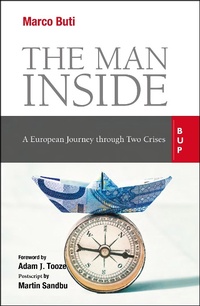
Man Inside
A European Journey Through Two Crises
Published on 1. November 2021
376 pages
978-88-31322-36-2 (ISBN)
Description

"e;An insider of the European Commission since the late 1980s, Marco Buti is a unique guide through the two crises of the 21st century."e;Giuliano Amato, former Prime Minister of Italy "e;Marco Buti and I have not always agreed on issues of economic policy. But I cannot think of somebody more qualified to tell us about the travails of Europe since the Great Financial Crisis. He was there all along."e;Olivier Blanchard, Senior Fellow at Peterson Institute for International Economics"e;This collection of VoXEU contributions shows how history is made. Marco Buti, a man inside the vortex of the making of European monetary history, produced and published a steady stream of reflections, analysis and reform proposals on VoxEU."e; Beatrice Weder Di Mauro, President of the Centre for Economic Policy Research The book brings together his real time input to the economic and policy debate, traces the intellectual journey leading to the design and implementation under duress of difficult policies and controversial reforms. What emerges is a new compass that helps understand the policy strategy the EU has adopted to fight the economic fallout of the pandemic.
More details
Other editions
Additional editions

Book
10/2021
Bocconi University Press
€94.70
Shipment within 3-4 weeks
Content
- Description
- Biography
- Title
- Copyright
- Table of Contents
- Acknowledgements
- Foreword, by Adam Tooze
- 1 European Economic Policymaking under Duress: My Own Account
- 1 Florence, Oxford, Brussels
- 2 The Pioneers, the Architects and the Builders
- 3 The circumstances: the global financial crisis, the rise of populism and the pandemic
- 4 The role of the European Commission in policy design and coordination
- 5 Some lessons for the future
- Europe 2008-2021: A Chronology
- Part A. EMU: Past, Present and Future
- 2 The First Ten Years of the Euro
- 1 Introduction
- 2 Uncertain beginnings
- 3 A decade of success
- 4 The challenges ahead
- 3 The Commission's Proposals for Stronger EU Economic Governance
- 1 What are the main goals?
- 2 What is new and why do we need it?
- 3 Would the new tools have made a difference?
- 4 Will it work this time?
- 4 Stronger EU Economic Governance: A Response to the Critics
- 1 Common analysis but diverging conclusions
- 2 The big picture
- 3 Enforcement, yes please. Sanctions, no thanks
- 4 What is not "empty and useless"
- 5 Macroeconomic policy analysis in flux
- 5 Smoothing Economic Shocks in the Eurozone: The Untapped Potential of the Financial Union
- 1 The importance of resilience to shocks in the Eurozone
- 2 Cross-border risk-sharing channels
- 3 What is the size of the various risk-sharing channels in the Eurozone and the US?
- 4 Conclusion
- 6 Completing EMU
- 1 EMU has been reformed but is still in an unsustainable equilibrium
- 2 Completing Financial Union to increase risk-sharing and reduce legacy risks
- 3 Achieving a more integrated Economic and Fiscal Union
- 4 Strengthening Eurozone institutions and accountability
- 5 Conclusions
- 7 Deepening EMU Requires a Coherent and Well-Sequenced Package
- 1 Building on the progress made
- 2 Preserving financial stability is of the utmost importance
- 3 A stone that could hit many birds
- 4 Conclusion
- 8 The Case for a Central Fiscal Capacity in EMU
- 1 Introduction
- 2 Is there evidence of large cyclical fluctuations in EMU, including country-specific components?
- 3 Does private risk-sharing via the completion of Banking Union and CMU eliminate the case for a central fiscal capacity?
- 4 Do national fiscal stabilisers within the SGP suffice to smooth the remaining shocks?
- 5 Does a central fiscal capacity necessarily entail moral hazard and permanent transfers?
- 6 Conclusions
- 9 The Euro, a Tale of 20 Years: The Priorities Going Forward
- 1 Coming of age
- 2 The Maastricht assignment
- 3 The Eurozone throughout the crisis: weaknesses of EMU's architecture come to the fore
- 4 Reforms during the crisis, but job still not completed
- 5 Conclusion
- 10 Should the Eurozone Be Less Intergovernmental?
- 1 Intergovernmentalism versus Supranationalism
- 2 The "new" economic governance framework
- 3 Is the new intergovernmental model successful?
- 4 The way forward: recreating the "veil of ignorance"
- Part B. Fiscal Policy and Fiscal Rules
- 11 Fiscal Austerity and Policy Credibility
- 1 Introduction
- 2 The debate on fiscal austerity: a stylised representation
- 3 How the EU fiscal framework fits in the policy debate
- 4 Conclusion
- 12 Fiscal Policy in Europe: Searching for the Right Balance
- 1 Introduction
- 2 Allegations and rejoinders
- 3 Broader implications
- 13 What is a "Responsible" Fiscal Policy Today for Europe?
- 1 Introduction
- 2 Navigating in a grey reality
- 3 Heading north or south?
- 4 Conclusion
- 14 Designing Fiscal Policy for Steady, Enduring Growth
- 1 Why fiscal stabilisation?
- 2 The importance of automatic stabilisers
- 3 How to improve automatic stabilisers?
- 4 Conclusion
- 15 Fiscal Space and Low Interest Rates: A Eurozone Perspective
- 1 The basic arithmetic of debt, growth and interest rates
- 2 What is the empirical evidence and prospects?
- 3 Eurozone specificities
- 4 Which "debt anchors" in the EU?
- 5 Conclusions
- 16 Why We Need a Positive Fiscal Stance for the Eurozone and What It Means
- 1 Introduction
- 2 Why a positive fiscal stance for the Eurozone?
- 3 The desirable fiscal stance from a Eurozone standpoint
- 4 Toward a better composition of the Eurozone fiscal stance
- 5 Concluding remarks
- 17 Potential Output and EU Fiscal Surveillance
- 1 Introduction
- 2 The structural focus of the SGP's "second generation" fiscal rules has improved EU fiscal surveillance
- 3 The issue of potential output unobservability and recent criticisms of the EU's output gap estimates
- 4 Are recent criticisms of the EU's CAM based on solid empirical evidence?
- 5 Dealing with potential output unobservability in EU fiscal surveillance must involve an element of constrained judgement
- 6 Conclusion
- Part C. The Political Economy of European Integration
- 18 Can Governments Implement Structural Reforms and Yet Be Re-Elected?
- 1 Juncker's curse
- 2 Raw evidence
- 3 Finance, reform, and elections
- 4 Conclusions
- 19 Reform and Be Re-Elected: Evidence from the Post-Crisis Period
- 1 Juncker's curse again
- 2 The record before and after the crisis
- 3 What lessons can we draw?
- 4 Conclusion
- 20 A Consistent Trinity for the Eurozone
- 1 Post-crisis "inconsistent trinities"
- 2 Structural reforms to safeguard European welfare systems
- 3 Reclaiming macroeconomic policy space for greater adjustment symmetry
- 4 Effectively combatting systemic financial sector vulnerabilities
- 5 Overcoming the policy conflicts
- 21 Delivering the Eurozone "Consistent Trinity"
- 1 Introduction
- 2 Changing challenges: structural reforms and rotation of demand
- 3 Eurozone governance coming of age
- 22 Europe's Incompatible Political Trinities
- 1 EU economic policy coordination: where we come from
- 2 The EU after the financial crisis: policy challenges and their political consequences
- 3 Overcoming inconsistent trinities to achieve a new political synthesis
- 23 European Integration and Populism: Addressing Dahrendorf's Quandary
- 1 The tide has turned
- 2 A populist backlash with economic and cultural roots
- 3 The EU and European integration as an easy target for populist onslaught
- 4 Some guiding principles for a new positive EU narrative
- Part D. Real Economy and Convergence During the "Great Recession"
- 24 Slow but Steady? External Adjustment Within the Eurozone Starts Working
- 1 Introduction
- 2 Wage and competitiveness adjustment, where do we stand?
- 3 What's next?
- 4 What is missing?
- 5 Conclusions
- 25 From a Vicious to a Virtuous Circle in the Eurozone: The Time Is Ripe
- 1 The need to focus on a strategic response to the crisis
- 2 A five-point strategy to ensure a good equilibrium
- 3 Weak economic growth remains the key challenge
- 26 How to Make Europe's Incipient Recovery Durable: End Policy Uncertainty
- 1 A subdued and fragile recovery
- 2 A targeted policy response to make the recovery durable
- 3 Conclusion
- 27 How to Make Europe's Incipient Recovery Durable: A Rejoinder
- 1 Introduction
- 2 Is fiscal consolidation at the root of the current investment-growth differentials between the Eurozone and the US?
- 3 Have Eurozone-specific sources of uncertainty affected growth?
- 4 Do structural reforms boost growth in a low-growth environment?
- 5 To conclude
- 28 Lacklustre Investment in the Eurozone: Is There a Puzzle?
- 1 On the importance of investment for the Eurozone economy
- 2 It's the accelerator, stupid! Or is it?
- 3 How to unleash investment spending?
- 29 Lacklustre Investment in the Eurozone: The Policy Response
- 1 Explaining investment weakness
- 2 The need of a comprehensive policy strategy
- 3 The Investment Plan for Europe: the ?300 billion question and more
- 4 A key complement: removing sectoral and other financial and non-financial barriers
- 30 Three Waves of Convergence: Can Eurozone Countries Start Growing Together Again?
- 1 Introduction
- 2 The faces of economic convergence
- 3 The three waves of convergence in EMU
- 4 Can Eurozone countries start growing together again?
- 31 Overcoming Eurozone Wage Inertia
- 1 Can we have price stability, Eurozone rebalancing, and uncoordinated competitiveness developments?
- 2 The current coordination framework and its rationale
- 3 Why coordination helps
- 4 Conclusion
- Part E. Eastern Enlargement, Global Governance and the Euro
- 32 Five Years after the Enlargement of the EU
- 1 New members and old members
- 2 The EU made a difference, but not every country took full advantage
- 3 A three-pronged strategy to safeguard achievements
- 4 Conclusion
- 33 Trade Shocks, Growth, and Resilience: Eastern Europe's Adjustment Tale
- 1 The unusual nature of the EU11
- 2 Global value chains and FDI inflows
- 3 Economic responses during the crisis: a model-based simulation
- 4 Adjustment to shocks
- 5 Policy options
- 34 "Winning the Peace": The Challenge for the G20
- 1 Introduction
- 2 The G20 is lagging behind on its growth ambition
- 3 Necessary conditions for G20 to deliver growth
- 4 Reformulating international economic policy coordination
- 35 Governing a Fragmented World Economy: Towards Inclusive Multilateralism
- 1 Clouds are gathering on the outlook
- 2 Institutional, economic and social fragmentation remain pervasive
- 3 What kind of multilateralism?
- 4 What should be the role of Europe?
- 5 Conclusions
- 36 The International Role of the Euro: From Monetary Independence to Monetary Sovereignty
- 1 The international role of the euro: time to revisit the benign neglect
- 2 The international role of the euro in figures: untapped potential?
- 3 Determinants of the global use of a currency: where does the euro stand?
- 4 Towards a stronger international use of the euro
- 5 Conclusion
- Part F. Between Two Crises
- 37 Right Here, Right Now: The Quest for a More Balanced Policy Mix
- 1 Introduction
- 2 A better policy set-up is needed to lift economies back to growth
- 3 There is a strong case for a more supportive fiscal policy in the Eurozone
- 4 Now is the time to invest in stronger and more sustainable economies for the future
- 38 Economic Policy in the Rough: A European Journey
- 1 Introduction
- 2 Moment one: Latvia and the other Baltics - a prequel to the crisis
- 3 Moment two: the Deauville meeting on 18 October 2010
- 4 Moment three: the Toronto G20 Summit in June 2010
- 5 Moment four: Greece - a fiscal and a structural crisis
- 6 Moment five: Mario Draghi's speech at the Jackson Hole Symposium in August 2014
- 7 Key lessons for future work on the Economic and Monetary Union
- 39 A Tale of Two Crises: Lessons from the Financial Crisis to Prevent the Great Fragmentation
- 1 COVID-19: a tragedy with huge economic costs
- 2 Preventing the Great Fragmentation: lessons from the financial crisis
- 3 The European response: Next Generation EU
- 4 Stronger political integration ahead?
- 40 Veto Player Theory and the Governance of the Recovery and Resilience Facility
- 1 The Recovery and Resilience Facility impossible trinity
- 2 The governance of the national plans
- 3 The veto player theory: single and multiple veto players
- 4 Veto players and the governance of the RRF: theory and practice
- 5 Final remarks
- 41 The Legacy of the Pandemic: How COVID-19 Is Reshaping Economic Policy in the EU
- 1 The EU: a history of resilience
- 2 The COVID economic policy response
- 3 How macroeconomics has changed
- 4 The different features of the COVID-19 crisis
- 5 Policy learning from the financial crisis
- 6 Getting the EU governance right
- 7 Making sure the COVID response works - looking at Member States
- 8 Conclusions - post-COVID shaping factors
- 42 A Curiosum: When Dunning-Kruger Meets Carlo M. Cipolla at the Time of COVID-19
- Postscript: The Value of "Just in Case" Policymaking by Martin Sandbu
- Bibliography
