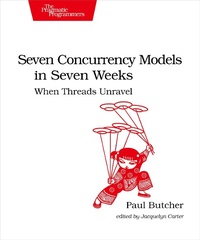
Seven Concurrency Models in Seven Weeks
Description

Your software needs to leverage multiple cores, handle thousands of users and terabytes of data, and continue working in the face of both hardware and software failure. Concurrency and parallelism are the keys, and Seven Concurrency Models in Seven Weeks equips you for this new world. See how emerging technologies such as actors and functional programming address issues with traditional threads and locks development. Learn how to exploit the parallelism in your computer''s GPU and leverage clusters of machines with MapReduce and Stream Processing. And do it all with the confidence that comes from using tools that help you write crystal clear, high-quality code. This book will show you how to exploit different parallel architectures to improve your code''s performance, scalability, and resilience. You''ll learn about seven concurrency models: threads and locks, functional programming, separating identity and state, actors, sequential processes, data parallelism, and the lambda architecture. Learn about the perils of traditional threads and locks programming and how to overcome them through careful design and by working with the standard library. See how actors enable software running on geographically distributed computers to collaborate, handle failure, and create systems that stay up 24/7/365. Understand why shared mutable state is the enemy of robust concurrent code, and see how functional programming together with technologies such as Software Transactional Memory (STM) and automatic parallelism help you tame it. You''ll learn about the untapped potential within every GPU and how GPGPU software can unleash it. You''ll see how to use MapReduce to harness massive clusters to solve previously intractable problems, and how, in concert with Stream Processing, big data can be tamed. With an understanding of the strengths and weaknesses of each of the different models and hardware architectures, you''ll be empowered to tackle any problem with confidence. What You Need: The example code can be compiled and executed on *nix, OS X, or Windows. Instructions on how to download the supporting build systems are given in each chapter.
More details
Other editions
Additional editions