

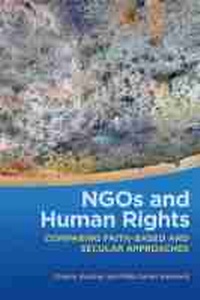
NGOs and Human Rights
Description

This study examines and compares the important work on global human rights advocacy done by religious NGOs and by secular NGOs. By studying the similarities in how such organizations understand their work, we can better consider not only how religious and secular NGOs might complement each other but also how they might collaborate and cooperate in the advancement of human rights. However, little research has attempted to compare these types of NGOs and their approaches. NGOs and Human Rights explores this comparison and identifies the key areas of overlap and divergence. In so doing, it lays the groundwork for better understanding how to capitalize on the strengths of religious groups, especially in addressing the world's many human rights challenges.
This book uses a new dataset of more than three hundred organizations affiliated with the United Nations Human Rights Council to compare the extent to which religious and secular NGOs differ in their framing, discussion, and operationalization of human rights work. Using both quantitative analysis of the extensive data collected by the authors and forty-seven in depth interviews conducted with members of human rights organizations in the sample, Charity Butcher and Maia Carter Hallward analyze these organizations' approaches to questions of culture, development, women's rights, children's rights, and issues of peace and conflict.
More details
Other editions
Additional editions
Persons
Maia Carter Hallward is a professor of middle east politics and the editor of the Journal of Peacebuilding and Development at Kennesaw State University. She is the author of Struggling for a Just Peace: Israeli and Palestinian Activism in the Second Intifada and Transnational Activism and the Israeli-Palestinian Conflict, and she is coeditor of Understanding Nonviolence and Understanding International Conflict Management.
