

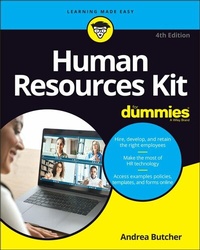
Human Resources Kit For Dummies
Description

Human Resources Kit For Dummies is the guide talent pros turn to for improving their leadership across the businesses they serve. The world of HR is full of unforeseen challenges, and this For Dummies reference will help you to handle them with grace and professionalism. This book provides tips and tricks for creating an engaging employee experience from the get-go, prioritizing employee well-being and health, navigating the recent wave of resignations, and implementing better hiring practices. In this new era of virtual offices, you'll also learn to implement remote and hybrid onboarding and work models. Plus, you'll explore HR technologies, learning and development strategies that get results, hiring ethics, diversity and inclusion best practices, social media uses and policies, and beyond.
* Learn all the functions of the human resources role
* Discover new software, HR best practices, and employment trends
* Make your organization more ethical with diversity, equity, and inclusion initiatives
* Get insights on how to navigate remote workers and other common HR challenges
New and working HR professionals will love this friendly, easy-to-read resource for developing HR skills. If you're a business owner, this book can also help you recruit, hire, and retain the right people, or build an HR function that gets results!
More details
Other editions
Additional editions
Person
Content
Part 1: Embracing the Evolving Role of HR 5
Chapter 1: Peeking into the World of HR 7
Chapter 2: Setting the Stage: Trends in the HR and Talent Space 13
Chapter 3: Leveraging HR Technology 23
Part 2: Putting the Right People in the Right Roles 35
Chapter 4: Creating a Talent Strategy Aligned with Business Strategy 37
Chapter 5: Kicking Off the Hiring Process 57
Chapter 6: Attracting Great Talent 69
Chapter 7: Narrowing the Pool: Evaluating and Assessing Candidates 91
Chapter 8: Maximizing the Interviewing Process 109
Chapter 9: Making the Hiring Decision 131
Part 3: Retaining and Engaging Talent 157
Chapter 10: Onboarding: Setting Up New Team Members for Success 159
Chapter 11: Ensuring a Competitive Total Rewards System 181
Chapter 12: Putting Together the Right Benefits Package 203
Chapter 13: Creating a Meaningful Employee Experience 229
Part 4: Developing Talent 253
Chapter 14: Providing the Right Growth Experiences for Team Members 255
Chapter 15: Pathing Careers and Developing Leaders 271
Chapter 16: Managing Ongoing Performance 293
Part 5: Minimizing Organizational Risk 309
Chapter 17: Navigating Risks When Hiring and Leading Team Members 311
Chapter 18: Handling Difficult Situations 329
Part 6: The Part of Tens 359
Chapter 19: Ten (or So) Best Practices for HR and Talent Leaders 361
Chapter 20: Ten (or So) Strategies for Building Relationships with Key Stakeholders 367
Chapter 21: Ten Skills You Need for Navigating Paradox 373
Appendix: What's Online 377
Index 383
Chapter 1
Peeking into the World of HR
IN THIS CHAPTER
Identifying key HR responsibilities
Getting the people you want to hire to want to work for you
Providing a great employee experience
Generating growth and development opportunities for employees
Mitigating risk around hiring and managing employees
Whether you're a business owner building an organization, a leader within an organization supporting the success of your team, or a human resources (HR) or talent professional creating processes and systems that maximize the strengths and talents within your workforce, it's important to recognize that the people within your business are your business. You get more from the talent within your organization when you're clear about what success looks like, care for people, provide an experience that allows people to bring the best of who they are, and create processes and systems that support their needs and their ongoing growth and development.
No matter what products or services a company offers, the talents and abilities of every team member are what ultimately determine how well it performs and serves customers. Whether you call them team members or employees (I use both interchangeably throughout this book), these human beings differ from physical or financial assets of the company because each human being has unique talents and needs that collectively shape the culture of your organization. The world of HR exists to leverage their individual and collective potential, and because the focus is on the human (more so than the human as a resource), many organizations are rebranding human resources to better reflect a focus on people, culture, and talent. Regardless of the name, the impact of strong talent and people processes in an organization is clear, particularly in today's complex work environment.
In order to best support the people within your organization, you have to understand what makes them tick - their preferences, their needs, their expectations, and their humanness, and in this volatile, uncertain, complex, and ambiguous (VUCA) world, their humanness is front and center. Team members no longer "leave their personal lives at the door" as many are working from home - the line between personal and professional has blended as HR leaders promote life/work integration and focus on the holistic well-being of the workforce.
As organizations adapt to the shifting landscape, HR plays a critical role. This chapter provides an overview of how you can navigate the changing landscape and best support your team members (and ultimately, your business) in the process.
Recognizing Key HR Responsibilities
Overall, the HR or talent function within an organization leads the decisions, activities, and processes designed to support the needs and performance of employees in today's dynamic environment. The most common responsibilities falling within the HR function include the following:
- Attracting talent: Strategically attracting, sourcing, recruiting, and onboarding the talent needed to accomplish business goals
- Creating a positive employee experience: Ensuring a safe environment and retaining team members
- Providing a total rewards package: Establishing legally compliant, effective, and attractive compensation, benefits, and recognition
- Developing employees and providing opportunities for growth: Ensuring that team members grow in knowledge and experience, and that their skill sets support the goals of the business
- Navigating risk: Complying with the ever-increasing complexities within the regulatory environment
Regardless of the number of employees within your organization, a people-focus is important in order to get and keep the talent necessary to serve your customers. After they reach a certain size, most organizations find it more efficient to establish a team focused on people and culture - even if it consists of only one person. Because of the increasing complexity of HR issues, larger organizations have boosted the size of their departments and typically employ specialists in areas such as talent acquisition, learning and development, and total rewards, but smaller organizations that don't have the resources for such specialization must ensure that the people who handle their HR functions (or they themselves) possess skills in several areas of HR rather than in one particular specialty.
The HR profession has undergone enormous changes in the past 20 years . even the last 2 years, in the wake of the Covid-19 pandemic. HR and talent activities are an integral part of a business (remember, the people in the business are your business). Rather than creating and executing a talent strategy in a vacuum, HR leaders work cooperatively with leaders at all levels of the business to determine the most effective ways to meet team members' needs.
Building Your Team: Attracting Talent
One of the primary jobs of an HR professional is recruiting and hiring the best people for the organization. It all starts with developing an overall talent strategy. This involves putting your current employees in the right places to best address the organization's most critical task, as well as attracting additional people with the talent and attributes that complement both your short- and long-term business goals. At the heart of a talent strategy is taking advantage of the strengths of your people and augmenting their talent and capabilities in a thoughtful, focused way. (See Chapter 4 for more on creating a talent strategy.)
A carefully crafted job description (or position success profile as I encourage you to think of it as) - and job postings based on it - are critical to bringing the best people onboard. Both should focus on a job's expected outcomes to attract the best applicants possible. The key to a good position success profile is clearly defining what success looks like (hence the name). (See Chapter 5 for more on creating a position success profile.)
From there, you have a broad array of potential candidate sources. These include referrals from your current team members, online job boards, social media and online networking sites, and your own company website. (See Chapter 6 for more on your sourcing strategy.)
Now comes the process of narrowing the candidate pool and assessing talent. The goal is to choose the prospective candidates who are in the best position to achieve the outcomes of the position, so it's critical to look for specifics about their experience and history of achievement in the focus areas that have been defined. You may use a video or phone interview as an initial way to determine those who are likely to be most successful in the position. When it's time for the all-important in-person or more detailed virtual interview, you need to use effective interview techniques and strategies, with a special emphasis on nondiscriminatory interview questions. (See Chapter 7 for more on evaluating applicants and Chapter 8 for tips on interviewing.)
As you near the final hiring decision, it's important to set up a system to help select the right candidate, including how and when to conduct background and reference checks (refer to Chapter 9). Final considerations include ways to craft and present a job offer, and from there, techniques to negotiate a total rewards package to be competitive and win over an attractive candidate.
Retaining and Engaging Talent: Creating a Positive Employee Experience
Recruiting and hiring great talent is obviously the first step but represents only one side of the talent strategy coin. Creating an environment and a culture that keep employees onboard is no less critical to the long-term growth of your organization. Employee retention begins the moment you connect with the prospective candidate in the recruiting process and is heightened on their first day with your organization (see Chapter 10). Upon joining the organization, one of your first responsibilities is to get to know your team member to best set them up for success. It's not a one-size-fits-all approach. Your employee handbook will provide general guidelines and expectations for all employees, but each manager should connect with individual employees regarding any individual needs or expectations. Communication and clarity are the keys to setting up new hires for success.
It's also important to leverage onboarding strategies to help new team members engage quickly, get off to a strong start, and have some quick wins. The onboarding process is ongoing and should include regular check-ins and follow-up about what the employee is learning through the process.
Every business needs an effective rewards and motivation system that includes how much and by what means employees are compensated (see Chapter 11). A first step for all organizations is to determine an overall compensation philosophy that can help establish pay levels and wage plans throughout the company. Your compensation philosophy also applies to raises, bonuses, and other forms of incentives. Next, of course, are the benefits themselves. It takes a high-level understanding of (and access to experts who can provide detailed expertise on) health insurance, retirement packages, workers' compensation, employee wellness, and on-the-job safety (refer to Chapter 12).
Creating a great...
