

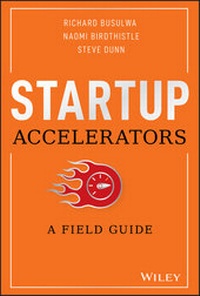
Startup Accelerators
A Field Guide
1st Edition
Published on 22. January 2020
368 pages
978-1-119-63865-0 (ISBN)
Description

The must - read guidebook for entrepreneurs looking to get into accelerator programs and to build and scale their startups with speed
Accelerator programs have become one of the most powerful and valuable resources for entrepreneurs seeking to learn rapidly, build powerful networks, raise capital, build their startups and do this at speed and scale. In recent years, the number of accelerator programs around the world has grown at an incredible rate, propelling startups such as AirBnB, Uber, DropBox, Reddit, and others -- many to billion-dollar valuations. The number of accelerators, the differences in accelerator program offerings and the unique benefits and costs of different accelerator locations makes choosing the right accelerator a challenge. Selecting the wrong accelerator, failing to be accepted in the right one, or not fully taking advantage of all the accelerator has to offer can be costly, sometimes fatal. With the stakes so high, entrepreneurs need to understand all their options, choose carefully and do the right things to maximize their chances of success.
Startup Accelerators is the go to guide for any entrepreneur, providing a firsthand look into the acceptance criteria and inner workings of different accelerator programs. Written by entrepreneurs for entrepreneurs, this indispensable resource explains what different accelerator programs offer, how to get accepted, what to do during the program, how to raise money during accelerators, what to do after the program ends, and much more. Packed with real-world case studies and advice from leading experts on startup accelerator programs, this one-stop resource provides step-by-step guidance on the entire accelerator process.
* Reveals how accelerators help founders navigate different challenges in the startup journey
* Describes the differences in the benefits and costs of different accelerator programs
* Explains how to prepare accelerator applications
* Discloses what actions to take during an accelerator to make the most of it
* Depicts case studies of entrepreneurs' accelerator applications, experiences and outcomes across different accelerators
* Features interviews with accelerator program managers, founders who went through accelerators, and investors in companies going through or having gone through accelerators
* Includes insightful data and reflections from entrepreneurship education researchers and academics
Startup Accelerators: A Field Guide will prove to be invaluable for startup founders considering or going through accelerators, as well as aspiring entrepreneurs, educators, and other startup accelerator stakeholders.
Accelerator programs have become one of the most powerful and valuable resources for entrepreneurs seeking to learn rapidly, build powerful networks, raise capital, build their startups and do this at speed and scale. In recent years, the number of accelerator programs around the world has grown at an incredible rate, propelling startups such as AirBnB, Uber, DropBox, Reddit, and others -- many to billion-dollar valuations. The number of accelerators, the differences in accelerator program offerings and the unique benefits and costs of different accelerator locations makes choosing the right accelerator a challenge. Selecting the wrong accelerator, failing to be accepted in the right one, or not fully taking advantage of all the accelerator has to offer can be costly, sometimes fatal. With the stakes so high, entrepreneurs need to understand all their options, choose carefully and do the right things to maximize their chances of success.
Startup Accelerators is the go to guide for any entrepreneur, providing a firsthand look into the acceptance criteria and inner workings of different accelerator programs. Written by entrepreneurs for entrepreneurs, this indispensable resource explains what different accelerator programs offer, how to get accepted, what to do during the program, how to raise money during accelerators, what to do after the program ends, and much more. Packed with real-world case studies and advice from leading experts on startup accelerator programs, this one-stop resource provides step-by-step guidance on the entire accelerator process.
* Reveals how accelerators help founders navigate different challenges in the startup journey
* Describes the differences in the benefits and costs of different accelerator programs
* Explains how to prepare accelerator applications
* Discloses what actions to take during an accelerator to make the most of it
* Depicts case studies of entrepreneurs' accelerator applications, experiences and outcomes across different accelerators
* Features interviews with accelerator program managers, founders who went through accelerators, and investors in companies going through or having gone through accelerators
* Includes insightful data and reflections from entrepreneurship education researchers and academics
Startup Accelerators: A Field Guide will prove to be invaluable for startup founders considering or going through accelerators, as well as aspiring entrepreneurs, educators, and other startup accelerator stakeholders.
More details
Other editions
Additional editions
Book
01/2020
2nd Edition
Wiley
€37.50
Shipment within 15-20 days
Persons
RICHARD BUSULWA (PHD, MBA, M.Innov) is a researcher in the Business School at Swinburne University of Technology, home to the Australian Graduate School of Entrepreneurship. His research focuses on startup evolution, entrepreneurial learning, entrepreneurial well-being, and strategy for startups. He is co-author of Strategy Execution and Complexity: Thriving in the Era of Disruption. Richard is a startup co-founder and seed investor in cloud, IoT, AI, blockchain, property, and niche professional service firms.
NAOMI BIRDTHISTLE (PHD, MBS, BA Hons) is Associate Professor of Entrepreneurship and Business Innovation at Griffith University and is a visiting academic to Aalto University-Mikkeli campus. Naomi has published research on entrepreneurship education, entrepreneurial ecosystems, and family business management issues. Her research has received numerous awards including Emerald Literati awards, a best Doctoral Dissertation Award from the Family Firm Institute, and the Institute of Small Business and Entrepreneurship (ISBE) best paper in a conference track. Naomi has run her own consulting business and has worked in her family business in Ireland.
STEVE DUNN (MBA, BA) is CEO and cofounder of LEAPIN Digital Keys, a startup that delivers NB IoT smart access control solutions. Since its founding, Steve has led the startup through a number of different accelerators within Asia Pacific, USA, and Europe. He has also led the startup through several iterations and pivots with a variety of IoT technologies, to finally find product-market fit. Steve is a mentor and coach in university-based accelerators and incubators.
NAOMI BIRDTHISTLE (PHD, MBS, BA Hons) is Associate Professor of Entrepreneurship and Business Innovation at Griffith University and is a visiting academic to Aalto University-Mikkeli campus. Naomi has published research on entrepreneurship education, entrepreneurial ecosystems, and family business management issues. Her research has received numerous awards including Emerald Literati awards, a best Doctoral Dissertation Award from the Family Firm Institute, and the Institute of Small Business and Entrepreneurship (ISBE) best paper in a conference track. Naomi has run her own consulting business and has worked in her family business in Ireland.
STEVE DUNN (MBA, BA) is CEO and cofounder of LEAPIN Digital Keys, a startup that delivers NB IoT smart access control solutions. Since its founding, Steve has led the startup through a number of different accelerators within Asia Pacific, USA, and Europe. He has also led the startup through several iterations and pivots with a variety of IoT technologies, to finally find product-market fit. Steve is a mentor and coach in university-based accelerators and incubators.
Content
1 - Cover [Seite 1]
2 - Title Page [Seite 5]
3 - Copyright [Seite 6]
4 - Contents [Seite 7]
5 - About the Authors [Seite 11]
6 - Acknowledgments [Seite 13]
7 - Preface [Seite 15]
7.1 - Research for This Book [Seite 17]
7.2 - How to Use This Book [Seite 17]
8 - Introduction [Seite 21]
8.1 - How Accelerator Programs Can Help Startups [Seite 32]
8.2 - Accelerators versus Incubators, Investors, Government Programs, and Other StartupEcosystem Institutions [Seite 34]
8.3 - Notes [Seite 38]
9 - Chapter 1 The Emergence of Startup Accelerators [Seite 43]
9.1 - Emergence [Seite 43]
9.2 - Ascendance [Seite 44]
9.3 - Expansion [Seite 48]
9.4 - Impact [Seite 50]
9.5 - Future [Seite 52]
9.6 - Notes [Seite 54]
10 - Chapter 2 What Happens in an Accelerator [Seite 57]
10.1 - Accelerator Programs [Seite 57]
10.2 - Accelerator Curriculums [Seite 58]
10.3 - Accelerator Co-Working Spaces [Seite 59]
10.4 - Accelerator Mentors [Seite 60]
10.5 - Accelerator Program Managers [Seite 62]
10.6 - Accelerator Weekly Check-In Sessions [Seite 66]
10.7 - Accelerator Advisors [Seite 67]
10.8 - Demo Day [Seite 70]
10.9 - Case Study 1: LEAPIN Digital Keys and the H-Farm Deutsche Bank IoTAccelerator Program (Italy) [Seite 74]
10.10 - Notes [Seite 81]
11 - Chapter 3 Is Your Startup Ready for an Accelerator? [Seite 85]
11.1 - What It Takes to Get into an Accelerator [Seite 85]
11.2 - Accelerator Acceptance Criteria [Seite 86]
11.2.1 - The Team [Seite 88]
11.2.2 - The Product [Seite 90]
11.2.3 - The Market [Seite 92]
11.2.4 - Progress [Seite 94]
11.2.5 - What Matters More: The Team, the Product, the Market, or Progress? [Seite 97]
11.3 - Common Accelerator Turnoffs [Seite 98]
11.3.1 - Incomplete, Error-Laden, Inconcise, or Vague Applications [Seite 99]
11.3.2 - Too Early [Seite 99]
11.3.3 - No Product/No Market or Bad Product/Bad Market [Seite 100]
11.3.4 - Solo Founder/Inability to Lead [Seite 100]
11.3.5 - Prohibitive Location [Seite 101]
11.3.6 - Lying and/or Questionable Values [Seite 103]
11.3.7 - Prohibitive Cap Table [Seite 105]
11.3.8 - Lack of Persistence/Distraction/Half-Hearted Effort/Poor Past Decisions [Seite 106]
11.4 - When Are You Ready for an Accelerator? [Seite 107]
11.4.1 - Depends on the Accelerator [Seite 107]
11.4.2 - Depends on Your Startup [Seite 108]
11.5 - Can You Be Too Early or Too Late for an Accelerator? [Seite 108]
11.6 - What If You Are Not Ready? [Seite 109]
11.7 - Case Study 2: BroZone Inc. and the Founders Frontier Accelerator* (USA) [Seite 110]
11.8 - Notes [Seite 115]
12 - Chapter 4 How to Prepare the Accelerator Application [Seite 123]
12.1 - Accelerator Acceptance Criteria versus the Accelerator Application [Seite 123]
12.2 - The Accelerator Application Process [Seite 124]
12.3 - The Accelerator Application Questionnaire [Seite 126]
12.3.1 - Where to Find Accelerator Application Forms [Seite 126]
12.3.2 - Elements or Sections of the Accelerator Application Questionnaire [Seite 127]
12.4 - Company Overview [Seite 129]
12.4.1 - What Accelerators Are Looking for in This Section [Seite 129]
12.4.2 - Common Tips and Traps [Seite 129]
12.4.3 - The Startup Website [Seite 130]
12.5 - The Founders/Team [Seite 132]
12.5.1 - What Accelerators Are Looking For in This Section [Seite 132]
12.5.2 - Founding Team Talent [Seite 132]
12.5.3 - Founding Team Functioning [Seite 136]
12.5.4 - Founder Commitment [Seite 137]
12.5.5 - Flexibility/Adaptability [Seite 139]
12.5.6 - Common Tips and Traps [Seite 139]
12.5.7 - Accelerator-Specific Founder Characteristics [Seite 140]
12.6 - The Product/Idea [Seite 140]
12.6.1 - What Accelerators Are Looking for in This Section [Seite 140]
12.6.2 - Problem/Solution Fit [Seite 141]
12.6.3 - MVP [Seite 143]
12.6.4 - Product-Line Growth Path [Seite 145]
12.6.5 - Product Risks [Seite 146]
12.6.6 - Competition and Competitive Barriers [Seite 147]
12.6.7 - Product/Market Fit [Seite 148]
12.6.8 - Business Model [Seite 149]
12.6.9 - Common Tips and Traps [Seite 150]
12.6.10 - Getting Your First Piece of Traction [Seite 151]
12.7 - Progress [Seite 151]
12.8 - Equity [Seite 156]
12.9 - Other Common Accelerator-Specific Criteria [Seite 157]
12.10 - How Accelerator Applications Are Evaluated [Seite 159]
12.11 - Case Study 3: LEAPIN Digital Keys' Journey through Three Different AcceleratorApplications (Italy, United States, and Germany) [Seite 161]
12.12 - Notes [Seite 185]
13 - Chapter 5 How to Handle the Accelerator Interview [Seite 189]
13.1 - What Is an Accelerator Interview and Why Is It Important? [Seite 189]
13.2 - The Interview Process and Interview Questions [Seite 190]
13.2.1 - The Virtual Interview [Seite 190]
13.2.2 - The Face-to-Face Interview [Seite 192]
13.3 - Accelerator Interview Questions [Seite 193]
13.4 - What Can Go Wrong in the Accelerator Interview [Seite 195]
13.5 - Common Tips and Traps [Seite 196]
13.5.1 - Do Your Research [Seite 196]
13.5.2 - Overprepare [Seite 197]
13.5.3 - Plan the Interview [Seite 197]
13.5.4 - Start Off on the Right Footing [Seite 198]
13.5.5 - Smile, Be Energizing and Show Personality [Seite 199]
13.5.6 - Tell a Story/Know the Power of Story [Seite 199]
13.5.7 - Be Concise [Seite 200]
13.5.8 - Be Authentic [Seite 200]
13.5.9 - Be Willing to Say You Don't Know [Seite 201]
13.5.10 - Don't Get Defensive [Seite 201]
13.5.11 - Know Your Data and Metrics [Seite 202]
13.5.12 - Know Your Direct and Indirect Competition [Seite 202]
13.5.13 - Be Prepared to Discuss Your Weaknesses [Seite 203]
13.5.14 - Know Your Big Three and Make Sure They Are Understood and Remembered [Seite 203]
13.5.15 - Be Congruent [Seite 204]
13.5.16 - Rehearse, Rehearse, Rehearse [Seite 204]
13.5.17 - Plan for the Unexpected [Seite 206]
13.6 - Case Study 4: Listen Notes' Y Combinator Interview*47 (USA) [Seite 206]
13.7 - Notes [Seite 209]
14 - Chapter 6 Should You Give Up Equity to Get into an Accelerator? [Seite 213]
14.1 - Equity as a Prerequisite to Getting into an Accelerator [Seite 213]
14.1.1 - Giving Up Equity to an Accelerator [Seite 214]
14.1.2 - Giving Up Equity to Multiple Accelerators [Seite 217]
14.2 - What Else Do Founders Give Up in Accelerator Term Sheets? [Seite 217]
14.2.1 - Key Elements of Accelerator Term Sheets [Seite 218]
14.2.2 - Types of Securities (or Types of Shares) [Seite 218]
14.2.3 - Valuation [Seite 219]
14.2.4 - Anti-Dilution Provisions [Seite 219]
14.2.5 - Founder Vesting [Seite 220]
14.2.6 - Liquidation Preference [Seite 221]
14.2.7 - Voting Rights [Seite 221]
14.2.8 - Dividends [Seite 222]
14.2.9 - Board of Directors [Seite 222]
14.2.10 - Veto Rights or Protective Provisions [Seite 222]
14.2.11 - Negotiating Accelerator Term Sheets [Seite 223]
14.3 - Case Study 5: Impact of Signing Multiple Accelerator Agreements on aStartup's Capital-Raising Rounds [Seite 224]
14.4 - Notes [Seite 230]
15 - Chapter 7 Choosing an Accelerator Program [Seite 235]
15.1 - Significance of the Decision to Participate in or Forgo Accelerator Programs [Seite 235]
15.2 - Significance of the Accelerator Choice Decision [Seite 236]
15.3 - What Makes Choosing an Accelerator So Challenging [Seite 238]
15.4 - What Makes a Good Accelerator [Seite 240]
15.4.1 - First, Do No Harm [Seite 240]
15.4.2 - Seed Investment [Seite 242]
15.4.3 - Accelerated Learning and Skills Development [Seite 242]
15.4.4 - Accelerated Investment Readiness [Seite 243]
15.4.5 - Accelerated Product Development [Seite 245]
15.4.6 - Getting Legal Right from the Start [Seite 246]
15.4.7 - Getting Strategy Right [Seite 247]
15.4.8 - Exclusive Access to Investors, Customers, Strategic Partners, Cofounders [Seite 248]
15.4.9 - An Effective Support Network [Seite 248]
15.4.10 - Professionalism, Confidence, and Other Ancillary Benefits [Seite 249]
15.5 - What Makes an Accelerator Right for a Startup [Seite 249]
15.6 - How to Choose the Right Accelerator [Seite 251]
15.6.1 - Understand What Makes a Good Accelerator [Seite 252]
15.6.2 - Know Thyself [Seite 252]
15.6.3 - Do the Investigative Work to Separate Reality from Spin [Seite 253]
15.6.4 - Consider Alternate Sources of Benefits [Seite 254]
15.7 - Case Study 6: An Unexpected Accelerator Experience [Seite 255]
15.8 - Notes [Seite 259]
16 - Chapter 8 How to Get the Most out of an Accelerator [Seite 265]
16.1 - Plan Ahead [Seite 265]
16.2 - Clarify Priorities and Plan Your Time [Seite 266]
16.3 - Show That You Are Committed [Seite 267]
16.4 - Go Fast [Seite 268]
16.5 - Get Customer Discovery and Customer Validation Right [Seite 269]
16.6 - Get Strategy Right [Seite 270]
16.7 - Get Legal Right [Seite 270]
16.8 - Get Investment Ready or Raise Investment [Seite 271]
16.9 - Perfect Your Pitching, Storytelling, and Business Communication [Seite 272]
16.10 - Building Your Network within the Network [Seite 272]
16.11 - Resolve Any Difficult Issues [Seite 273]
16.12 - Maximize Learning [Seite 274]
16.13 - Case Study 7: One Co-Founder's Approach to Making the Mostof the Techstars Accelerator Experience [Seite 275]
16.14 - Notes [Seite 277]
17 - Chapter 9 What to Expect after the Accelerator Ends [Seite 281]
17.1 - What Happens after the Accelerator Ends [Seite 281]
17.2 - The Need to Maintain Momentum [Seite 282]
17.3 - What to Do after the Accelerator [Seite 282]
17.3.1 - Plan Ahead How You Will Maintain the Sense of Urgency [Seite 283]
17.3.2 - Establish Ongoing Mentoring [Seite 284]
17.3.3 - Keep Investors Engaged [Seite 284]
17.3.4 - Keep Accelerator Organizers Engaged and Leverage Them Fully [Seite 285]
17.3.5 - Nurture Existing Relationships/Make New Connections [Seite 286]
17.3.6 - Look Forward, Not Sideways [Seite 286]
17.4 - Notes [Seite 287]
18 - Appendix: Founder Resource Directory [Seite 289]
18.1 - Resource Directory Overview [Seite 289]
18.2 - Part 1: Founder Reflections [Seite 290]
18.2.1 - Founder Reflections Overview [Seite 290]
18.3 - Founder Reflection #1 [Seite 290]
18.3.1 - Startup and Accelerator Overview [Seite 290]
18.3.2 - Finding the Accelerator [Seite 291]
18.3.3 - Accelerator Application and Accelerator Experience [Seite 291]
18.3.4 - After the Accelerator [Seite 293]
18.3.5 - Tips for Founders Considering Applying for an Accelerator [Seite 293]
18.3.6 - Final Thoughts [Seite 295]
18.4 - Founder Reflection #2 [Seite 295]
18.4.1 - Startup and Accelerator Overview [Seite 295]
18.4.2 - Finding the Accelerator [Seite 296]
18.4.3 - The Accelerator Application and Accelerator Experience [Seite 296]
18.4.4 - After the Accelerator [Seite 297]
18.4.5 - Tips for Founders Considering Applying for an Accelerator [Seite 297]
18.5 - Founder Reflection #3 [Seite 298]
18.5.1 - Startup and Accelerator Overview [Seite 298]
18.5.2 - Finding the Accelerator [Seite 299]
18.5.3 - The Accelerator Application and Accelerator Experience [Seite 299]
18.5.4 - After the Accelerator [Seite 300]
18.5.5 - Tips for Founders Considering Applying for an Accelerator [Seite 301]
18.5.6 - Final Thoughts [Seite 301]
18.6 - Additional Founder Reflections [Seite 302]
18.7 - Part 2: Accelerator Program Manager and Entrepreneurship Educator Reflections [Seite 303]
18.7.1 - Accelerator Program Manager and Entrepreneurship Educator Reflections Overview [Seite 303]
18.8 - Accelerator Program Manager Reflection #1 [Seite 304]
18.8.1 - Accelerator Overview [Seite 304]
18.8.2 - Value of Accelerators [Seite 304]
18.8.3 - Choosing an Accelerator [Seite 305]
18.8.4 - The Accelerator Application [Seite 305]
18.8.5 - The Accelerator Interview [Seite 306]
18.8.6 - Accelerator Costs [Seite 306]
18.8.7 - The Accelerator Curriculum [Seite 306]
18.8.8 - Fundraising [Seite 307]
18.8.9 - Networks [Seite 307]
18.8.10 - Final Thoughts [Seite 307]
18.9 - Accelerator Program Manager Reflection #2 [Seite 307]
18.9.1 - Accelerator Overview [Seite 307]
18.9.2 - Value of Accelerators [Seite 308]
18.9.3 - Choosing an Accelerator [Seite 308]
18.9.4 - The Accelerator Application [Seite 308]
18.9.5 - The Accelerator Interview [Seite 309]
18.9.6 - Accelerator Costs [Seite 309]
18.9.7 - The Accelerator Curriculum [Seite 309]
18.9.8 - Fundraising [Seite 310]
18.9.9 - Networks [Seite 310]
18.9.10 - Final Thoughts [Seite 310]
18.10 - Entrepreneurship Educator Reflection #1 [Seite 310]
18.10.1 - Entrepreneurship Educator Overview [Seite 310]
18.10.2 - Entrepreneurship Education Approach [Seite 311]
18.10.3 - Entrepreneurship Education Challenges [Seite 311]
18.10.4 - Entrepreneurship Education at Universities [Seite 313]
18.10.5 - Future of Entrepreneurship Education at Universities [Seite 313]
18.10.6 - Entrepreneurship Education in Universities versus in Accelerators [Seite 314]
18.10.7 - Entrepreneurship Education in Government Programs [Seite 314]
18.11 - Entrepreneurship Educator Reflection #2 [Seite 315]
18.11.1 - Entrepreneurship Educator Overview [Seite 315]
18.11.2 - Entrepreneurship Education Approach [Seite 315]
18.11.3 - Entrepreneurship Education at Universities [Seite 315]
18.11.4 - Entrepreneurship Education Challenges [Seite 315]
18.11.5 - Future of Entrepreneurship Education at Universities [Seite 316]
18.11.6 - Entrepreneurship Education in Universities versus in Accelerators [Seite 316]
18.12 - Part 3: Curated Accelerator Resources [Seite 317]
18.13 - Resources to Help Founders Choose the Right Accelerator [Seite 317]
18.14 - Resources to Help Founders Prepare Accelerator Applications and Plan for the Start of an Accelerator [Seite 317]
18.15 - Resources to Help Founders Navigate Key Stages of the Accelerator Experience [Seite 319]
18.16 - Examples of Leading Accelerators Globally by Region [Seite 348]
19 - Index [Seite 349]
20 - EULA [Seite 369]
2 - Title Page [Seite 5]
3 - Copyright [Seite 6]
4 - Contents [Seite 7]
5 - About the Authors [Seite 11]
6 - Acknowledgments [Seite 13]
7 - Preface [Seite 15]
7.1 - Research for This Book [Seite 17]
7.2 - How to Use This Book [Seite 17]
8 - Introduction [Seite 21]
8.1 - How Accelerator Programs Can Help Startups [Seite 32]
8.2 - Accelerators versus Incubators, Investors, Government Programs, and Other StartupEcosystem Institutions [Seite 34]
8.3 - Notes [Seite 38]
9 - Chapter 1 The Emergence of Startup Accelerators [Seite 43]
9.1 - Emergence [Seite 43]
9.2 - Ascendance [Seite 44]
9.3 - Expansion [Seite 48]
9.4 - Impact [Seite 50]
9.5 - Future [Seite 52]
9.6 - Notes [Seite 54]
10 - Chapter 2 What Happens in an Accelerator [Seite 57]
10.1 - Accelerator Programs [Seite 57]
10.2 - Accelerator Curriculums [Seite 58]
10.3 - Accelerator Co-Working Spaces [Seite 59]
10.4 - Accelerator Mentors [Seite 60]
10.5 - Accelerator Program Managers [Seite 62]
10.6 - Accelerator Weekly Check-In Sessions [Seite 66]
10.7 - Accelerator Advisors [Seite 67]
10.8 - Demo Day [Seite 70]
10.9 - Case Study 1: LEAPIN Digital Keys and the H-Farm Deutsche Bank IoTAccelerator Program (Italy) [Seite 74]
10.10 - Notes [Seite 81]
11 - Chapter 3 Is Your Startup Ready for an Accelerator? [Seite 85]
11.1 - What It Takes to Get into an Accelerator [Seite 85]
11.2 - Accelerator Acceptance Criteria [Seite 86]
11.2.1 - The Team [Seite 88]
11.2.2 - The Product [Seite 90]
11.2.3 - The Market [Seite 92]
11.2.4 - Progress [Seite 94]
11.2.5 - What Matters More: The Team, the Product, the Market, or Progress? [Seite 97]
11.3 - Common Accelerator Turnoffs [Seite 98]
11.3.1 - Incomplete, Error-Laden, Inconcise, or Vague Applications [Seite 99]
11.3.2 - Too Early [Seite 99]
11.3.3 - No Product/No Market or Bad Product/Bad Market [Seite 100]
11.3.4 - Solo Founder/Inability to Lead [Seite 100]
11.3.5 - Prohibitive Location [Seite 101]
11.3.6 - Lying and/or Questionable Values [Seite 103]
11.3.7 - Prohibitive Cap Table [Seite 105]
11.3.8 - Lack of Persistence/Distraction/Half-Hearted Effort/Poor Past Decisions [Seite 106]
11.4 - When Are You Ready for an Accelerator? [Seite 107]
11.4.1 - Depends on the Accelerator [Seite 107]
11.4.2 - Depends on Your Startup [Seite 108]
11.5 - Can You Be Too Early or Too Late for an Accelerator? [Seite 108]
11.6 - What If You Are Not Ready? [Seite 109]
11.7 - Case Study 2: BroZone Inc. and the Founders Frontier Accelerator* (USA) [Seite 110]
11.8 - Notes [Seite 115]
12 - Chapter 4 How to Prepare the Accelerator Application [Seite 123]
12.1 - Accelerator Acceptance Criteria versus the Accelerator Application [Seite 123]
12.2 - The Accelerator Application Process [Seite 124]
12.3 - The Accelerator Application Questionnaire [Seite 126]
12.3.1 - Where to Find Accelerator Application Forms [Seite 126]
12.3.2 - Elements or Sections of the Accelerator Application Questionnaire [Seite 127]
12.4 - Company Overview [Seite 129]
12.4.1 - What Accelerators Are Looking for in This Section [Seite 129]
12.4.2 - Common Tips and Traps [Seite 129]
12.4.3 - The Startup Website [Seite 130]
12.5 - The Founders/Team [Seite 132]
12.5.1 - What Accelerators Are Looking For in This Section [Seite 132]
12.5.2 - Founding Team Talent [Seite 132]
12.5.3 - Founding Team Functioning [Seite 136]
12.5.4 - Founder Commitment [Seite 137]
12.5.5 - Flexibility/Adaptability [Seite 139]
12.5.6 - Common Tips and Traps [Seite 139]
12.5.7 - Accelerator-Specific Founder Characteristics [Seite 140]
12.6 - The Product/Idea [Seite 140]
12.6.1 - What Accelerators Are Looking for in This Section [Seite 140]
12.6.2 - Problem/Solution Fit [Seite 141]
12.6.3 - MVP [Seite 143]
12.6.4 - Product-Line Growth Path [Seite 145]
12.6.5 - Product Risks [Seite 146]
12.6.6 - Competition and Competitive Barriers [Seite 147]
12.6.7 - Product/Market Fit [Seite 148]
12.6.8 - Business Model [Seite 149]
12.6.9 - Common Tips and Traps [Seite 150]
12.6.10 - Getting Your First Piece of Traction [Seite 151]
12.7 - Progress [Seite 151]
12.8 - Equity [Seite 156]
12.9 - Other Common Accelerator-Specific Criteria [Seite 157]
12.10 - How Accelerator Applications Are Evaluated [Seite 159]
12.11 - Case Study 3: LEAPIN Digital Keys' Journey through Three Different AcceleratorApplications (Italy, United States, and Germany) [Seite 161]
12.12 - Notes [Seite 185]
13 - Chapter 5 How to Handle the Accelerator Interview [Seite 189]
13.1 - What Is an Accelerator Interview and Why Is It Important? [Seite 189]
13.2 - The Interview Process and Interview Questions [Seite 190]
13.2.1 - The Virtual Interview [Seite 190]
13.2.2 - The Face-to-Face Interview [Seite 192]
13.3 - Accelerator Interview Questions [Seite 193]
13.4 - What Can Go Wrong in the Accelerator Interview [Seite 195]
13.5 - Common Tips and Traps [Seite 196]
13.5.1 - Do Your Research [Seite 196]
13.5.2 - Overprepare [Seite 197]
13.5.3 - Plan the Interview [Seite 197]
13.5.4 - Start Off on the Right Footing [Seite 198]
13.5.5 - Smile, Be Energizing and Show Personality [Seite 199]
13.5.6 - Tell a Story/Know the Power of Story [Seite 199]
13.5.7 - Be Concise [Seite 200]
13.5.8 - Be Authentic [Seite 200]
13.5.9 - Be Willing to Say You Don't Know [Seite 201]
13.5.10 - Don't Get Defensive [Seite 201]
13.5.11 - Know Your Data and Metrics [Seite 202]
13.5.12 - Know Your Direct and Indirect Competition [Seite 202]
13.5.13 - Be Prepared to Discuss Your Weaknesses [Seite 203]
13.5.14 - Know Your Big Three and Make Sure They Are Understood and Remembered [Seite 203]
13.5.15 - Be Congruent [Seite 204]
13.5.16 - Rehearse, Rehearse, Rehearse [Seite 204]
13.5.17 - Plan for the Unexpected [Seite 206]
13.6 - Case Study 4: Listen Notes' Y Combinator Interview*47 (USA) [Seite 206]
13.7 - Notes [Seite 209]
14 - Chapter 6 Should You Give Up Equity to Get into an Accelerator? [Seite 213]
14.1 - Equity as a Prerequisite to Getting into an Accelerator [Seite 213]
14.1.1 - Giving Up Equity to an Accelerator [Seite 214]
14.1.2 - Giving Up Equity to Multiple Accelerators [Seite 217]
14.2 - What Else Do Founders Give Up in Accelerator Term Sheets? [Seite 217]
14.2.1 - Key Elements of Accelerator Term Sheets [Seite 218]
14.2.2 - Types of Securities (or Types of Shares) [Seite 218]
14.2.3 - Valuation [Seite 219]
14.2.4 - Anti-Dilution Provisions [Seite 219]
14.2.5 - Founder Vesting [Seite 220]
14.2.6 - Liquidation Preference [Seite 221]
14.2.7 - Voting Rights [Seite 221]
14.2.8 - Dividends [Seite 222]
14.2.9 - Board of Directors [Seite 222]
14.2.10 - Veto Rights or Protective Provisions [Seite 222]
14.2.11 - Negotiating Accelerator Term Sheets [Seite 223]
14.3 - Case Study 5: Impact of Signing Multiple Accelerator Agreements on aStartup's Capital-Raising Rounds [Seite 224]
14.4 - Notes [Seite 230]
15 - Chapter 7 Choosing an Accelerator Program [Seite 235]
15.1 - Significance of the Decision to Participate in or Forgo Accelerator Programs [Seite 235]
15.2 - Significance of the Accelerator Choice Decision [Seite 236]
15.3 - What Makes Choosing an Accelerator So Challenging [Seite 238]
15.4 - What Makes a Good Accelerator [Seite 240]
15.4.1 - First, Do No Harm [Seite 240]
15.4.2 - Seed Investment [Seite 242]
15.4.3 - Accelerated Learning and Skills Development [Seite 242]
15.4.4 - Accelerated Investment Readiness [Seite 243]
15.4.5 - Accelerated Product Development [Seite 245]
15.4.6 - Getting Legal Right from the Start [Seite 246]
15.4.7 - Getting Strategy Right [Seite 247]
15.4.8 - Exclusive Access to Investors, Customers, Strategic Partners, Cofounders [Seite 248]
15.4.9 - An Effective Support Network [Seite 248]
15.4.10 - Professionalism, Confidence, and Other Ancillary Benefits [Seite 249]
15.5 - What Makes an Accelerator Right for a Startup [Seite 249]
15.6 - How to Choose the Right Accelerator [Seite 251]
15.6.1 - Understand What Makes a Good Accelerator [Seite 252]
15.6.2 - Know Thyself [Seite 252]
15.6.3 - Do the Investigative Work to Separate Reality from Spin [Seite 253]
15.6.4 - Consider Alternate Sources of Benefits [Seite 254]
15.7 - Case Study 6: An Unexpected Accelerator Experience [Seite 255]
15.8 - Notes [Seite 259]
16 - Chapter 8 How to Get the Most out of an Accelerator [Seite 265]
16.1 - Plan Ahead [Seite 265]
16.2 - Clarify Priorities and Plan Your Time [Seite 266]
16.3 - Show That You Are Committed [Seite 267]
16.4 - Go Fast [Seite 268]
16.5 - Get Customer Discovery and Customer Validation Right [Seite 269]
16.6 - Get Strategy Right [Seite 270]
16.7 - Get Legal Right [Seite 270]
16.8 - Get Investment Ready or Raise Investment [Seite 271]
16.9 - Perfect Your Pitching, Storytelling, and Business Communication [Seite 272]
16.10 - Building Your Network within the Network [Seite 272]
16.11 - Resolve Any Difficult Issues [Seite 273]
16.12 - Maximize Learning [Seite 274]
16.13 - Case Study 7: One Co-Founder's Approach to Making the Mostof the Techstars Accelerator Experience [Seite 275]
16.14 - Notes [Seite 277]
17 - Chapter 9 What to Expect after the Accelerator Ends [Seite 281]
17.1 - What Happens after the Accelerator Ends [Seite 281]
17.2 - The Need to Maintain Momentum [Seite 282]
17.3 - What to Do after the Accelerator [Seite 282]
17.3.1 - Plan Ahead How You Will Maintain the Sense of Urgency [Seite 283]
17.3.2 - Establish Ongoing Mentoring [Seite 284]
17.3.3 - Keep Investors Engaged [Seite 284]
17.3.4 - Keep Accelerator Organizers Engaged and Leverage Them Fully [Seite 285]
17.3.5 - Nurture Existing Relationships/Make New Connections [Seite 286]
17.3.6 - Look Forward, Not Sideways [Seite 286]
17.4 - Notes [Seite 287]
18 - Appendix: Founder Resource Directory [Seite 289]
18.1 - Resource Directory Overview [Seite 289]
18.2 - Part 1: Founder Reflections [Seite 290]
18.2.1 - Founder Reflections Overview [Seite 290]
18.3 - Founder Reflection #1 [Seite 290]
18.3.1 - Startup and Accelerator Overview [Seite 290]
18.3.2 - Finding the Accelerator [Seite 291]
18.3.3 - Accelerator Application and Accelerator Experience [Seite 291]
18.3.4 - After the Accelerator [Seite 293]
18.3.5 - Tips for Founders Considering Applying for an Accelerator [Seite 293]
18.3.6 - Final Thoughts [Seite 295]
18.4 - Founder Reflection #2 [Seite 295]
18.4.1 - Startup and Accelerator Overview [Seite 295]
18.4.2 - Finding the Accelerator [Seite 296]
18.4.3 - The Accelerator Application and Accelerator Experience [Seite 296]
18.4.4 - After the Accelerator [Seite 297]
18.4.5 - Tips for Founders Considering Applying for an Accelerator [Seite 297]
18.5 - Founder Reflection #3 [Seite 298]
18.5.1 - Startup and Accelerator Overview [Seite 298]
18.5.2 - Finding the Accelerator [Seite 299]
18.5.3 - The Accelerator Application and Accelerator Experience [Seite 299]
18.5.4 - After the Accelerator [Seite 300]
18.5.5 - Tips for Founders Considering Applying for an Accelerator [Seite 301]
18.5.6 - Final Thoughts [Seite 301]
18.6 - Additional Founder Reflections [Seite 302]
18.7 - Part 2: Accelerator Program Manager and Entrepreneurship Educator Reflections [Seite 303]
18.7.1 - Accelerator Program Manager and Entrepreneurship Educator Reflections Overview [Seite 303]
18.8 - Accelerator Program Manager Reflection #1 [Seite 304]
18.8.1 - Accelerator Overview [Seite 304]
18.8.2 - Value of Accelerators [Seite 304]
18.8.3 - Choosing an Accelerator [Seite 305]
18.8.4 - The Accelerator Application [Seite 305]
18.8.5 - The Accelerator Interview [Seite 306]
18.8.6 - Accelerator Costs [Seite 306]
18.8.7 - The Accelerator Curriculum [Seite 306]
18.8.8 - Fundraising [Seite 307]
18.8.9 - Networks [Seite 307]
18.8.10 - Final Thoughts [Seite 307]
18.9 - Accelerator Program Manager Reflection #2 [Seite 307]
18.9.1 - Accelerator Overview [Seite 307]
18.9.2 - Value of Accelerators [Seite 308]
18.9.3 - Choosing an Accelerator [Seite 308]
18.9.4 - The Accelerator Application [Seite 308]
18.9.5 - The Accelerator Interview [Seite 309]
18.9.6 - Accelerator Costs [Seite 309]
18.9.7 - The Accelerator Curriculum [Seite 309]
18.9.8 - Fundraising [Seite 310]
18.9.9 - Networks [Seite 310]
18.9.10 - Final Thoughts [Seite 310]
18.10 - Entrepreneurship Educator Reflection #1 [Seite 310]
18.10.1 - Entrepreneurship Educator Overview [Seite 310]
18.10.2 - Entrepreneurship Education Approach [Seite 311]
18.10.3 - Entrepreneurship Education Challenges [Seite 311]
18.10.4 - Entrepreneurship Education at Universities [Seite 313]
18.10.5 - Future of Entrepreneurship Education at Universities [Seite 313]
18.10.6 - Entrepreneurship Education in Universities versus in Accelerators [Seite 314]
18.10.7 - Entrepreneurship Education in Government Programs [Seite 314]
18.11 - Entrepreneurship Educator Reflection #2 [Seite 315]
18.11.1 - Entrepreneurship Educator Overview [Seite 315]
18.11.2 - Entrepreneurship Education Approach [Seite 315]
18.11.3 - Entrepreneurship Education at Universities [Seite 315]
18.11.4 - Entrepreneurship Education Challenges [Seite 315]
18.11.5 - Future of Entrepreneurship Education at Universities [Seite 316]
18.11.6 - Entrepreneurship Education in Universities versus in Accelerators [Seite 316]
18.12 - Part 3: Curated Accelerator Resources [Seite 317]
18.13 - Resources to Help Founders Choose the Right Accelerator [Seite 317]
18.14 - Resources to Help Founders Prepare Accelerator Applications and Plan for the Start of an Accelerator [Seite 317]
18.15 - Resources to Help Founders Navigate Key Stages of the Accelerator Experience [Seite 319]
18.16 - Examples of Leading Accelerators Globally by Region [Seite 348]
19 - Index [Seite 349]
20 - EULA [Seite 369]
