

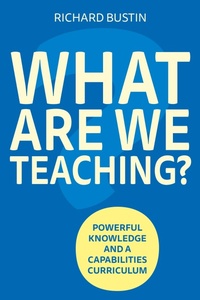
What are we Teaching? Powerful knowledge and a capabilities curriculum
Published on 23. October 2024
224 pages
978-1-78583-734-0 (ISBN)
Description

Discusses the importance of having a subject-based curriculum in schools and explores the responsibility that teachers, through their subject specialisms, have to help ensure this is achieved.
Reviews / Votes
Richard Bustin's book is a much-needed addition to the academic discussion on the meaning and role of subjects in school education. Much has previously been written about the concept of powerful knowledge and its potential to highlight the importance of specialised knowledge in education: scholars in several discipline-based subject groups - for example, in geography and history - have studied it, but most of this work has been done in the context of these individual subjects. In this book, Richard looks at different subjects and gives voice to teachers themselves. In the theoretical part of the book, he makes a clear introduction to the concepts of powerful knowledge and the capability approach to help teachers explore what kind of contribution their subjects can have for their students. Even though the book is mainly targeted at readers in the UK, it also works well for the international audience interested in the role of subject-based education. I highly recommend this book to all teachers, teacher educators and student teachers.Sirpa Tani This is a remarkable book and the timing of it is impeccable. The 2024 Labour Government is strongly committed to social justice and is looking to restore the promise of education. This book should inform that work. It is well informed, showing up some of the snake oil solutions of recent years, and through its conceptual framing provides a way to avoid the familiar swing of the educational pendulum. And Richard Bustin makes no bones about it: we need to trust teachers and support them properly in the 'knowledge work' which I fervently believe underpins great teaching at all levels.It is not a 'practical' handbook, but it is written mainly for teachers and the voices of teachers are loud. The book advocates for the rich and enriching intellectual component of teaching, summed up in the idea of curriculum making. Over half the book explores how over 200 teachers of various subjects (across three schools) respond to the simple yet radical idea that what we teach young people should empower them. Obviously, the book in no sense offers a final word. But it does open up this question and provides productive ways to work with it.David Lambert Richard Bustin has written an excellent book about one of the things which matters most - what teachers should actually teach. He makes a strong case for powerful knowledge, in both theory and practice, and does something which is unfortunately rare: he looks at each school subject, or groups of subjects, and asks what knowledge matters most. A terrific book.Barnaby Lennon What Are We Teaching? offers school leaders and teachers a profound opportunity to reflect on the crucial role of subject specialist teachers and their contributions to a subject-based curriculum. Drawing upon research with educators across various subjects, the book captures the authentic voices of teachers in art, design and technology, drama, English, history, mathematics, modern foreign languages, music, physical education, religious education, and science. Alongside the teachers' insights, explorations of knowledge within these subject areas illuminate the potential for each subject to contribute distinctively to young people's education.Grace HealyMore details
Language
English
Place of publication
Carmarthen
United Kingdom
Target group
College/higher education
Professional and scholarly
File size
1,07 MB
ISBN-13
978-1-78583-734-0 (9781785837340)
Copyright in bibliographic data and cover images is held by Nielsen Book Services Limited or by the publishers or by their respective licensors: all rights reserved.
Schweitzer Classification
Other editions
Additional editions
Book
10/2024
Crown House Publishing
€21.50
Shipment within 3-4 weeks
Person
Dr Richard Bustin teaches Geography and leads the department at Lancing College, where he is responsible for staff development and teacher training. Richard's research on curriculum has resulted in multiple publications, invitations to speak at education conferences and work with trainee teachers around the world.
