

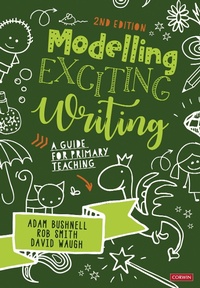
Modelling Exciting Writing
A guide for primary teaching
2nd Edition
Published on 27. August 2022
208 pages
978-1-5297-8554-8 (ISBN)
Description

The Primary National Curriculum sets challenging expectations for the teaching of writing. Children must master the process of composition, redrafting, editing and writing final pieces.
The book:
*Provides practical advice for the teaching of writing
*Demonstrates how to model writing for children
*Includes examples of good classroom practice of modelling writing
*Focuses on writing in different aspects of the curriculum
*Provides guidance, case studies and theoretical perspectives to show readers how they can become writers with and for children
The updated second edition includes:
*Ideas for discussion in a seminar/staff meeting/CPD event
*A new chapter enabling teachers to support children to bring their own cultures and ethnicities into their writing
The book:
*Provides practical advice for the teaching of writing
*Demonstrates how to model writing for children
*Includes examples of good classroom practice of modelling writing
*Focuses on writing in different aspects of the curriculum
*Provides guidance, case studies and theoretical perspectives to show readers how they can become writers with and for children
The updated second edition includes:
*Ideas for discussion in a seminar/staff meeting/CPD event
*A new chapter enabling teachers to support children to bring their own cultures and ethnicities into their writing
More details
Edition
Second Edition
Language
English
Place of publication
United Kingdom
Publishing group
Sage Publications Ltd
Target group
Professional and scholarly
Product notice
Reflowable
ISBN-13
978-1-5297-8554-8 (9781529785548)
Copyright in bibliographic data and cover images is held by Nielsen Book Services Limited or by the publishers or by their respective licensors: all rights reserved.
Schweitzer Classification
Other editions
Additional editions
Book
09/2022
2nd Edition
SAGE Publications Ltd
€51.70
Shipment within 15-20 days
Book
09/2022
2nd Edition
SAGE Publications Ltd
€103.20
Shipment within 15-20 days
Persons
Adam Bushnell is a full-time author who delivers creative writing workshops in the UK and internationally in both state and private education to all ages.
His books have been selected by the School Library Association for the Boys into Books recom-mended reading list. Previously a teacher, Adam now also delivers CPD to teachers and others working in education on how to inspire writing in the classroom.
Rob Smith is the creator and curator of the award-winning website: The Literacy Shed. After a 12-year career as a primary teacher, Rob now delivers writing workshops to students and professional development for teachers across the UK and around the world.
David Waugh is a former deputy headteacher who worked in ITT from 1990 at the University of Hull, where he led the PGCE course and became Head of Department. In 2008 he was appointed as one of two (the other being Wendy) National Strategies Regional Advisers for ITT. He is currently lectures at Durham University. He has published extensively in primary English, as well as developing e-learning resources for National Strategies for English, mathematics and mentoring and coaching. David also writes children's stories, including The Wishroom, which was written with 45 children from 15 East Durham primary schools and published in 2017.
His books have been selected by the School Library Association for the Boys into Books recom-mended reading list. Previously a teacher, Adam now also delivers CPD to teachers and others working in education on how to inspire writing in the classroom.
Rob Smith is the creator and curator of the award-winning website: The Literacy Shed. After a 12-year career as a primary teacher, Rob now delivers writing workshops to students and professional development for teachers across the UK and around the world.
David Waugh is a former deputy headteacher who worked in ITT from 1990 at the University of Hull, where he led the PGCE course and became Head of Department. In 2008 he was appointed as one of two (the other being Wendy) National Strategies Regional Advisers for ITT. He is currently lectures at Durham University. He has published extensively in primary English, as well as developing e-learning resources for National Strategies for English, mathematics and mentoring and coaching. David also writes children's stories, including The Wishroom, which was written with 45 children from 15 East Durham primary schools and published in 2017.
Content
1. Writing, spelling, punctuation and grammar
2. Reading for writing
3. Scaffoldng writing
4. Writing for children
5. Writing with children
6. Writing narrative, character and setting
7. Writing poetry
8. Writing fanfiction
9. Film as a model text
10. Writing fiction and non-fiction by retelling
11. Using technology to engage reluctant readers and aid writing
12. Cultural identity in children's writing
2. Reading for writing
3. Scaffoldng writing
4. Writing for children
5. Writing with children
6. Writing narrative, character and setting
7. Writing poetry
8. Writing fanfiction
9. Film as a model text
10. Writing fiction and non-fiction by retelling
11. Using technology to engage reluctant readers and aid writing
12. Cultural identity in children's writing
