
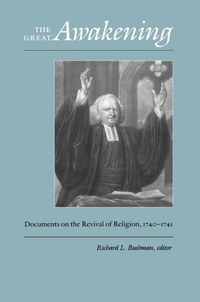
The Great Awakening
Description
Alles über E-Books | Antworten auf Fragen rund um E-Books, Kopierschutz und Dateiformate finden Sie in unserem Info- & Hilfebereich.
Most twentieth-century Americans fail to appreciate the power of Christian conversion that characterized the eighteenth-century revivals, especially the Great Awakening of the 1740s. The common disdain in this secular age for impassioned religious emotion and language is merely symptomatic of the shift in values that has shunted revivals to the sidelines. The very magnitude of the previous revivals is one indication of their importance. Between 1740 and 1745 literally thousands were converted. From New England to the southern colonies, people of all ages and all ranks of society underwent the New Birth. Virtually every New England congregation was touched. It is safe to say that most of the colonists in the 1740s, if not converted themselves, knew someone who was, or at least heard revival preaching. The Awakening was a critical event in the intellectual and ecclesiastical life of the colonies. The colonists' view of the world placed much importance on conversion. Particularly, Calvinist theology viewed the bestowal of divine grace as the most crucial occurrence in human life. Besides assuring admission to God’s presence in the hereafter, divine grace prepared a person for a fullness of life on earth. In the 1740s the colonists, in overwhelming numbers, laid claim to the divine power which their theology offered them. Many experienced the moral transformatoin as promised. In the Awakening the clergy’s pleas of half a century came to dramatic fulfillment. Not everyone agreed that God was working in the Awakening. Many believed preachers to be demagogues, stirring up animal spirits. The revival was looked on as an emotional orgy that needlessly disturbed the churches and frustrated the true work of God. But from 1740 to 1745 no other subject received more attention in books and pamphlets. Through the stirring rhetoric of the sermons, theological treatises, and correspondence presented in this collection, readers can vicariously participate in the ecstasy as well as in the rage generated by America’s first national revival.
All prices
More details
Other editions
Additional editions
Person
Richard L. Bushman is Gouverneur Morris Professor of History Emeritus at Columbia University and author of the award-winning From Puritan to Yankee: Character and the Social Order in Connecticut, 1690-1765 and King and People in Provincial Massachusetts.

System requirements
File format: ePUB
Copy protection: Adobe-DRM (Digital Rights Management)
System requirements:
- Computer (Windows; MacOS X; Linux): Install the free reader Adobe Digital Editions prior to download (see eBook Help).
- Tablet/smartphone (Android; iOS): Install the free app Adobe Digital Editions or the app PocketBook before downloading (see eBook Help).
- E-reader: Bookeen, Kobo, Pocketbook, Sony, Tolino and many more (not Kindle).
The file format ePub works well for novels and non-fiction books – i.e., „flowing” text without complex layout. On an e-reader or smartphone, line and page breaks automatically adjust to fit the small displays.
This eBook uses Adobe-DRM, a „hard” copy protection. If the necessary requirements are not met, unfortunately you will not be able to open the eBook. You will therefore need to prepare your reading hardware before downloading.
Please note: We strongly recommend that you authorise using your personal Adobe ID after installation of any reading software.
For more information, see our ebook Help page.
File format: PDF
Copy-Protection: Adobe-DRM (Digital Rights Management)
System requirements:
- Computer (Windows; MacOS X; Linux): Install the free reader Adobe Digital Editions prior to download (see eBook Help).
- Tablet/smartphone (Android; iOS): Install the free app Adobe Digital Editions or the app PocketBook before downloading (see eBook Help).
- E-reader: Bookeen, Kobo, Pocketbook, Sony, Tolino and many more (only limited: Kindle).
The file format PDF always displays a book page identically on any hardware. This makes PDF suitable for complex layouts such as those used in textbooks and reference books (images, tables, columns, footnotes). Unfortunately, on the small screens of e-readers or smartphones, PDFs are rather annoying, requiring too much scrolling.
This eBook uses Adobe-DRM, a „hard” copy protection. If the necessary requirements are not met, unfortunately you will not be able to open the eBook. You will therefore need to prepare your reading hardware before downloading.
Please note: We strongly recommend that you authorise using your personal Adobe ID after installation of any reading software.
For more information, see our eBook Help page.
File format: ePUB
Copy protection: Watermark-DRM (Digital Rights Management)
System requirements:
- Computer (Windows; MacOS X; Linux): Use a reading software that can process the file format ePUB: e.g., Adobe Digital Editions or FBReader – both free (see eBook Help).
- Tablet/Smartphone (Android; iOS): Before downloading, install the free app Adobe Digital Editions (see eBook Help).
- E-reader: Bookeen, Kobo, Pocketbook, Sony, Tolino and many more (not Kindle).
The file format ePUB works well for novels and non-fiction books – i.e., „flowing” text without complex layout. On an e-reader or smartphone, line and page breaks automatically adjust to fit the small displays.
This eBook uses Watermark-DRM, a „soft” copy protection. This means that there are no technical restrictions to prevent illegal distribution. However, there is a personalised watermark embedded in the eBook that can be used to identify the purchaser of the eBook in the event of misuse and to provide evidence for legal purposes.
For more information, see our eBook Help page.
