

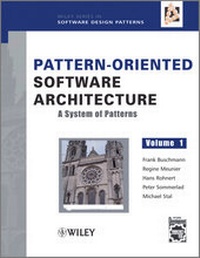
Pattern-Oriented Software Architecture, Volume 1, A System of Patterns
Description

More details
Other editions
Additional editions
Persons
Frank Buschmann is a Senior Principal Engineer for systems and software architecture at Siemens Corporate Technology in Munich. He focuses on digitalization strategies and technologies, the design and realization of industrial automation systems and research in software design and engineering technologies. He has served as serves as an editor of the Wiley Series in Software Design Patterns.
Regine Meunier is author of Pattern-Oriented Software Architecture, Volume 1, A System of Patterns, published by Wiley.
Hans Rohnert is author of Pattern-Oriented Software Architecture, Volume 1, A System of Patterns, published by Wiley.
Peter Sommerlad is author of Pattern-Oriented Software Architecture, Volume 1, A System of Patterns, published by Wiley.
Michael Stal is author of Pattern-Oriented Software Architecture, Volume 1, A System of Patterns, published by Wiley.
Content
Architectural Patterns.
Design Patterns.
Idioms.
Pattern Systems.
Patterns and Software Architecture.
The Pattern Community.
Where Will Patterns Go?
Notations.
Glossary.
References.
Index of Patterns.
About this Book
This is a book about patterns for software architecture, or simply, patterns. Patterns have been drawing considerable attention over recent years: workshops, tutorials, forums for electronic discussion, papers in journals and whole books are being devoted to patterns. The pattern community has even started its own conference. All this enthusiastic discussion of patterns makes them seem as if they are the climax of the 'object wave'.
What is so exciting about patterns? It is probably the fact that they constitute a 'grass roots' effort to build on the collective experience of skilled designers and software engineers. Such experts already have solutions to many recurring design problems. Patterns capture these proven solutions in an easily-available and, hopefully, well-written form.
We want this book to support both novices and experts in software development. It should help novices to act as if they were-or almost as if they were-experts on modest-sized projects, without having to gain many years of experience. It should support experts in the design of large-scale and complex software systems with defined properties. It should also enable them to learn from the experience of other experts. The book should help both groups to find well-proven solutions, as well as alternatives, to specific design problems.
The book is intended to be both an instructive text and a reference guide. It helps software developers to think about software architecture in a new way, and presents a number of techniques for solving particular recurring design problems. Using this book as a guide in a software engineering course can provide students with an entirely new perspective on the design of large-scale software systems. It can serve as a reference manual, because it presents our techniques comprehensively and ready for use. We include many guidelines and constraints for the practical application of the patterns we include.
The idea of recording design wisdom in a canonical form can be traced to Christopher Alexander1. He pioneered patterns in the context of the architecture of buildings. His book The Timeless Way of Building shows how patterns can be applied to house construction, as well as to the planning of neighborhoods and whole cities. The underlying theme of his work is the design of living places that are not only functional and fashionable, but also comforting and consoling. Well-designed buildings demonstrate inherent qualities that can be clearly perceived, but are hard to describe or quantify. In short, such buildings possess 'a quality without a name'.
Early experiments in adapting this approach to software engineering leaned heavily on Alexander's style. More recently the software community has been experimenting to find a stylistic form better-suited to software design. Several different description forms for patterns have been tried, but there is no consensus yet.
Although we put considerable effort into finding a good way to describe patterns, developing theories on 'pattern styles' is not the main goal of this book. It was certainly not our initial motivation for starting work on patterns. In 1991 we recorded our first patterns in a straightforward way. While our style of pattern documentation improved slowly, it soon became clear that individual patterns do not stand alone. Instead, patterns reveal a rich set of interrelationships. This was one of the driving forces for producing a book, rather than documenting patterns one at a time and publishing them as a series of papers. The disadvantage of the book approach is the long gestation period before it becomes available. Although this has been well-known for decades, it still astonishes us just how long it takes to come up with good pattern descriptions.
Four other authors experienced the same phenomenon. In the fall of 1994, Erich Gamma, Richard Helm, Ralph Johnson and John Vlissides published the seminal book Design Patterns - Elements of Reusable Object-Oriented Software. Although the idea of design patterns was no longer novel, the 'GoF' book (named after the 'Gang-of-Four' in Chinese politics) presented the first catalog of well-described design patterns for object-oriented programs.
Our approach is slightly different to the Gang-of-Four, though there are many similarities and some overlaps. The GoF book concentrates on design-level patterns, whereas our patterns span several levels of abstraction. These range from high-level architectural patterns through design patterns to low-level idioms. We also focus on issues other than object-orientation, and try to incorporate the latest insights into pattern description techniques. Our overall goal is to use patterns to help in the wider context of software architecture. We call this approach pattern-oriented software architecture. We talk about pattern systems, in which patterns are not just collected into a heterogeneous container, but are also grouped according to appropriate criteria. The GoF book started this categorization effort by dividing patterns into 'creational', 'structural' and 'behavioral' groupings. We try to take the next step by grouping patterns according to finer-grained criteria such as interactive and adaptable systems, organization of work, communication and access control.
We want to encourage users of our pattern system to share it with their colleagues. Pattern-sharing establishes a common vocabulary for design problems. It allows the members of the growing pattern community to identify, name and discuss both problems and solutions more effectively. Getting 'up to speed' in systems design is one of the more important reasons to work with patterns.
Our pattern system is not intended to be complete. There are already so many patterns that it is impossible to record all of them in a single book. With evolving technology new patterns may evolve. We hope you will extend, modify and tailor our pattern system to your specific needs. Missing patterns should be added, those not needed may be ignored and others may be changed.
If you have any comments, criticisms or suggestions for improvement of the style and content of this book, please feel free to make them. We also welcome reports of experiences with the patterns we describe. You can write to us care of John Wiley & Sons Ltd., or send electronic mail to patterns@mchp.siemens.de.
Preliminary versions of most of the patterns we include were discussed on the Internet. Our motivation was not to get free advertising or to give away patterns. Instead, we wanted to help a new trend in publishing, that of showing material early on to involve the community before printing, with benefit to all parties. We enjoyed this experience and thank all participants. This does not mean that public electronic discussion of our book is closed, however. The mailing list still exists and readers are welcome to participate. Guidelines for subscription can be found on the patterns home page. Its URL is:
http://www.hillside.net/patterns/
This URL is also the most important information source for all aspects of patterns, such as available and forthcoming books, conferences on patterns, papers on patterns and so on.
The Structure of the Book
The first chapter systematically introduces the notion of a pattern and discusses the principles of pattern description. Chapters 2 through 4 present our catalog of patterns.
Architectural patterns are the highest-level patterns. They are intended to provide the skeleton of an overall system architecture. Chapter 2 features eight architectural patterns from different application areas.
Chapter 3 presents a collection of eight design patterns that address the sort of problems typically encountered after the overall structure of a software system has been specified. Our design patterns deal, for example, with structuring components to handle complexity, distributing workload between components and organizing inter-component communication.
Chapter 4 is the third and last part of the catalog. It deals with idioms, the language-dependent patterns. We refer however mainly to other people's work instead of documenting our own idioms, and only present one idiom as a concrete example. The reason for not describing our own set of idioms is simple-a lot of idioms for languages such as C++ and Smalltalk are already available. Instead of just rephrasing these patterns, we choose to refer to the original source.
In Chapter 5 we argue that it is important to organize patterns into pattern systems. Such systems should help both writers and users of patterns in several ways: finding the right pattern for the situation at hand, filling gaps in a collection of patterns, understanding the relationships between patterns and evolving pattern systems.
In Chapter 6 we discuss how patterns are embedded in software architecture. In particular we discuss our understanding of software architecture and its underlying principles and we demonstrate how these principles are supported by patterns.
Chapter 7 is about the history of patterns, related work and the pattern community at large. To complete the book, Chapter 8 gives our view of the future of patterns.
The book ends with an appendix on notations, a glossary of frequently used terms, comprehensive references and a pattern...
