

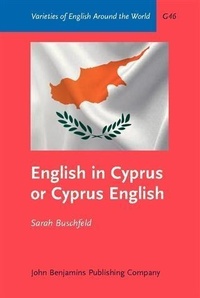
English in Cyprus or Cyprus English
An empirical investigation of variety status
1st Edition
Published on 12. June 2013
XVI, 246 pages
978-90-272-7217-1 (ISBN)
Description

This volume provides the first-ever comprehensive analysis of a potential variety of English, spoken in the Greek part of the Mediterranean island of Cyprus. Despite the fact that Cyprus was a British colony from 1878 to 1960, the status of the English language spoken there has not yet been discussed systematically within the framework of World Englishes. To determine whether English in Cyprus has second-language variety status or should rather be considered as learner English, the monograph investigates its historical, sociopolitical and sociolinguistic background and, drawing on a corpus of spoken data, offers a synchronic analysis of linguistic features. The results suggest to rethink some of the well-established taxonomies of World Englishes research, especially those that strictly differentiate between second-language varieties and learner Englishes. This renders the book relevant not only to scholars working in the field of World Englishes but also to second language acquisition researchers.
More details
Other editions
Additional editions
Book
06/2013
John Benjamins Publishing Co
€104.94
Shipment within 10-15 days
Person
Content
- English in Cyprus or Cyprus English
- Editorial page
- Title page
- LCC data
- Table of contents
- List of tables
- List of figures and charts
- List of maps and pictures
- Acknowledgments
- Chapter 1. Introduction
- 1.1 Motivation for the research project
- 1.2 Scientific aims of the study
- 1.3 Theoretical framework
- 1.4 Methodological framework
- 1.5 Outline
- Chapter 2. English in Cyprus
- 2.1 Introduction
- 2.2 Historical background
- 2.2.1 From the first settlements to the British occupation
- 2.2.2 British rule in Cyprus
- 2.2.3 Post-independence, Turkish invasion, and after
- 2.3 Identity constructions
- 2.3.1 Resistance against foreign domination and British rule
- 2.3.2 The Turkish invasion as "Event X"?
- 2.4 Sociolinguistic conditions
- 2.4.1 Language use
- 2.4.2 Language attitudes
- 2.5 Summary and preliminary conclusions
- Chapter 3. World Englishes research and the case of Cyprus
- 3.1 Introduction
- 3.2 30 years of World Englishes research
- 3.2.1 The ENL-ESL-EFL distinction
- 3.2.2 Kachru's (1985b) Three Concentric Circles of World Englishes
- 3.2.3 Schneider's (2007) Dynamic Model
- 3.2.4 Terminology
- 3.3 Research into English in Cyprus/Cyprus English
- 3.4 Learner Englishes vs. second-language varieties?
- 3.4.1 Learner English and interlanguage
- 3.4.2 Second-language varieties
- 3.4.3 "Bridging the paradigm gap"
- 3.4.4 Drawing some theoretical conclusions
- 3.5 Transfer and feature nativization: A crosslinguistic comparison of English and the Greek-Cypriot dialect
- 3.5.1 The nominal domain
- 3.5.2 The verbal domain
- 3.5.3 Prepositions
- 3.5.4 Hypotheses
- 3.6 Summary
- Chapter 4. Empirical study
- 4.1 Introduction
- 4.2 CEDAR (Cyprus English Data Analysis and Research)
- 4.2.1 The interviews: Data collection
- 4.2.2 Participants
- 4.3 Data transcription
- 4.4 Summary
- Chapter 5. Identifying characteristics of EiCy/CyE
- 5.1 Introduction
- 5.2 Methodology
- 5.3 Results
- 5.3.1 Phonological features
- 5.3.2 Morphosyntactic features
- 5.3.3 Lexical features
- 5.3.4 Lexicogrammatical features
- 5.3.5 Lexicosemantic feature
- 5.3.6 Pragmatic features
- 5.4 Summary
- Chapter 6. Linguistic characteristics of EiCy/CyE
- 6.1 Introduction
- 6.2 Methodology
- 6.2.1 Feature selection
- 6.2.2 Data coding
- 6.2.3 Frequency counts and data analysis
- 6.3 Results
- 6.3.1 The morphosyntactic domain
- 6.3.2 The lexicogrammatical domain
- 6.3.3 The lexicosemantic domain
- 6.3.4 Summary and discussion
- 6.3.5 Statistical test for intergenerational differences
- 6.4 Summary
- Chapter 7. Assessing the variety status of EiCy/CyE
- 7.1 Introduction
- 7.2 EiCy/CyE: Second-language variety or learner English?
- 7.2.1 Spread of bilingualism and expansion in function
- 7.2.2 Nativization of linguistic structures
- 7.2.3 Institutionalization
- 7.2.4 Ways of language acquisition
- 7.2.5 EiCy/CyE - a hybrid case
- 7.3 Placing EiCy/CyE on the map of World Englishes research
- 7.3.1 EiCy/CyE, the ENL-ESL-EFL distinction, and Kachru's (1985b) Three Concentric Circles
- 7.3.2 EiCy/CyE in Schneider's (2007) Dynamic Model
- 7.4 Summary
- Chapter 8. Conclusions
- References
- Appendices
- I. Questionnaire language attitudes and use
- II. Interview guidelines
- II.1 Question set "adults"
- II.2 Question set "high school students"
- III. Supplementary questionnaire
- IV. Participants
- V. Excerpt sample transcript
- Index
