

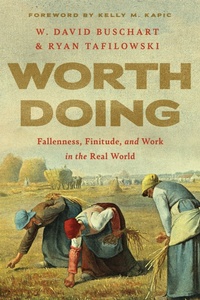
Worth Doing
Description

Reimagine Your Theology of Faith and Work
Conversations about faith and work often miss an important truth: limitations are not a problem; they're a key part of what it means to be human. Work has always been part of humanity's purpose, but we're no longer in the perfect Garden of Eden, nor are we in the future new heavens and new earth. To truly address the challenges of work, we need a new theological perspective.
In Worth Doing, David Buschart and Ryan Tafilowski embrace the realities of limitations, challenging the myths of "You are what you do" and "Do what you love." Instead, they propose a theology of work that affirms the goodness of human limits while addressing the realities of fallenness, offering hope for those who may not find deep fulfillment in their daily jobs.
Buschart and Tafilowski outline a new vision of work that resonates with all workers, recognizing that every job has value, even when it doesn't align with idealized notions of purpose or calling. By embracing this perspective, people can find new ways to approach daily labor, even when it doesn't feel deeply fulfilling.
In Worth Doing, readers will:
- Gain a theology of work that moves beyond only ideas of productivity or calling.
- Learn how to embrace human limitations as part of God's good design.
- Reflect on the ways work connects to broader questions of purpose and human flourishing.
Worth Doing invites readers to consider their limitations as valuable aspects of their vocational journey, offering a thoughtful framework for addressing the complexities of work. This book is particularly relevant for theologians examining the intersections of work, faith, and rest; Christian educators; and leaders in the faith and work space. By moving beyond conventional theological approaches to faith and work, Worth Doing presents a hopeful and theologically rich perspective on vocation that acknowledges and embraces human limitations.
More details
Other editions
Additional editions
Persons
W. David Buschart (PhD, Drew University) is professor of theology and historical studies at Denver Seminary. He is the author of Exploring Protestant Traditions and coauthor of Theology as Retrieval. He is a ruling elder and member of the theology committee of the Evangelical Presbyterian Church.
Ryan Tafilowski (PhD, Edinburgh) is assistant professor of theology at Denver Seminary and lead pastor of Foothills Fellowship Church in Littleton, Colorado. He is the coauthor, with Ross Chapman, of Faithful Work: In the Daily Grind with Godand for Others. He previously served as theologian-in-residence for the Denver Institute for Faith and Work.
Kelly M. Kapic holds the Honorary Chair of Theology and Culture at Covenant College in Lookout Mountain, Georgia. Kapic has also worked on research teams funded by the John Templeton Foundation. He is an author or editor of more than fifteen books, including the award-winning titles You're Only Human and Embodied Hope, and is an active speaker.
Content
Foreword by Kelly M. Kapic 1. Introduction 2. Good: A Theology of Finitude 3. Enough: Work (with)in God's Creation 4. The View from the Middle: Life East of Eden 5. Toil and Trouble: Work in the Middle 6. The Goodnessof Finite and Fallen Work 7. Worth Doing: The End of the Matter Acknowledgments Appendix: The Rise of Faith and Work General Index Scripture Index
