

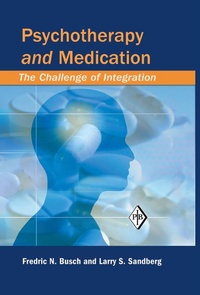
Psychotherapy and Medication
The Challenge of Integration
Published on 6. May 2016
190 pages
978-1-136-64834-2 (ISBN)
Description

Over the past two decades, the use of medication combined with psychotherapy or psychoanalysis has shifted from an infrequent occurrence to common practice. Concurrently, attitudes toward medication have changed from viewing this intervention as disruptive or as a last resort to a welcome aid in the psychotherapeutic or psychoanalytic process. However, this relatively rapid change has created difficulty in the integration of medication use into the psychotherapeutic setting. Psychotherapy and Medication is an exceptionally valuable and timely volume that provides psychoanalysts, psychotherapists, and other mental health professionals with information on how to work with medication theoretically, clinically, and technically in the context of a psychotherapeutic or psychoanalytic treatment.
Important areas of discussion include evidence that a change in the use of medication has taken place, an examination of the factors that have led to this shift, as well as a review of the issues and questions about combining treatments. Psychotherapy and Medication also serves as a framework in how to best answer the many questions that have arisen as the willingness of analysts to use medication increases. Such significant questions include: How should analysts introduce patients to medication? What are the clinical advantages of combined treatment? What is the impact of medication discussions and prescribing on the analyst's role and how is this best handled?
Important areas of discussion include evidence that a change in the use of medication has taken place, an examination of the factors that have led to this shift, as well as a review of the issues and questions about combining treatments. Psychotherapy and Medication also serves as a framework in how to best answer the many questions that have arisen as the willingness of analysts to use medication increases. Such significant questions include: How should analysts introduce patients to medication? What are the clinical advantages of combined treatment? What is the impact of medication discussions and prescribing on the analyst's role and how is this best handled?
Reviews / Votes
"As medication has become more useful and acceptable as an ancillary treatment for psychotherapy and psychoanalytic patients alike, Busch and Sandberg offer a comprehensive guide to all of the complexities of this combined mode of treatment, including transference/countertransference problems for prescribing within the treatment or referring for psychopharmacological evaluation. With an excellent chapter for the nonmedical therapist/analyst that involves a split model, and useful case examples and vignettes that enrich the volume, this is the finest guide available on the use of medication in psychotherapy."- Joseph Reppen, PhD, ABPP, Editor, Psychoanalytic Psychology "This book is an excellent description of the use of combined treatment, answering many questions about the rationale; the complexity of meanings that develop for the patient and therapist (and the psychopharmacologist in a split treatment); the special problems encountered in the transference and countertransference; and ensuing enactments as well as the more complex cases which challenge the limits of the medication and/or psychotherapy."
- Alan Z. Skolnikoff, M.D., International Journal of Psychoanalysis
"As medication has become more useful and acceptable as an ancillary treatment for psychotherapy and psychoanalytic patients alike, Busch and Sandberg offer a comprehensive guide to all of the complexities of this combined mode of treatment, including transference/countertransference problems for prescribing within the treatment or referring for psychopharmacological evaluation. With an excellent chapter for the nonmedical therapist/analyst that involves a split model, and useful case examples and vignettes that enrich the volume, this is the finest guide available on the use of medication in psychotherapy."
- Joseph Reppen, Ph.D., ABPP, Editor, Psychoanalytic Psychology
"Psychotropic medication and dynamic therapies are frequently combined, but the integration of these two approaches into an optimal treatment has been fraught with conflict and remains elusive. Drs. Busch and Sandberg elegantly present in-depth clinical material that illustrates all the complexities of this issue and then provide a compelling and cogent approach to the effective administration of combined treatment. This book documents the knowledge, decision making and clinical practices of two very theoretically sophisticated and experienced clinicians at work."
- Steven Roose, M.D., Center for Psychoanalytic Training and Research, Columbia University
"[This book] is very relevant for dynamically oriented psychologists and mental health professionals. The insights provided in this book make good reading because the authors have constructively addressed the challenges of integrating drug therapy and psychodynamic interventions. More cognitively oriented therapists may not be as concerned with this topic, though I believe they should be. Overall I found this book to be interesting, concise, and helpful to therapists of all orientations. In addition, students in training for mental health professions should also find this book to be of significant interest."
- Norman Abeles, PsyCRITIQUES
"This highly readable and thought provoking book sets out to provide information on how to work with medication theoretically, clinically, and technically in the context of psychodynamic or analytic treatment. [It] is essential reading for all mental health clinicians working with patients in therapy - psychiatrists, psychologists, clinical social workers, and psychoanalysts."
- Sara Rosen, M.D., & Donald Ross, M.D., Journal of Nervous and Mental Disease
"I can highly recommend this book to psychiatrists, psychotherapists, and psychoanalysts who are struggling with the increasing dominance of psychiatric drugs and the medicalization of psychological suffering. With this book, Busch and Sandberg have started an important debate, which raises questions and requires an open mind and a willingness to listen. What more could a psychoanalyst desire?"
- Wouter Keirse, Tijdschrift voor Psychoanalyse, 2009
More details
Series
Language
English
Place of publication
London
United Kingdom
Publishing group
Taylor & Francis Ltd
Target group
Professional and scholarly
File size
5,06 MB
ISBN-13
978-1-136-64834-2 (9781136648342)
Copyright in bibliographic data and cover images is held by Nielsen Book Services Limited or by the publishers or by their respective licensors: all rights reserved.
Schweitzer Classification
Other editions
Additional editions
Book
09/2014
1st Edition
Routledge
€76.50
Shipment within 10-20 days
Book
06/2007
1st Edition
Analytic Press,U.S.
€225.20
Shipment within 3-4 weeks
Persons
Fredric N. Busch, M.D., is a Clinical Associate Professor at Weill Cornell Medical College and a faculty member of the Columbia University Center for Psychoanalytic Training and Research. He is on the editorial board of Psychoanalytic Inquiry. Dr. Busch has authored over 30 publications as well as 10 books or book chapters.
Larry S. Sandberg, M.D., is a Clinical Associate Professor of Psychiatry at Weill Cornell Medical Center and Lecturer in Psychiatry at Columbia University Center for Psychoanalytic Training and Research. He maintains a private practice in psychoanalysis and adult psychiatry.
Larry S. Sandberg, M.D., is a Clinical Associate Professor of Psychiatry at Weill Cornell Medical Center and Lecturer in Psychiatry at Columbia University Center for Psychoanalytic Training and Research. He maintains a private practice in psychoanalysis and adult psychiatry.
Content
Introduction. Theoretical Bases of Combined Treatment. Getting Started with Medication. The Meaning of Medication. Clinical Values of Combined Treatment. Approaches to Treatment: The Prescribing Therapist. Split Treatment. Combined Treatment for Depressive and Anxiety Disorders. Complex Cases.
