

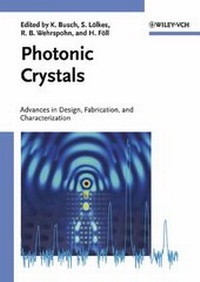
Photonic Crystals
Advances in Design, Fabrication, and Characterization
1st Edition
Published on 12. May 2006
XXVI, 354 pages
978-3-527-60717-4 (ISBN)
Description

The majority of the contributions in this topically edited book stems from the priority program SPP 1113 "Photonische Kristalle" run by the Deutsche Forschungsgemeinschaft (DFG), resulting in a survey of the current state of photonic crystal research in Germany. The first part of the book describes methods for the theoretical analysis of their optical properties as well as the results. The main part is dedicated to the fabrication, characterization and modeling of two- and three-dimensional photonic crystals, while the final section presents a wide spectrum of applications: gas sensors, micro-lasers, and photonic crystal fibers.
Illustrated in full color, this book is not only of interest to advanced students and researchers in physics, electrical engineering, and material science, but also to company R&D departments involved in photonic crystal-related technological developments.
Illustrated in full color, this book is not only of interest to advanced students and researchers in physics, electrical engineering, and material science, but also to company R&D departments involved in photonic crystal-related technological developments.
Reviews / Votes
"Photonic Crystals, edited by Kurt Busch, Stefan Lölkes, Ralf B. Wehrspohn and Helmut Föll, collects together excellent contributions from a number of experts - mainly from Germany - in the field of photonic bandgap structures. The book, with a foreword by S. John, reviews the state-of-the-art in the field with great emphasis on the achievements of the German scientific community."Cefe López, Instituto de Ciencia de Materiales de Madrid (CSIC), Madrid, Advanced Materials, Vol. 16, No. 22, November 18, 2004
More details
Other editions
Additional editions
Kurt Busch | Stefan Lölkes | Ralf B. Wehrspohn
Photonic Crystals
Advances in Design, Fabrication, and Characterization
Book
02/2004
1st Edition
Wiley-VCH
€155.00
Article exhausted; check different version
Persons
Editors:
-Dr. Ralf B. Wehrspohn is group leader at the Max-Planck-Institute for Microstructure Physics in Halle, Germany.
-Dr. Kurt Busch is assistant professor at the Institute for Theory of Condensed Matter (University of Karlsruhe, Germany).
-Stefan Lölkes is finishing his PhD in Materials Science at the University of Kiel, Germany.
-Prof. Dr. H. Föll, Lehrstuhl für Allgemeine Materialwissenschaft der Technischen Fakultät, University of Kiel, Germany.
Authors:
Dr. Kurt Busch, Universität Karlsruhe
Dr. Carsten Henkel, Universität Potsdam
Dr. Torsten Meier, Philipps-Universität Marburg
Prof. Dr. Ralf Wehrspohn, Universität Paderborn
Prof. Dr. Harald Giessen, Rheinische Friedrich-Wilhelms-Universität Bonn
Prof. Dr. Rudolf Zentel, Universität Mainz
Dr. Sergei G. Romanov, University of Glasgow
Prof. Dr. Martin Wegener, Universität Karlsruhe
Prof. Dr. Heinz-Siegfried Kitzerow, Universität Paderborn
Prof. Dr. Ulrike Woggon, Universität Dortmund
Dr. Wiltraud Wischmann, Alcatel Deutschland GmbH
Martin Kamp, Universität Würzburg
Prof. Dr. Wolfgang Freude, Universität Karlsruhe
Prof. Dr. Vahid Sandoghdar, ETH Zürich
Dr. Armin Lambrecht, Fraunhofer IPM
Prof. Dr. Uli Lemmer, Universität Karlsruhe
Prof. Dr. Hartmut Bartelt, Institut für Physikalische Hochtechnologie
Dr. Reinhard März, Infineon Technologies
-Dr. Ralf B. Wehrspohn is group leader at the Max-Planck-Institute for Microstructure Physics in Halle, Germany.
-Dr. Kurt Busch is assistant professor at the Institute for Theory of Condensed Matter (University of Karlsruhe, Germany).
-Stefan Lölkes is finishing his PhD in Materials Science at the University of Kiel, Germany.
-Prof. Dr. H. Föll, Lehrstuhl für Allgemeine Materialwissenschaft der Technischen Fakultät, University of Kiel, Germany.
Authors:
Dr. Kurt Busch, Universität Karlsruhe
Dr. Carsten Henkel, Universität Potsdam
Dr. Torsten Meier, Philipps-Universität Marburg
Prof. Dr. Ralf Wehrspohn, Universität Paderborn
Prof. Dr. Harald Giessen, Rheinische Friedrich-Wilhelms-Universität Bonn
Prof. Dr. Rudolf Zentel, Universität Mainz
Dr. Sergei G. Romanov, University of Glasgow
Prof. Dr. Martin Wegener, Universität Karlsruhe
Prof. Dr. Heinz-Siegfried Kitzerow, Universität Paderborn
Prof. Dr. Ulrike Woggon, Universität Dortmund
Dr. Wiltraud Wischmann, Alcatel Deutschland GmbH
Martin Kamp, Universität Würzburg
Prof. Dr. Wolfgang Freude, Universität Karlsruhe
Prof. Dr. Vahid Sandoghdar, ETH Zürich
Dr. Armin Lambrecht, Fraunhofer IPM
Prof. Dr. Uli Lemmer, Universität Karlsruhe
Prof. Dr. Hartmut Bartelt, Institut für Physikalische Hochtechnologie
Dr. Reinhard März, Infineon Technologies
Content
THEORY
On the solid-state theoretical description of photonic crystals
Spontaneous emission in photonic structures: theory and simulation
Semiconductor optics in photonic crystal structures
FABRICATION AND CHARACTERIZATION
Electrochemically-prepared 2D and 3D photonic crystals
Optical properties of planar metallo-dielectric photonic crystals
Preparation of 3D photonic crystals from opals
Light emitting opal-based photonic crystal heterojunctions
Three-dimensional lithography of photonic crystals
Tunable photonic crystals using liquid crystals
Microwave modelling of photonic crystals
Near-field visualization of light in photonic devices
APPLICATIONS
Application of photonic crystals for gas detection and sensing
Polymeric photonic crystal laser
Photonic crystal fibers
Photonic crystal optical circuits in moderate index materials
Planar high index-contrast photonic crystals for Telecom applications
Photonic crystals based active optoelectronic devices
On the solid-state theoretical description of photonic crystals
Spontaneous emission in photonic structures: theory and simulation
Semiconductor optics in photonic crystal structures
FABRICATION AND CHARACTERIZATION
Electrochemically-prepared 2D and 3D photonic crystals
Optical properties of planar metallo-dielectric photonic crystals
Preparation of 3D photonic crystals from opals
Light emitting opal-based photonic crystal heterojunctions
Three-dimensional lithography of photonic crystals
Tunable photonic crystals using liquid crystals
Microwave modelling of photonic crystals
Near-field visualization of light in photonic devices
APPLICATIONS
Application of photonic crystals for gas detection and sensing
Polymeric photonic crystal laser
Photonic crystal fibers
Photonic crystal optical circuits in moderate index materials
Planar high index-contrast photonic crystals for Telecom applications
Photonic crystals based active optoelectronic devices
