

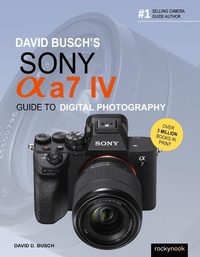
David Busch's Sony Alpha a7 IV Guide to Digital Photography
Description

David Busch''s Sony Alpha a7 IV Guide to Digital Photography is the most comprehensive resource and reference for Sony's long-awaited 33-megapixel full frame mirrorless camera. Capable of 10 frame-per-second bursts even at full resolution, the a7 IV is fast enough for action photography, and its enhanced dynamic range delivers the image quality that the most demanding landscape or fine-art photographer requires. This camera's remarkable low-light performance, fast sensor-based phase detect autofocus (with real-time face and eye tracking in both still and movie modes), and improved 5-axis in-body image stabilization, the a7 IV has all the tools needed to take incredible images. This book will show you how to master those features as you explore the world of digital photography and hone your creativity with your a7 IV.
Filled with detailed how-to steps and full-color illustrations, David Busch''s Sony Alpha a7 IV Guide to Digital Photography covers every feature of this camera in depth, from taking your first photos through advanced details of setup, exposure, lens selection, lighting, and more, and relates each feature to specific photographic techniques and situations. Also included is the handy camera "roadmap" chapter, an easy-to-use visual guide to the camera''s features and controls. Learn when to use every option and, more importantly, when not to use them, by following the author's recommended settings for each menu entry. With best-selling photographer and mentor David Busch as your guide, you''ll quickly have full creative mastery of your camera's capabilities, whether you''re shooting on the job, as an advanced enthusiast exploring full frame photography for the first time, or are just out for fun. Start building your knowledge and confidence, while bringing your vision to light with the Sony a7 IV.
More details
Other editions
Additional editions
Content
- Cover
- Title Page
- Copyright
- Dedication
- Acknowledgments
- About the Author
- Contents
- Preface
- Introduction
- Chapter 1: Meet Your Sony Alpha a7 IV
- Your Out-of-Box Experience
- Initial Setup
- Battery Included
- Final Initial Steps
- Menu Navigation Quick Start
- Formatting a Memory Card
- Selecting a Shooting Mode
- Hidden Scenes
- Other Modes
- Choosing a Metering Mode
- Choosing a Focus Mode
- Selecting a Focus Area
- Other Settings
- Adjusting White Balance and ISO
- Using the Self-Timer
- Quick Start to Movie Making
- Reviewing the Images You've Taken
- Transferring Files to Your Computer
- Wireless File Transfer
- Chapter 2: Your Camera Roadmap
- Using Cross-References
- Front View
- The Sony a7 IV's Business End
- Using the Function Menus
- Introducing the Touch Screen/Pad
- LCD Panel Data Displays
- Going Topside
- Underneath Your Sony a7 IV
- Chapter 3: Nailing the Optimum Exposure
- Getting a Handle on Exposure
- Equivalent Exposure
- How the a7 IV Calculates Exposure
- Correctly Exposed
- Overexposed
- Underexposed
- The Importance of ISO
- Choosing a Metering Method
- Multi Metering
- Center-Weighted Metering
- Spot Metering
- Entire Screen Averaging
- Highlight-Weighted Metering
- Choosing an Exposure Mode
- Aperture Priority (A) Mode
- Shutter Priority (S) Mode
- Program Auto (P) Mode
- Making Exposure Value Changes
- Manual Exposure (M) Mode
- Using ISO Auto
- Exposure Bracketing
- Continuous Bracketing
- Single Bracketing
- White Balance Bracketing
- DRO Bracketing
- Dealing with Digital Noise
- High ISO Noise
- Long Exposure Noise
- Using Dynamic Range Optimizer
- Working with HDR
- Bracketing and Merge to HDR
- Exposure Evaluation with Histograms
- The Live Histogram
- The Playback Histograms
- Tonal Range
- Histogram Basics
- Understanding Histograms
- Fine-Tuning Exposure
- Chapter 4: Mastering Autofocus Options
- Getting into Focus
- Contrast Detection
- Phase Detection
- Comparing the Two Hybrid Components
- Focus Modes and Options
- Focus Pocus
- Adding Circles of Confusion
- Your Focus Mode Options
- Focus or Release Priority?
- Autofocus Magnified
- Choosing the AF Area
- Tracking and Focusing on Subjects, Faces, and Eyes
- Face Detection and Eye AF Overview
- Making Your Face/Eye Detection Settings
- Magic Autofocus-Set and Forget
- Your AF-C to AF-S Switch
- Understanding Aperture Drive in AF
- Using Manual Focus
- Back-Button Focus
- Activating Back-Button Focus
- Chapter 5: Advanced Techniques
- Exploring Ultra-Fast Exposures
- Long Exposures
- Continuous Shooting
- Customizing White Balance
- Shockless White Balance
- Fine-Tuning Preset White Balance
- Setting a Custom White Balance
- Setting White Balance by Color Temperature
- Interval Shooting
- Interval Shooting Checklist
- Settings Recap
- Viewing Your Interval Sequences
- Time-Lapse Movies
- Star Trails
- Chapter 6: My Menu and Shooting Menu
- Menu Navigation
- My Menu Tab
- Shooting Menu Tab
- 1. Image Quality
- JPEG/HEIF Switch
- Image Quality Settings
- Aspect Ratio
- (Movie) File Format
- Movie Settings
- S&Q Settings
- Proxy Recording
- APS-C/S35mm Shooting
- Long Exposure NR/High ISO NR
- HLG Still Image
- Color Space
- Lens Compensation
- 2. Media
- Format
- Recording Media Settings
- Recover Image Database
- Display Media Information
- 3. File
- File/Folder Settings/File
- Select Recording Folder
- Create New Folder
- IPTC Information
- Copyright Info
- Write Serial Number
- 4. Shooting Mode
- Exposure Control Type
- Introduction to Memory Registers
- Recall Camera Settings
- Camera Settings Memory
- Memory/Recall Media
- Register Custom Shooting Set
- 5. USB Streaming
- USB Stream: Res/Frame Rate
- USB Stream: Movie Recording
- 6. Drive Mode (Stills only)
- Drive Mode
- Bracket Settings
- Interval Shooting Functions
- 7. Shutter/Silent
- Silent Mode Settings
- Shutter Type
- e-Front Curtain Shutter
- Release w/o Lens
- Release w/o Card
- Anti-Flicker Settings
- Movie Settings
- 8. Image Stabilization
- SteadyShot
- SteadyShot Adjustments
- Focal Length
- 9. Zoom
- Zoom
- Zoom Range
- Custom Key/Remote Zoom Speed
- Using Zoom
- 10. Shooting Display
- Grid Line Display/Grid Line Type
- Live View Display Settings
- Emphasized Record Display
- Chapter 7: Exposure and Color Menus
- 1. Exposure
- Auto Slow Shutter
- ISO
- ISO Range Limit
- ISO Auto Minimum Shutter Speed
- Auto/Manual Switch Setting
- 2. Exposure Compensation
- Exposure Compensation
- Exposure Compensation Step
- Exposure Standard Adjustment
- 3. Metering
- Metering Mode
- Face Priority in Multi Metering
- Spot Metering Point
- Autoexposure Lock with Shutter
- 4. Flash
- Flash Mode
- Flash Compensation
- Exposure Compensation Settings
- Wireless Flash
- Red Eye Reduction
- External Flash Settings
- 5. White Balance
- White Balance
- Priority Setting in AWB
- Shutter AWB Lock
- Shockless White Balance
- 6. Color/Tone
- D-Range Optimizer
- Creative Look
- Picture Profile
- Soft Skin Effect
- 7. Zebra Display
- Zebra Display
- Zebra Level
- Chapter 8: Focus and Playback Menus
- Focus Menu Tab
- 1. AF/MF
- Focus Mode
- Priority Set in AF-S/Priority Set in AF-C
- AF Tracking Sensitivity
- AF Transition Speed
- AF Subject Shift Sensitivity
- AF Illuminator
- Aperture Drive in AF
- AF with Shutter
- Pre-AF
- 2. Focus Area
- Focus Area
- Focus Area Limit
- Switch Vertical/Horizontal AF Area
- Focus Area Color
- AF Area Registration
- Delete Registered AF Area
- AF Area Auto Clear
- Area Display During Tracking
- AF-C Area Display
- Phase Detection Area
- Circulation of Focus Point
- AF Frame Movement Amount
- 3. Face/Eye AF
- Face/Eye Priority in Autofocus
- Face/Eye Subject
- Subject Selection Setting
- Right/Left Eye Selection
- Face/Eye Frame Display
- Face Memory
- Register Faces Priority
- 4. Focus Assistant
- Focus Map
- Auto Magnifier in Manual Focus
- Focus Magnifier
- Focus Magnifier Time
- Initial Focus Magnification
- (Movie) Initial Focus Magnification
- AF in Focus Magnification
- 5. Peaking Display
- Peaking Display
- Peaking Level
- Peaking Color
- Playback Tab
- 1. Playback Target
- Select Playback Media
- View Mode
- 2. Magnification
- Enlarge Image
- Enlarge Initial Magnification
- Enlarge Initial Position
- 3. Selection/Memo
- Protect
- Rating
- Rating Settings (Custom Key)
- 4. Delete (Stills/Movies)
- Delete
- Delete Pressing Twice
- Delete Confirmation
- 5. Edit
- Crop
- Rotate
- Copy
- Photo Capture
- JPEG/HEIF Switch
- 6. Viewing
- Continuous Playback for Interval
- Playback Speed for Interval
- Slide Show
- 7. Playback Option
- Image Index
- Display as Group
- Display Rotation
- Focus Frame Display
- Display Specified Time Image
- Image Jump Setting
- Chapter 9: Network and Setup Menus
- Network Menu Tab
- 1. Smartphone Connect
- Smartphone Registration
- Select on Camera and Send
- Reset Transfer Status
- Connect While Power Off
- Remote Shooting Setting
- 2. Transfer/Remote
- FTP Transfer Function
- PC Remote Function
- Bluetooth Remote Control
- 3. Wi-Fi
- WPS Push/Access Point Settings
- Registering Manually
- Wi-Fi Frequency Band
- Display Wi-Fi Information
- SSID/PW Reset
- 4. Bluetooth
- Bluetooth Settings
- Pairing
- Manage Paired Device
- Display Device Address
- 5. Wired LAN
- LAN IP Address Setting
- Display Wired LAN Info
- 6. Network Option
- Airplane Mode
- Edit Device Name
- Import Root Certificate
- Security (Ipsec)
- Reset Network Settings
- Setup Menu Tab
- 1. Area/Date (Stills/Movies)
- Language
- Area/Date/Time Setting
- NTSC/PAL Selector
- 2. Reset/Save Settings
- Setting Reset
- Save/Load Settings
- 3. Operation Customize
- Custom Key/Dial Settings (Stills)
- Custom Key/Dial Settings (Movies)
- Custom Key Settings (Playback)
- Function Menu Settings
- Different Settings for Stills/Movies
- Display (Screen Display) Settings
- (Movie) Record with Shutter
- Zoom Ring Rotate
- 4. Dial Customize
- Custom Key/Dial Settings (Stills) / Custom Key/Dial Settings (Movies)
- My Dial Settings
- Av/Tv Rotate
- Function Ring (Lens)
- Lock Operation Parts
- 5. Touch Operation
- Touch Operation
- Touch Panel/Pad
- Touch Pad Settings
- Touch Function in Shooting
- 6. Accessibility
- Screen Reader
- 7. Finder/Monitor
- Select Finder/Monitor
- Monitor Brightness
- Viewfinder Brightness
- Finder Color Temperature
- Display Quality
- Finder Frame Rate
- 8. Display Options
- TC/UB Settings
- Gamma Display Assist
- Gamma Display Assist Type
- (Images) Remaining Shooting Display
- (Images) Auto Review
- 9. Power Setting Option
- Auto Monitor Off
- Power Save Start Time
- Power Save By Monitor
- Auto Power Off Temperature
- 10. Sound Option
- Volume Settings
- 4 Channel Audio Monitoring
- Audio Signals
- 11. USB
- USB Connection Mode
- USB LUN Setting
- USB Power Supply
- 12. External Output
- HDMI Resolution
- HDMI Output Settings
- HDMI Information Display
- CTRL For HDMI
- 13. Setup Option
- Video Light Mode
- Anti-Dust Function
- Auto Pixel Mapping/Pixel Mapping
- Version
- Certification Logo (Non-US/Canada Models Only)
- Chapter 10: Movie-Making Basics
- Some Fundamentals
- Preparing to Shoot Video
- Steps During Movie Making
- More About Frame Rates and Bit Rates
- Frame Rates
- Bit Rates
- Choosing Metering/Exposure Modes
- Stop That!
- Choosing an Autofocus Mode
- Tracking in Video
- Tips for Movie Making
- Composition
- Lighting for Video
- Audio
- Lens Craft
- Chapter 11: Advanced Video Features
- More on Sensors and Crop Factors
- Sensor Size
- Crop Factor
- Other Important Parameters
- Frame Guides
- Time Codes and User Bits
- Picture Profiles
- Gamma, Gamma Ding Dong
- More on 4K Video
- Using an External Recorder
- Audio Settings
- Audio Recording
- Audio Recording Level
- Audio Out Timing
- Wind Noise Reduction
- Multi-interface Shoe Audio Settings
- Audio Level Display
- Chapter 12: Choosing and Using Lenses
- Don't Forget the Crop Factor
- The Crop Factor and the a7 IV
- SteadyShot and You
- How It Works
- Choosing a Lens
- Sony FE Lenses
- A-Mount Lenses
- Zeiss Batis Lenses
- Zeiss Loxia Lenses
- Adapters and Third-Party Lenses
- What Lenses Can Do for You
- Categories of Lenses
- Using Wide-Angle Lenses
- Avoiding Potential Wide-Angle Problems
- Using Telephoto and Tele-Zoom Lenses
- Avoiding Telephoto Lens Problems
- Chapter 13: Working with Flash
- Why Flash?
- Electronic Flash Basics
- How Electronic Flash Works
- Flash Modes
- Flash Exposure Compensation
- Red Eye Reduction
- Using an External Electronic Flash
- Guide Numbers, Hot Shoes, and More
- HVL-F60M/RM/RM2 Flash Units
- HVL-F46RM Flash Unit
- HVL-F45RM Flash Unit
- HVL-F43M Flash Unit
- HVL-F32M Flash Unit
- HVL-F28RM Flash Unit
- HVL-F20M Flash Unit
- Wireless Flash (Optical)
- Key Wireless Concepts
- Setting Channels and Remote Groups
- Setting Ratios
- Radio Control
- Index
