

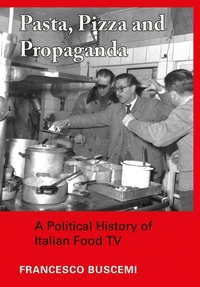
Pasta, Pizza and Propaganda
A Political History of Italian Food TV
Published on 19. April 2022
171 pages
978-1-78938-408-6 (ISBN)
Description

This book aims to develop a political history of Italian 'good food' on national television, and the central role of food in Italian culture. The focus is highly original and this is a unique interdisciplinary study at the intersection between food studies, media studies and politics.
The three protagonists of Pasta, Pizza and Propaganda are food, television and politics. These are the three main characters that interrelate, collaborate and fight behind the scenes, while in front of the camera the writers, intellectuals and celebrity chefs talk about, prepare or taste the best Italian dishes.
The book retraces the history of Italian food television from a political point of view: the early shows of the pioneers under strict Catholic control in the 1950s and 1960s, the left-wing political twist of the 1970s, the conservative riflusso or resurgence of the 1980s, the disputed Berlusconian era and the rise of the celebrity chefs, which, for better or for worse, makes Italy similar to the other western countries.
The history of Italy since the mid-1950s is retold through the lenses of food television. This lively book demonstrates that cooking spaghetti in a TV studio is a political act, and tries to uncover how it is possible that, while watching on TV how to make pizza, we become citizens.
The primary readership will be an academic audience, including those in the disciplines of food studies, media studies, politics and Italian studies, as well as potentially for those interested in Italian sociology and anthropology. There may be a potential wider readership because of the popularity of Italian food and food television.
The three protagonists of Pasta, Pizza and Propaganda are food, television and politics. These are the three main characters that interrelate, collaborate and fight behind the scenes, while in front of the camera the writers, intellectuals and celebrity chefs talk about, prepare or taste the best Italian dishes.
The book retraces the history of Italian food television from a political point of view: the early shows of the pioneers under strict Catholic control in the 1950s and 1960s, the left-wing political twist of the 1970s, the conservative riflusso or resurgence of the 1980s, the disputed Berlusconian era and the rise of the celebrity chefs, which, for better or for worse, makes Italy similar to the other western countries.
The history of Italy since the mid-1950s is retold through the lenses of food television. This lively book demonstrates that cooking spaghetti in a TV studio is a political act, and tries to uncover how it is possible that, while watching on TV how to make pizza, we become citizens.
The primary readership will be an academic audience, including those in the disciplines of food studies, media studies, politics and Italian studies, as well as potentially for those interested in Italian sociology and anthropology. There may be a potential wider readership because of the popularity of Italian food and food television.
Reviews / Votes
'Buscemi provides in-depth discussions on the important links between British and Italian food culture, television, politics and associated industries and behaviours. [...] [This book] will be valuable to students of television generally, and particularly those taking an interdisciplinary approach to media, food, culture, politics and globalisation. Buscemi provides a capsule case study of the development over sixty years of Italian television and the journey of food through those decades, witnessing changes to gender expectations, ideas of being a 'better' Italian and the possibility of food being used to promote a political 'lie' (p. 138) to viewers. [It] considers the culinary and cultural capital that the presenters acquire through television appearances and then use in their representations of the politics of food, world events and aspects of our lives which are far from frivolous.' -- Kevin Geddes, Critical Studies on TelevisionMore details
Series
Edition
New edition
Language
English
Place of publication
Bristol
United Kingdom
Publishing group
Intellect
Target group
Professional and scholarly
Edition type
New edition
Illustrations
12 Halftones, black and white
ISBN-13
978-1-78938-408-6 (9781789384086)
Copyright in bibliographic data and cover images is held by Nielsen Book Services Limited or by the publishers or by their respective licensors: all rights reserved.
Schweitzer Classification
Other editions
Additional editions
Book
05/2022
Intellect Books
€117.30
Shipment within 3-4 weeks
Persons
Francesco Buscemi researches on food TV, political communication and cultural history. He teaches media history and media writing at the Catholic University of Milan, Insubria University and University of Udine.
Content
Introduction
Chapter 1: Literature review, theoretical framework and methodology
Politics, television and food in Italy: Dangerous liaisons
Politics in Italy after the Second World War
Television in Italy
Italian food between reality and stereotypes
Italian food TV
Theoretical framework
Methodology
Conclusion
Chapter 2: Broadcasting sacred food: 1954-1970
Soldati's journey to the Po Valley
Soldati's conception of genuineness
Nature and culture
Culture and the past
Where are the women?
Soldati's sacred food
Linea contro linea
Conclusion
Chapter 3: 1971-1980: The ephemeral wind of change
A new political scenario
The new scenario on TV: RAI's reformation
A Tavola alle 7
The relationship between Veronelli and Ninchi
Ninchi, Veronelli and the field of Italian politics in the 1970s
Dimmi Come Mangi and the dawn of neo-TV
Conclusion
Chapter 4: 1981-1999: Going back home (and to the kitchen)
Riflusso and Italy in the 1980s and 1990s
Wilma De Angelis and home cooking
A Pranzo con Wilma
Food television becomes a genre
Conclusion
Chapter 5: Eating TV: Food on Berlusconian television, 2000-2012
The celebrity housewives and their shows
La Prova del Cuoco
Women between power and stereotype
Serving sacred food in Trattoria
The contrasted discovery of foreign food
Food in the news
Conclusion
Chapter 6: 2012-the present, the Italian way to the celebrity chef
The invasion of the global formats
A case of Italian adaptation: From kitchen nightmares to Cucine da Incubo
A Cena da Me: Representing food to talk about something else
Food Network Italia
The new celebrity chefs
Alessandro Borghese e Simone Rugiati
MasterChef
Italian food out of Italy
Dietary chefs and their enemies
The tough chef
Female professional cooking
Benedetta Rossi, the anti-chef
Conclusion
Conclusion
Chapter 1: Literature review, theoretical framework and methodology
Politics, television and food in Italy: Dangerous liaisons
Politics in Italy after the Second World War
Television in Italy
Italian food between reality and stereotypes
Italian food TV
Theoretical framework
Methodology
Conclusion
Chapter 2: Broadcasting sacred food: 1954-1970
Soldati's journey to the Po Valley
Soldati's conception of genuineness
Nature and culture
Culture and the past
Where are the women?
Soldati's sacred food
Linea contro linea
Conclusion
Chapter 3: 1971-1980: The ephemeral wind of change
A new political scenario
The new scenario on TV: RAI's reformation
A Tavola alle 7
The relationship between Veronelli and Ninchi
Ninchi, Veronelli and the field of Italian politics in the 1970s
Dimmi Come Mangi and the dawn of neo-TV
Conclusion
Chapter 4: 1981-1999: Going back home (and to the kitchen)
Riflusso and Italy in the 1980s and 1990s
Wilma De Angelis and home cooking
A Pranzo con Wilma
Food television becomes a genre
Conclusion
Chapter 5: Eating TV: Food on Berlusconian television, 2000-2012
The celebrity housewives and their shows
La Prova del Cuoco
Women between power and stereotype
Serving sacred food in Trattoria
The contrasted discovery of foreign food
Food in the news
Conclusion
Chapter 6: 2012-the present, the Italian way to the celebrity chef
The invasion of the global formats
A case of Italian adaptation: From kitchen nightmares to Cucine da Incubo
A Cena da Me: Representing food to talk about something else
Food Network Italia
The new celebrity chefs
Alessandro Borghese e Simone Rugiati
MasterChef
Italian food out of Italy
Dietary chefs and their enemies
The tough chef
Female professional cooking
Benedetta Rossi, the anti-chef
Conclusion
Conclusion
