

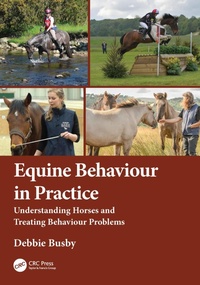
Equine Behaviour in Practice
Understanding Horses and Treating Behaviour Problems
1st Edition
Published on 11. March 2025
256 pages
978-1-040-30678-9 (ISBN)
Description

Combining an in-depth exploration of equine behaviour with clinical practice from a new progressive perspective, Equine Behaviour in Practice: Understanding Horses and Treating Behaviour Problems focuses not just on the horse's behaviour but also on the behaviour of the human interacting with the horse. Acclaimed Clinical Equine Behaviourist Debbie Busby delivers evidence-based knowledge that will equip readers with the understanding and skills to become effective equine behaviour consultants.
Supported by considered discussion of how and why horses sometimes struggle to cope, the book comprehensively explains how to consult on and treat a range of equine behaviour problems. Rather than providing a formulaic "here's the problem; here's how to fix it", Busby encourages readers to develop a critical biopsychosocial evaluation based on an understanding of how horses evolved, their ethological and physiological adaptations, how they learn, and how their welfare and wellbeing can be assessed.
KEY FEATURES:
Part 1 explains theories of equine evolution and the thin veneer of domestication
Part 2 describes psychological and physiological theories of how horses learn, and how this can be applied in training and behaviour modification
Part 3 illustrates this with reference to relevant legislation and widely used animal welfare models, as well as assessments of abnormal and stereotypic behaviour and practical aspects of measuring welfare
Part 4 turns to the theory and practice of behaviour consulting, in three chapters divided into elements of behavioural assessment and treatment planning
Part 5 examines the use of psychopharmaceuticals in behaviour therapy, discussing the roles of the behaviour consultant and the referring veterinary surgeon
Bridging the gap between science and practice, this book is a must-read for equine behaviour and veterinary students, equine behaviour consultants and practitioners, horse trainers, interested leisure riders and competition riders. It will empower equine professionals to combine behavioural and welfare knowledge with counselling and coaching skills to support horse owners in a mutual flourishing, enriching the lives of both species.
Supported by considered discussion of how and why horses sometimes struggle to cope, the book comprehensively explains how to consult on and treat a range of equine behaviour problems. Rather than providing a formulaic "here's the problem; here's how to fix it", Busby encourages readers to develop a critical biopsychosocial evaluation based on an understanding of how horses evolved, their ethological and physiological adaptations, how they learn, and how their welfare and wellbeing can be assessed.
KEY FEATURES:
Part 1 explains theories of equine evolution and the thin veneer of domestication
Part 2 describes psychological and physiological theories of how horses learn, and how this can be applied in training and behaviour modification
Part 3 illustrates this with reference to relevant legislation and widely used animal welfare models, as well as assessments of abnormal and stereotypic behaviour and practical aspects of measuring welfare
Part 4 turns to the theory and practice of behaviour consulting, in three chapters divided into elements of behavioural assessment and treatment planning
Part 5 examines the use of psychopharmaceuticals in behaviour therapy, discussing the roles of the behaviour consultant and the referring veterinary surgeon
Bridging the gap between science and practice, this book is a must-read for equine behaviour and veterinary students, equine behaviour consultants and practitioners, horse trainers, interested leisure riders and competition riders. It will empower equine professionals to combine behavioural and welfare knowledge with counselling and coaching skills to support horse owners in a mutual flourishing, enriching the lives of both species.
More details
Edition
1. Auflage
Language
English
Place of publication
London
United Kingdom
Publishing group
Taylor & Francis Ltd
Target group
College/higher education
Professional and scholarly
Illustrations
23 Tables, color; 2 Line drawings, color; 36 Halftones, color; 38 Illustrations, color
File size
12,56 MB
ISBN-13
978-1-040-30678-9 (9781040306789)
Copyright in bibliographic data and cover images is held by Nielsen Book Services Limited or by the publishers or by their respective licensors: all rights reserved.
Schweitzer Classification
Other editions
Additional editions
Book
03/2025
1st Edition
CRC Press
€76.00
Shipment within 10-20 days

Book
03/2025
1st Edition
CRC Press
€227.50
Shipment within 10-20 days

Book
02/2025
CRC Press
Unfortunately, price unknown
Article exhausted; check different version
Person
Debbie Busby graduated with a first class degree in psychology before going on to gain a distinction for her MSc in applied animal behaviour and welfare from Newcastle University. She grew up with horses and learned to ride aged 7 on Badger, one of the last retired pit ponies in England. Her first experience of using positive reinforcement to influence behaviour came when she had to ride Badger down a busy dual carriageway into Manchester to farrier Jack Priday's forge and was immediately sent to the next-door shop to buy a quarter of mint imperials. Somewhat bemusedly thinking they were for her, she soon learned who their actual recipients were: the ponies! Later Debbie looked after championship-winning harness racing horses and competed in eventing and dressage after studying for British Horse Society exams. After this she concentrated on teaching, especially coaching to improve performance, and developed a popular empathic and encouraging teaching style. At the same time she developed a fascination with the behaviour problems she saw in her clients' horses. Throughout this time, Debbie was partnered by her beloved chestnut thoroughbred cross Rusty, originally a dangerous challenge but emerging as a treasured companion, about whom you're sure to read in the pages of her books and articles.
Debbie Busby founded her successful international equine behaviour consultancy in 2006, and as a clinical equine behaviourist she works with vets and caregivers to resolve complex equine behaviour problems, as well as acts as expert witness in equine legal cases. A full member of the Association of Pet Behaviour Counsellors and a Certificated Clinical Animal Behaviourist, Debbie was only the third practising equine behaviourist in the UK to qualify to register at the highest level with the Animal Behaviour and Training Council (ABTC) as a clinical animal behaviourist specialising in horses. She is a graduate member of the British Psychological Society and an academic member of the International Society for Equitation Science. As a registered member of the British Association for Counselling and Psychotherapy she practices therapeutically within a Transactional Analysis framework, and she has drawn on this modality to develop a model promoting effective communication between horse owners and animal practitioners.
Debbie's intention as a behaviour consultant is to help horses and their owners to cope with the challenges of multispecies living: the domesticated horse is the same animal that ran wild over plains and steppe; domestication came late in this animal's history. Sometimes the mismatch between what we expect of our horses and what they need for physical and psychological health can be overwhelming, and behavioural problems often follow. Through her knowledge, experience and expertise Debbie helps owners understand and resolve the difficulties their animals are experiencing, achieving this in a way that is psychologically and ethologically sound.
Debbie writes books and articles and delivers lectures, presentations and workshops internationally on all aspects of equine behaviour, consulting and human behaviour change. She is a primary author of a book and a chapter contributor of another book. She has had articles published in a number of peer-reviewed journals and speaks at academic and professional conferences around the world.
As well as working with horses in the UK, Debbie travels to Spain, Turkey and the Middle East to research equine welfare and training practices and to consult with horse owners. Until the demands of her consultancy work took over, Debbie partnered with a trail riding company in Wadi Rum, Jordan, to organise week-long desert rides, sleeping under the stars each night and crossing the spectacular desert of mountains on strong, gentle, family-bred Arab horses.
Debbie supervises university students on behaviour courses at master's level and mentors new behaviourists coming through professional routes. She is currently conducting interdisciplinary doctoral research in horse-human relationships at Manchester Metropolitan University in the contexts of riding, sustainability and interspecies wellbeing.
Debbie Busby founded her successful international equine behaviour consultancy in 2006, and as a clinical equine behaviourist she works with vets and caregivers to resolve complex equine behaviour problems, as well as acts as expert witness in equine legal cases. A full member of the Association of Pet Behaviour Counsellors and a Certificated Clinical Animal Behaviourist, Debbie was only the third practising equine behaviourist in the UK to qualify to register at the highest level with the Animal Behaviour and Training Council (ABTC) as a clinical animal behaviourist specialising in horses. She is a graduate member of the British Psychological Society and an academic member of the International Society for Equitation Science. As a registered member of the British Association for Counselling and Psychotherapy she practices therapeutically within a Transactional Analysis framework, and she has drawn on this modality to develop a model promoting effective communication between horse owners and animal practitioners.
Debbie's intention as a behaviour consultant is to help horses and their owners to cope with the challenges of multispecies living: the domesticated horse is the same animal that ran wild over plains and steppe; domestication came late in this animal's history. Sometimes the mismatch between what we expect of our horses and what they need for physical and psychological health can be overwhelming, and behavioural problems often follow. Through her knowledge, experience and expertise Debbie helps owners understand and resolve the difficulties their animals are experiencing, achieving this in a way that is psychologically and ethologically sound.
Debbie writes books and articles and delivers lectures, presentations and workshops internationally on all aspects of equine behaviour, consulting and human behaviour change. She is a primary author of a book and a chapter contributor of another book. She has had articles published in a number of peer-reviewed journals and speaks at academic and professional conferences around the world.
As well as working with horses in the UK, Debbie travels to Spain, Turkey and the Middle East to research equine welfare and training practices and to consult with horse owners. Until the demands of her consultancy work took over, Debbie partnered with a trail riding company in Wadi Rum, Jordan, to organise week-long desert rides, sleeping under the stars each night and crossing the spectacular desert of mountains on strong, gentle, family-bred Arab horses.
Debbie supervises university students on behaviour courses at master's level and mentors new behaviourists coming through professional routes. She is currently conducting interdisciplinary doctoral research in horse-human relationships at Manchester Metropolitan University in the contexts of riding, sustainability and interspecies wellbeing.
Content
PART 1: Who is The Horse? From Evolution to Domestication 2. Equine Ethology 3. Equine Senses and Communication PART 2 How Horses Learn 4. Fundamentals of learning theory 5. Further learning theory 6. Physiology of behaviour PART 3 Equine Welfare 7. Welfare and Wellbeing PART 4 Behaviour Consulting 8. Diagnosing behaviour problems - how to assess a behaviour problem and identify its likely causes 9. Treatment planning - safety and situation 10. Treatment planning - behaviour modification 11. Communication skills and behaviour consulting PART 5 Psychopharmacology Awareness 12. A behaviourist's guide to psychopharmacology. Appendices
