

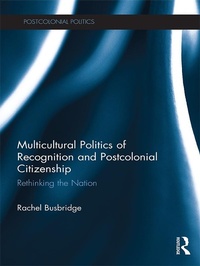
Multicultural Politics of Recognition and Postcolonial Citizenship
Rethinking the Nation
Published on 20. July 2017
202 pages
978-1-317-21570-7 (ISBN)
Description

This book examines claims for recognition of cultural difference from immigrant and Indigenous minorities, highlighting the ways in which they intersect with ideas of national community. Busbridge argues that there is an important, albeit under-explored, relationship between nation and multicultural politics of recognition.
Drawing on the Australian context, the book explores how nation features as a productive, if somewhat ambivalent, discursive resource in contemporary Muslim and Aboriginal struggles to be recognised. In demanding recognition, minorities enter into the business of 'making the nation' by positing alternative conceptions of national identity, culture and belonging that are more attentive to their differences and claims. This dynamic is engaged as an expression of 'postcolonial citizenship'. Postcolonial citizenship is imagined in terms of the ways in which minority groups actualise multicultural realities through rewriting ideas of national community. It underlines the critical importance of revising the power relations that deem some groups 'more national' and others less so - and which, in Western multicultural societies, are typically tied to notions of the 'West' and its 'others'.
This book is an important conceptual, theoretical and political intervention that brings postcolonialism and multiculturalism into dialogue on the increasingly potent issues of nation and national identity. It will be of great interest to scholars and students of sociology, politics, postcolonial studies, culture, identity and nation.
Drawing on the Australian context, the book explores how nation features as a productive, if somewhat ambivalent, discursive resource in contemporary Muslim and Aboriginal struggles to be recognised. In demanding recognition, minorities enter into the business of 'making the nation' by positing alternative conceptions of national identity, culture and belonging that are more attentive to their differences and claims. This dynamic is engaged as an expression of 'postcolonial citizenship'. Postcolonial citizenship is imagined in terms of the ways in which minority groups actualise multicultural realities through rewriting ideas of national community. It underlines the critical importance of revising the power relations that deem some groups 'more national' and others less so - and which, in Western multicultural societies, are typically tied to notions of the 'West' and its 'others'.
This book is an important conceptual, theoretical and political intervention that brings postcolonialism and multiculturalism into dialogue on the increasingly potent issues of nation and national identity. It will be of great interest to scholars and students of sociology, politics, postcolonial studies, culture, identity and nation.
More details
Series
Language
English
Place of publication
London
United Kingdom
Publishing group
Taylor & Francis Ltd
Target group
College/higher education
File size
1,71 MB
ISBN-13
978-1-317-21570-7 (9781317215707)
Copyright in bibliographic data and cover images is held by Nielsen Book Services Limited or by the publishers or by their respective licensors: all rights reserved.
Schweitzer Classification
Other editions
Additional editions
Rachel Busbridge
Multicultural Politics of Recognition and Postcolonial Citizenship
Rethinking the Nation
Book
12/2019
1st Edition
Routledge
€65.00
Shipment within 15-20 days
Rachel Busbridge
Multicultural Politics of Recognition and Postcolonial Citizenship
Rethinking the Nation
Book
07/2017
1st Edition
Routledge
€207.40
Shipment within 10-20 days
Person
Rachel Busbridge is a Research Associate of the Thesis Eleven Centre for Cultural Sociology at La Trobe University in Melbourne, Australia.
Content
1 Rethinking the nation: Between recognition and postcolonial politics
2 Conceptualising nation: Discourse, democracy and postcolonial debate
3 Postcolonial politics of recognition?
4 Contingent universals and shifting particulars: Reorienting recognition struggles
5 Beyond clashing civilisations: Muslim revisions of recognition in popular culture
6 Aboriginal Australians and recognition politics: Reconciliation, apology, sovereignty
7 Thinking postcolonial citizenship
2 Conceptualising nation: Discourse, democracy and postcolonial debate
3 Postcolonial politics of recognition?
4 Contingent universals and shifting particulars: Reorienting recognition struggles
5 Beyond clashing civilisations: Muslim revisions of recognition in popular culture
6 Aboriginal Australians and recognition politics: Reconciliation, apology, sovereignty
7 Thinking postcolonial citizenship
