

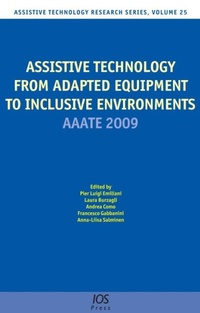
Assistive Technology from Adapted Equipment to Inclusive Environments
AAATE 2009
1st Edition
Published on 15. August 2009
924 pages
978-1-60750-454-2 (ISBN)
Description

The concept of Assistive Technology is moving away from adopting the most appropriate devices to overcome the limitations of users, to the designing and setting up of total environments in which people can live, supported by suitable services and additional support devices integrated within the environment. These two perspectives are deeply intertwined, both from technological and social points of view, and the relationship between them currently represent the primary challenge for the field of Assistive Technology. This publication covers the proceedings of the 10th European Conference of the Association for the Advancement of Assistive Technology in Europe (http://www.aaate.net), the organisation which stimulates the advancement of assistive technology for the benefit of people with disabilities, including elderly people. This conference seeks to bridge the gap between these two complementary approaches, providing an opportunity to clarify differences and common points, and better define future direction. Topics covered by the conference include: technological innovation in assistive technology; the need for multidisciplinary approaches; equipment interconnectivity and compatibility; cultural aspects and the acceptance of different approaches; and the role of Europe in building inclusion competence worldwide. Disability results not only from a person's intrinsic attributes but also from the context in which they live. This publication is a significant contribution to the advancement of inclusion for people living with a disability everywhere.
More details
Series
Language
English
Place of publication
London
Netherlands
Publishing group
IOS Press
Target group
Professional and scholarly
File size
13,79 MB
ISBN-13
978-1-60750-454-2 (9781607504542)
Copyright in bibliographic data and cover images is held by Nielsen Book Services Limited or by the publishers or by their respective licensors: all rights reserved.
Schweitzer Classification
Other editions
Additional editions
Laura Burzagli | Andrea Como | Anna-Liisa Salminen
Assistive Technology from Adapted Equipment to Inclusive Environments
AAATE 2009
Book
08/2009
1st Edition
IOS Press,US
€213.92
Article exhausted; check different version
Content
- Title page
- Preface
- Conference Organisation
- Local Organising Committee
- Scientific Committee
- Contents
- Technology for Motor Limitations 1
- AAC and Amyotrophic Lateral Sclerosis: A Literature Review and Aspects of Quality of Life and Service Delivery
- A Systematized Approach to Provide Assistive Technology (AT) for Augmentative Communication, to Patients with Amyotrophic Lateral Sclerosis (ALS)
- Selecting AAC Devices for Persons with ALS Taking into Consideration the Disease Progression
- Assistive Robotics in Robotics for Healthcare, Roadmap Study for the EC
- A Proposal for User Needs' Extractive Methodology in Development of Assistive Technology - Based on a Variety of Disabilities
- Technology for Motor Limitations 2
- Development of Assistive Functions for Joysticks of Electric Wheelchairs
- EMG Signal Controlled Pneumatic Gripper for Mouthsticks
- Evaluation of Failsafe Wheelchair Brake for Users with Memory Loss in Clinical Use: Short-Term Evaluation of Function
- Mobility-Related Participation Outcomes of Rollator Interventions
- Supporting Inclusion and Independence: Compliant Seating for Children with Cerebral Palsy and Whole Body Extensor Spasms
- Information Support to Mobility
- Study on the Veering Tendency of Persons with Visual Impairment
- Mobility Aid in Urban Scenarios for Visually Impaired People
- Staying in the Crosswalk: A System for Guiding Visually Impaired Pedestrians at Traffic Intersections
- Designing a Location Based Service for Visually Impaired People: MWA Guide
- A Step Forward Towards Increasing the Mobility and Participation of People with Disabilities Utilizing Satellite Navigation Technology Applications
- Healthcare and Rehabilitation
- Health @ Home: A New Homecare Model for Patients with Chronic Heart Failure
- Telecare Service Deployment - Case Study
- Effects of Lower Limb Prosthesis on Daily Living - A Systematic Review
- Technology Trends: A Focus on Sensors and Smart Materials in the Domain of Care Applications
- High Spatial Resolution Dry-Electrode Surface EMG Acquisition System
- Towards a New Concept to the Neurological Recovery for Knee Stabilization After Anterior Cruciate Ligament Reconstruction Based on Surface Electrical Stimulation
- Human Computer Interfaces for People with Motor Limitations
- The NADIA Terminal User Interface for People with Motor Disabilities
- Automatically Adjusting Pointing Device Settings Enhances User Double-Click Performance
- A Study of Two-Inputs Scanning Methods to Enhance the Communication Rate
- Increasing Software Keyboard Key by Recycling Needless Ones
- Evaluation of Unambiguous Virtual Keyboards with Character Prediction
- Robotics
- Affective Robotics for Assisting Elderly People
- Developing the IROMEC Robot for Play: Results from the First Experimental Trials
- Robots as Social Mediators: Field Trials with Children with Special Needs
- QuoVADis Project: Functionalities of the Robot and Data-Processing Architecture
- Methodological Framework to Set Up Educational and Therapy Sessions with Robotic Technology: The IROMEC Proposal
- Brain Computer Interfaces
- BCI Applications for People with Disabilities: Defining User Needs and User Requirements
- Efficient Algorithms for a Brain Computer Interface: Performance Studies
- Implementation of Error Detection into the Graz-Brain-Computer Interface, the Interaction Error Potential
- Controlling Domotic Appliances via a "Dynamical" P300-Based Brain Computer Interface
- Technology for Sensory and Cognitive Limitations
- Accessibility for the Blind: Rendering the Layout of the Web Page for a Tactile Experience
- odt2dtbook: OpenOffice.org Save-as-Daisy Extension
- Visualization of Personal Memory for Cognitive Support
- How Assistive Technology Support Cognitive Disability, Secure Active Living for Persons with Dementia and Enhance New Interfaces Between Formal and Informal Care in the Area of Dementia
- e-Services
- Information Services on Public Transport for People with Reduced Mobility - A Survey Among Public Transport Providers
- A Model of Peer to Peer Multi-Agent Information System to Support the Impaired Users Mobility
- IT Support at Home - What Do You Do when the Computer Is on the Blink?
- Miming Navigation Pages with a Personal Remote Control Device for the Aged
- The Assistive Technology Internet Café
- Service Delivery
- An On-Line System Supporting the Provision of Assistive Technology Products to Individual Users Through the National Health Service
- The ICT Assistive Devices Register: An Instrument to Support Appropriate Provision of Assistive Technology
- Benefits of an On-Line Library of Electronic Assistive Technology on AT Services in Ireland
- Plain Language Search
- Designing an Internet Search Engine on Disability Issues: Results of a Survey of the Users' Information Needs
- Ambient Assisted Living 1
- Mainstream Services for Elderly and Disabled People at Home
- Systematic Review: Activity Outcomes of Environmental Control Systems and Smart Home Technology
- The Meaning of Living with or without Environmental Control Systems for People with Tetraplegia: An Irish Focus Group Study
- Wireless and 1-Wire Solutions for Inclusive Home Environment of Seniors
- Internet-Based Home Monitoring and Control
- Ambient Assisted Living 2
- A Training Apartment with a Set of Electronic Memory Aids for Patients with Memory Difficulties After Acquired Brain Injury
- Integrating Fall Detection into a Home Control System
- A Video-Based Fall Detector Sensor Well Suited for a Data-Fusion Approach
- Autonomamente: A Multimodal Domotic Application and a Social Network to Support Autonomous Living of Persons with Cognitive Disabilities
- Case Study on a Pilot Project for Home Care Monitoring Health Status of Elderly: Lessons Learnt and Going to Scale
- Visual Tools to Select a Layout for an Adapted Living Area
- Aging Aspects
- User-Centred Physiological Emotion Detection for Assistive Technology
- Digital and Social Inclusion from Innovative D-TV Integration
- Development by a Field-Based Method of a Daily-Plan Indicator for Persons with Dementia
- Support in Everyday Activities with a Home-Based Electronic Memory Aid for Persons with Memory Impairments
- SHARE-it Scenarios
- Web for e-Inclusion
- Web Accessibility and Older People
- Is Flash Really Accessible when Interacting Through Screen Readers?
- A Design-for-All Approach Towards Multimodal Accessibility of Mathematics
- Navigation Assistant for Blind People to Explore Chemical Formulas
- Assessment 1
- Design and Outcome Measures in Trials of Assistive Technologies for People with Dementia: Methodological and Ethical Challenges
- An Objective Means of Establishing Optimal Information Transmission Rates in Individuals with Disability
- Development and Reliability Testing of the Nordic Housing Enabler - An Instrument for Accessibility Assessment of the Physical Housing
- The Partial Concurrent Thinking Aloud: A New Usability Evaluation Technique for Blind Users
- Users' Perceptions of Environmental Control Systems
- Assessment 2
- Assessment of an Assistive Technology that Allows Driving a Car with Low Vision
- Use and Prescription of Powered Electronic Wheelchairs for Patients with Severe Acquired Brain Injury
- Analysis of Prosthetic Gait on Stairs, Slopes and Uneven Terrain
- Analysis of Ground Reaction Forces in Walker Assisted Gait
- Evaluation of Body Vibrations During Manual Wheelchair Running over Sidewalk Surfaces and Curbs - Standardization and Promotion of New Curbs with Universal Design
- Aspects of Visual Limitations
- Study About the Walk Supporting System Using LED for People with Low Vision at Night
- Study on Illuminance Dependency of Color Identification Characteristics for Persons with Low Visual Capacity
- Study on Background Illuminance and Color Conspicuity Characteristics for Persons with Low Visual Capacity
- A Study on Sensations of Walking-Distance and Orientation of the Blind
- Interface Challenges for the Visually Impaired
- Aspects of Hearing Limitations
- Evaluation of the Emergent Information Reading Strategy in Bilingual Presentation of Japanese Sign Language and Japanese Text
- A New Evaluation Approach for Sign Language Machine Translation
- Universal Combined System: Speech Recognition, Emotion Recognition and Talking Head for Deaf and Hard of Hearing People
- An Analysis of the Phonological Database of Japanese Sign Language
- Developing Assistive Technology to Enhance Learning for all Students
- Attitudes of Children with Hearing Impairment Towards Assistive Technology in Pakistan
- Design for All
- Managing the Process of Design-for-All
- CMF4ALL: A Content Management Framework for ALL
- Promoting "Design for All" in the (e-)Tourism Industry: An Approach Towards Inclusion
- Organizing Research in Web 2.0 Era
- To Know and to Conserve the Heritage, Matching Rights and Needs! Contribution of New Pavements
- Matching Users and Technology
- Designing Reasonable Accommodation of the Workplace: A New Methodology Based on Risk Assessment
- Design of a MPT Based Instrument Supporting the Quality of Procurement of Assistive Technology
- The Adaptation and Use of the Italian Version of the Matching Assistive Technology and CHild (MATCH) Measure
- Designs on the Future: Linking Front Line AT Service Delivery with Product Design
- Approaches to Clinical Decision-Making in Assessment for Electronic Assistive Technology
- Users and Technology
- Increased User Involvement Through Free Choice of Assistive Technology
- Gathering and Applying Evidence in Computer Access Services
- User Perspective on Assistive Technology. A Qualitative Analysis of 55 Letters from Citizens Applying for Assistive Technology
- The Use of Information and Communication Technology (ICT) Outside of School for Boys and Girls with Motor Disabilities
- Evaluating the Long Term Outcomes of an Assistive Technology Training Course to Inform Service Development
- ICT for Education and Training
- MLG - Multimedia On-Line Lesson Generator
- Challenging Attitudes and Promoting Inclusion of High Tech Assistive Technology Users in Further Education
- Assistive Technology Devices in Educational Settings: Students' Perspective
- Music as an Enabler for Social Inclusion and Provision - The UMSIC Approach
- Distance Education and Training on Accessible Web Design
- Education and Inclusion
- Inclusive Education and ICT: Reflecting on Tools and Methods
- Using ICT to Enable Inclusive Teaching Practices in Higher Education
- How Schools View and Plan Technology for Inclusion: Results of a Project of the Italian Ministry of Education
- Creating an Inclusive Synergy Between User Focused and Environmental Approaches in Further and Higher Education
- Visual Impaired Students in the Portuguese Higher Education
- Entertainment and Education in Rehabilitation
- New Video Games Generations: Only Games or an Opportunity for Assistive Technology?
- Combining Location Based Services with Games Based Learning Approaches in Assistive Technology
- Multimodal Accessible Games for Visually Impaired Players
- Modeling Visitor-Exhibit Interaction at Dynamic Zoo and Aquarium Exhibits for Developing Real-Time Interpretation
- Accessible Game Console Interface for Upper Limbs and Mild Cognitive Impaired People
- e-Inclusion
- The Accessibility Agency" - Promoting the Development of Inclusive Environments by Mainstreaming Accessibility Issues
- Assistive Technology or Mainstreaming of ICT? Yes, Please!
- How Many Positive Results on Inclusion Do We Need to Make Changes?
- Wireless Portable Computer Systems and Technologies for the Disabled and the Aged Towards an Accessible, Inclusive and Intelligent Metropolis of the Future: The South African Context
- Exploring the Use of Assistive Technology for Developing Countries and Minority Languages
- Turning Back Time for Inclusion Today as Well as Tomorrow
- Technology Transfer and Market
- Analysis of the AT ICT Industry in Europe
- Delivering the D in R&D: Increasing Product Outcomes from R&D Projects
- Knowledge Translation for Technology Transfer: Making R&D Matter to Stakeholders
- An Innovations Broker that Increases Availability of Assistive Technology
- Modelling Assistive Technology Systems Using Coloured Petri Nets
- Economic Aspects
- A Macro Economic Cost-Benefit Model for the Assessment of Assistive Technology Future Development
- Assistive Technology Transfer to New EU Countries Market and Users
- The UN Convention on the Rights of Persons with Disabilities - Methodological Consequences for Economic Analyses
- Inclusion - What Does It Cost and How Do We Measure This?
- A Qualitative Approach to Assess Cost-Outcomes in Interventions for Promoting Independent Living
- User Needs Standards
- Participation of Users with Disabilities in Standardization
- Educational Approach for User Training in Standardisation
- USEM Trainees at Work - First Experiences
- STAND4ALL: Training of Stakeholders on Consultations on Standardisation
- The "DfA@eInclusion" Project
- Design for All for eInclusion
- The "Raising the Floor" Project
- Raising the Floor: A Collaborative Open-Source Approach to Providing Access Languages and to All Economic Levels
- Web Accessibility Initiative
- Accelerating Web Accessibility: Migrating to WCAG 2.0 and Ensuring Vigilance over Emerging Technologies
- Best Practice in Education and Training
- Design for All @ eInclusion: Best Practice in Education and Training
- Universal Design in Third Level Design Teaching in Ireland
- Posters
- A Mobile Phone Wayfinding System for Visually Impaired Users
- A Study on Recognition of Tactile Walking Surface Indicators by White Cane
- Ability to Manage Everyday Technology: A Comparison of People with Dementia or Mild Cognitive Impairment and Older Adults Without Cognitive Impairment
- Accessible 3D Game for Visually Impaired Students
- Adapting Linking Rules to the International Classification of Functioning as a Method for Representing Assistive Technology Knowledge
- An Accessible Web Searching: An On-Going Research Project
- Avatars@Home
- Clinical Experiences on Computer Access by Eye Gaze for Persons with Severe Motor Disabilities and Communication Difficulties
- Development of Digital Glass System to Support Tunnel Vision Person
- Does Electronic Assistive Technology Support Everyday Activities for People with Early Alzheimer's Disease?
- Enhancing Accessibility in Mobile Navigational Services
- Evaluation and Assistance for Disabled Persons Navigation with a Low Cost Electric Wheelchair Simulator
- Evaluation on Friction and Vibration for Sidewalk Environment - Toward Accessible and Safety Sidewalk for Pedestrians
- Eye Movements in Bilingual Emergency Message Reading for Deaf People
- Image Tool for AAC Materials
- Information and Communication Technology as a Tool to Increase Accessibility to Care
- ITSE-Assessment Model - A Tool for Evaluating User Satisfaction with Assistive Technology
- Japanese Sign Language Proficiency Test and its Electrical Expansion
- Moving Forward: AT in Egypt
- Disability and AT-ICT in Italy, France and Holland
- Note Taking System Based upon "Quantity Rather than Quality" Concept
- One Support and Care Getting Better Quality of His Life
- Optimized Interaction with Word Prediction List
- Portable System for Monitoring A.D.L., Including A.T. Use, in Urban Environments
- Sign Word Description Method for JSL Dictionaries over Internet
- Social Activity Made Possible Through Technology: Multi-Challenged Persons to Communicate/Influence Their Own Lives
- Technology for Elderly
- Technology for Elderly - Seniors and Internet
- Technology for Elderly - A Survey on 85 Years Old Persons' Use of Hearing-Aids and Subjective Hearing Loss
- Technology Meets Motor Impaired Children's Play: The State of the Art
- Text Messaging with Picture Symbols - Possibilities for Persons with Cognitive and Communicative Disabilities
- The Influence of the Exploration Interface on Blind Subjects' Mental Representation of Sonified Geographic Maps
- Two-Input Based Procedures Using a Single Device
- Usability Evaluation of BCIs
- Using Plain Language (Easy-to-Read) in Network Services
- Muscular Dystrophies Based Fitts' Model
- The Centro Protesi Inail's Project "Going Back Home
- Subject Index
- Author Index
