

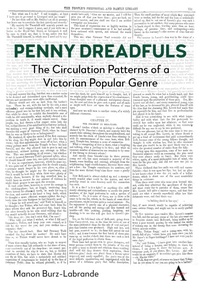
Penny Dreadfuls
The Circulation Patterns of a Victorian Popular Genre
1st Edition
Published on 10. March 2026
108 pages
978-1-83999-631-3 (ISBN)
Description

This study participates in the ongoing scholarly effort to re-appraise the penny dreadful phenomenon as a cornerstone of literary history and of popular culture, both within the nineteenth century and the development of Victorian popular fiction and beyond its specific context. The growing presence of these cheap entertaining Victorian texts in contemporary popular culture - through television series, musicals and literature - signals that it is high time to bestow more systematic and comprehensive attention to these publications. To do so, Penny Dreadfuls: The Circulation Patterns of a Victorian Popular Genre conceptualises the notion of circulation as a tool for analysis.
This book considers different aspects of circulation. The weaponisation of the penny dreadfuls' successful circulation by its critics highlights tensions in the literary marketplace over the hegemonic discourse of what should and should not be read, which mirror the broader issue of contemporary changes on a social, cultural and political level. In addition, the penny dreadfuls' consumption patterns and behaviour within the literary marketplace and within society are also marked by their circulation between different historically popular genres: within the network of late-eighteenth-century and early-nineteenth-century literature and culture, they refuse to remain within clear boundaries and constantly reinvent themselves at the intersection of several trends that constituted the popular, such as oral storytelling, sensationalism and the Gothic. Beyond the nineteenth century, their patterns of circulation develop diachronically, too, in the open-ended circulation of the penny dreadfuls across time through neo-Victorianism and the gradual transformation of the penny dreadfuls into a cultural reference.
Through the lens of the concept of circulation which pervades the penny dreadfuls' history and content, this book reassesses the impact of the penny dreadfuls on nineteenth-century print culture and entertainment, as well as on contemporary popular culture. This book demonstrates the importance of these publications to better understand broader notions of popular culture and to keep deconstructing such binaries as 'high' and 'low' culture. Further than sales numbers, circulation interweaves numerous aspects of popular culture and of this publishing phenomenon. An analysis of these patterns helps decode many aspects of the penny dreadfuls' life and afterlife, as it reveals how their material aspect is intimately interwoven with their seriality, their cultural significance, the reactions they provoked and their actual content. The resulting picture informs us about the nineteenth century's social history and culture, about class warfare and political change, and about the evolution of literature over the past two hundred and fifty years.
This book considers different aspects of circulation. The weaponisation of the penny dreadfuls' successful circulation by its critics highlights tensions in the literary marketplace over the hegemonic discourse of what should and should not be read, which mirror the broader issue of contemporary changes on a social, cultural and political level. In addition, the penny dreadfuls' consumption patterns and behaviour within the literary marketplace and within society are also marked by their circulation between different historically popular genres: within the network of late-eighteenth-century and early-nineteenth-century literature and culture, they refuse to remain within clear boundaries and constantly reinvent themselves at the intersection of several trends that constituted the popular, such as oral storytelling, sensationalism and the Gothic. Beyond the nineteenth century, their patterns of circulation develop diachronically, too, in the open-ended circulation of the penny dreadfuls across time through neo-Victorianism and the gradual transformation of the penny dreadfuls into a cultural reference.
Through the lens of the concept of circulation which pervades the penny dreadfuls' history and content, this book reassesses the impact of the penny dreadfuls on nineteenth-century print culture and entertainment, as well as on contemporary popular culture. This book demonstrates the importance of these publications to better understand broader notions of popular culture and to keep deconstructing such binaries as 'high' and 'low' culture. Further than sales numbers, circulation interweaves numerous aspects of popular culture and of this publishing phenomenon. An analysis of these patterns helps decode many aspects of the penny dreadfuls' life and afterlife, as it reveals how their material aspect is intimately interwoven with their seriality, their cultural significance, the reactions they provoked and their actual content. The resulting picture informs us about the nineteenth century's social history and culture, about class warfare and political change, and about the evolution of literature over the past two hundred and fifty years.
Reviews / Votes
"Burz-Labrande's groundbreaking study revolutionises our understanding of penny dreadfuls. This meticulously researched and engagingly written monograph traces these maligned publications from Victorian street culture to today's neo-Victorian, demonstrating their crucial role in democratising literature. Essential reading for scholars of popular fiction, Victorian studies and cultural history." -Andrew King, Professor Emeritus of English Literature and Literary Studies, University of Greenwich, London, UK."Its popular circulation was exactly what many Victorian commentators feared most about the penny dreadful, picturing it as they did as a powerful Gothic monster corrupting the masses. Burz-Labrande's fascinating new study cleverly recovers the term circulation as a vital critical lens with which to show the multifaceted significance of the penny dreadful from the early-Victorian period right up to the present day." -Mary L. Shannon, School of Arts, Humanities, and Social Sciences, Centre for Research in Society, Culture, and Social Change, University of Roehampton, London, UK.
"In the age of Dickens and Thackeray, the popular imagination was shaped as much by the penny dreadful with its tales of vampires, grave robbers, mysterious castles and damsels in distress. Manon Burz-Labrande has written a penetrating study of this vital popular form that thrilled the Victorian reading public." -Rohan McWilliam, Course Leader for History/Professor of Modern British History, Department of Humanities and Social Sciences, Anglia Ruskin University, UK.
More details
Series
Language
English
Place of publication
London
United Kingdom
Target group
College/higher education
US School Grade: College Graduate Student
Edition type
Digital original
Product notice
Reflowable
File size
2,18 MB
ISBN-13
978-1-83999-631-3 (9781839996313)
Copyright in bibliographic data and cover images is held by Nielsen Book Services Limited or by the publishers or by their respective licensors: all rights reserved.
Schweitzer Classification
Other editions
Additional editions
Book
03/2026
Anthem Press
€31.80
Shipment within 3-4 weeks
Person
Manon Burz-Labrande is an independent post-doctoral researcher who obtained her PhD at the University of Vienna, Austria, where she currently teaches at the Department of English and American Studies.
Content
List of Figures; Acknowledgements; Introduction: Circulation in and of the Penny Dreadfuls; 1. From Oral Storytelling to Seriality; 2. Sensationalism and Entertainment; 3. The Maze of Metropolitan Life: Urbanising the Gothic; 4. Consuming the Penny Dreadful in Neo-Victorian Fiction; Bibliography; Index
