

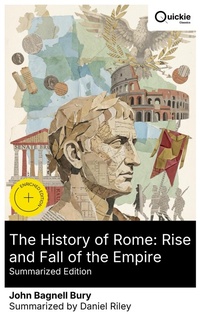
The History of Rome: Rise and Fall of the Empire (Summarized Edition)
Enriched edition. A Classical Study of Ancient Roman Society, Imperial Governance, and the Political-Economic Roots of Decline
Published on 10. January 2026
479 pages
8596547882770 (EAN)
Description

In The History of Rome: Rise and Fall of the Empire, John Bagnell Bury surveys Rome from republican ascent to late antique transformation. Drawing on Livy, Tacitus, Ammianus, inscriptions, papyri, and coinage, he reconstructs institutions, economy, army, and civic culture. The prose is lucid and analytic, wary of moralized "decline," and attentive to structures and causality. Situated within a Rankean, source-critical tradition yet alive to religious and intellectual change, the book marries brisk narrative to a carefully argued synthesis. An Irish classicist and Cambridge historian, Bury promoted history as a science, grounded in philology and administrative analysis. His engagement with Gibbon and his own studies of late Rome shape this project: reassessing decay as transformation, weighing imperial personalities against institutions, and privileging verifiable evidence over legend. This volume will reward advanced students and general readers seeking a reliable, unromantic survey. It provides orientation across complex chronology, models rigorous source criticism, and stages the major debates on expansion, governance, and collapse. For breadth joined to precision and calm judgment, Bury remains an indispensable guide.
Quickie Classics summarizes timeless works with precision, preserving the author's voice and keeping the prose clear, fast, and readable-distilled, never diluted. Enriched Edition extras: Introduction · Synopsis · Historical Context · Brief Analysis · 4 Reflection Q&As · Editorial Footnotes.
More details
Persons
John Bagnell Bury (1861-1927) was a distinguished historian and classicist whose scholarly works played a significant role in the study of European history. Renowned for his meticulous research and narrative historical writings, Bury's comprehensive scholarship remains influential among historians. He held the Regius Chair of Modern History at the University of Cambridge and later became the librarian of the university. One of his most celebrated works, 'The History of Rome: Rise and Fall of the Empire,' is an exhaustive analysis of Roman civilization that blends political, social, and economic aspects to deliver a vivid account of the empire's trajectory. Bury's approach to history was marked by his insistence on the rigorous evaluation of primary sources and a critical examination of historiographical trends, which allowed him to articulate a vision of the past informed by both evidence and lucidity. His literary style, characterized by clarity and elegance, makes his texts accessible to both academic audiences and general readers. Though Bury's contributions extend beyond Roman history, encompassing Byzantine studies and the intellectual history of Europe, it is his Rome narratives that cemented his status as one of the seminal authorities on classical antiquity. Bury's works are indispensable resources for students of Roman history, providing insights that have stood the test of time and continue to inform contemporary historical discourse.
