

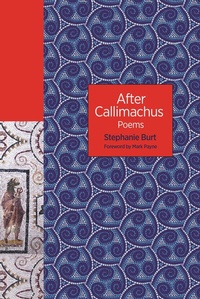
After Callimachus
Poems
1st Edition
Published on 6. April 2020
208 pages
978-0-691-20191-7 (ISBN)
Description

Contemporary translations and adaptations of ancient Greek poet Callimachus by noted writer and critic Stephanie Burt
Callimachus may be the best-kept secret in all of ancient poetry. Loved and admired by later Greeks and Romans, his funny, sexy, generous, thoughtful, learned, sometimes elaborate, and always articulate lyric poems, hymns, epigrams, and short stories in verse have gone without a contemporary poetic champion, until now. In After Callimachus, esteemed poet and critic Stephanie Burt's attentive translations and inspired adaptations introduce the work, spirit, and letter of Callimachus to today's poetry readers.
Skillfully combining intricate patterns of sound and classical precedent with the very modern concerns of sex, gender, love, death, and technology, these poems speak with a twenty-first-century voice, while also opening multiple gateways to ancient worlds. This Callimachus travels the Mediterranean, pays homage to Athena and Zeus, develops erotic fixations, practices funerary commemoration, and brings fresh gifts for the cult of Artemis. This reimagined poet also visits airports, uses Tumblr and Twitter, listens to pop music, and fights contemporary patriarchy. Burt bears careful fealty to Callimachus's whole poems, even as she builds freely from some of the hundreds of surviving fragments. Here is an ancient Greek poet made fresh for our times. An informative foreword by classicist Mark Payne places Burt's renderings of Callimachus in literary and historical context.
After Callimachus is at once a contribution to contemporary poetry and a new endeavor in the art of classical adaptation and translation.
Callimachus may be the best-kept secret in all of ancient poetry. Loved and admired by later Greeks and Romans, his funny, sexy, generous, thoughtful, learned, sometimes elaborate, and always articulate lyric poems, hymns, epigrams, and short stories in verse have gone without a contemporary poetic champion, until now. In After Callimachus, esteemed poet and critic Stephanie Burt's attentive translations and inspired adaptations introduce the work, spirit, and letter of Callimachus to today's poetry readers.
Skillfully combining intricate patterns of sound and classical precedent with the very modern concerns of sex, gender, love, death, and technology, these poems speak with a twenty-first-century voice, while also opening multiple gateways to ancient worlds. This Callimachus travels the Mediterranean, pays homage to Athena and Zeus, develops erotic fixations, practices funerary commemoration, and brings fresh gifts for the cult of Artemis. This reimagined poet also visits airports, uses Tumblr and Twitter, listens to pop music, and fights contemporary patriarchy. Burt bears careful fealty to Callimachus's whole poems, even as she builds freely from some of the hundreds of surviving fragments. Here is an ancient Greek poet made fresh for our times. An informative foreword by classicist Mark Payne places Burt's renderings of Callimachus in literary and historical context.
After Callimachus is at once a contribution to contemporary poetry and a new endeavor in the art of classical adaptation and translation.
More details
Other editions
Additional editions
Book
05/2022
Princeton University Press
€16.50
Shipment within 10-20 days
Book
04/2020
Princeton University Press
€24.76
Shipment within 10-20 days
Persons
Stephanie Burt is a poet and critic and professor of English at Harvard University. Her books include Don't Read Poetry, Advice from the Lights: Poems, and the essay collection Close Calls with Nonsense, which was a finalist for the National Book Critics Circle Award. Her work has appeared in such publications as the London Review of Books and the New York Times Book Review. She serves as poetry coeditor for the Nation. Mark Payne is professor of classics and comparative literature at the University of Chicago. He is the author of Theocritus and the Invention of Fiction, The Animal Part, and Hontology.
Content
- Cover
- Title Page
- Copyright Page
- Contents
- Foreword by Mark Payne
- Imitator's Note
- 1
- So reactionaries and radicals complain (Aetia, book 1, frag. 1: proem)
- This is a story with a happy ending (Aetia, book 3, frag. 67-75)
- That island feast (Galatea, frag. 378)
- Apollo has come to our house party, and Aphrodite (Lyric, frag. 227)
- Caro, you didn't seem to experience more (Epigram 62)
- Sleep, Conopion, sleep (Epigram 64)
- Zeus (I read here) once made love for three hundred years (Aetia, book 2, frag. 48)
- It's easier to explain if we use Mr. Spock (Epigram 43)
- The lord of the gods gets crushes on people too (Epigram 53)
- Honestly I don't know (Hecale, frag. 274)
- I hate to say it, Lee, but you look awful (Epigram 32)
- You were already in pain (Epigram 44)
- Warm ashes may flare up when stirred (Epigram 45)
- Don't worry, you (Hecale, frag. 256)
- There are so many versions of Aphrodite (Iamb 10, frag. 200a)
- Once they decided to make a home together (Epigram 27)
- The shepherds I know tell stories for one another (Epigram 24)
- When you can't be with somebody you want to be with-(Epigram 33)
- It's hard work making people fall in love (Epigram 39)
- Snakes stand for danger, but also for things intertwining (Aetia, book 4, frag. 101a)
- Snakes stand for danger, but also for things intertwining (Aetia, book 4, frag. 101b)
- Fun fact: long ago, in the age of myth (Epigram 47)
- 2
- The fuckers renamed an airport for a tyrant (Epigram 8)
- It hurts to be poor. It hurts more (Hecale, frag. 275)
- Choose me, Athena, defender (frag. 556, 638, 644)
- Berenice, rightful governor (frag. 388)
- All the Greek cities have seen their refugees (Aetia, book 2, frag. 44-51)
- The way a word like sanction, or inflammable (Aetia, book 4, frag. 90)
- Dear Thracians-no, dear citizens (Aetia, book 4, frag. 104)
- You're the kind of rich dude who drains wetlands (Aetia, book 3, frag. 64)
- People are going to hate you once you've won (Aetia, book 3, frag. 84-85)
- Now we pour out wine (Hymn 1: To Zeus)
- 3
- What the-(Aetia, book 1, frag. 31g, and frag. 620 and 731)
- There are so many-too many (Aetia, book 3, frag. 79)
- Nobody wants to talk about lochia. Or about menstruation (Aetia, book 3, frag. 65)
- Pour one out for women who date men (Lyric, frag. 226)
- Remember when we didn't get along? (Aetia, book 3, frag. 80-82)
- Goddess of parturition, listen when Cleo (Epigram 54)
- Asclepius, god of medicine, we've paid (Epigram 55)
- Artemis! Phileratis has placed (Epigram 35)
- Horses don't get periods. They used to (Iambs, frag. 223)
- Child-careworkers deserve to retire with pensions (Epigram 51)
- As in Hamlet, but harmless (Iambs, frag. 223)
- You were always a lamb (Aetia, book 1, frag. 27)
- Why is the stork called an avenger? (Hecale, frag. 271)
- In my poems about the origins of things (Iambs, frag. 221)
- This morning Patricia drew her own picture (Epigram 35)
- "My daughter won't leave her room, even though" (Epigram 41)
- I wish you wouldn't yell at me for trying (Hecale, frag. 248)
- Sometimes you just hit a wall (Aetia, book 4, frag. 97)
- What does Artemis want with attention? Of all the gods (Hymn 3: To Artemis)
- 4
- Half of me-an intangible half-is alive (Epigram 42)
- The poets who win a contest (Epigram 10)
- One of the Muses took this singer (frag. 471)
- Sometimes you don't want it (Aetia, book 1, frag. 2)
- You shouldn't make children work all the time (Iambs, frag. 222)
- Apollo, lord of my only art, mouse god (Iamb 3, frag. 193)
- Everything I set down has a source (frag. 612)
- Henry's new poems sound a lot like Hesiod's (Epigram 29)
- Attribution is weird, and scholars get it wrong (Epigram 7)
- Lucky Orestes (Epigram 60)
- The bitter god called Envy tried to get under (from Hymn 2: To Apollo)
- He was in one of those bands that use so much reverb (Iambs, frag. 215)
- When I began writing, I felt like a constellation (Epigram 56)
- Cover me quietly, stone (Epigram 28)
- Bunting I like, but not Olson, or Bernstein, or Pound (Epigram 30)
- Once on the hill of Tmolus (Iamb 4, frag. 194)
- 5
- My Muses, my Graces, I'm tired (Aetia, book 4, frag. 112: epilogue)
- Cheer up, goats! (Epigram 63a)
- Cheer up, malefactors! (Epigram 63b)
- I already know how your friends with the school-spirit hoodies (Epigram 4)
- Everybody wants to be the talent (Aetia, book 4, frag. 100)
- This bow (Epigram 38)
- What or who are you, whose nameplate reads Opportunity? (Epigram 59)
- Those who have known a god must know (frag. 557, 586)
- I'm an old nautilus egg case. I make a good toy (Epigram 6)
- Timon, you were part of an institution (Epigram 5)
- My first teacher prayed (Epigram 49)
- You've been my friend for a while. You know you can trust me (Iamb 5, frag. 195)
- For the sake of Laura Jane Grace and all the graces (Epigram 34)
- We all made fun of Celia when we learned that her name meant "hair" (Hecale, frag. 288 and 304)
- Eyes take what's seen and rarely ask for more (Hecale, frag. 282)
- Gentle wind from the south that meant we were coming home (Iamb 8, frag. 198)
- Our people have our own holidays (Aetia, frag. 178)
- 6
- I lost my friend's laptop. I thought about skipping town (Epigram 46)
- Hermes, you've definitely been around for a while (Iamb 9, frag. 199)
- I am a superhero with mask, gloves, and boots on (Epigram 26)
- I'm an enamel pin with a black-and-yellow(Epigram 57)
- By using no spice but salt (Epigram 48)
- I am the deity of the periphery (Iamb 7, frag. 197)
- There are more than two, and they work in secret (Aetia, frag. 115)
- There were four Graces. There are not (Epigram 52)
- Of course Athena does not date men (Hecale, frag. 261)
- The goddess we call our foe (Hecale, frag. 299, 301)
- The soft hats I brought back from my travels (Aetia, book 2, frag. 43)
- Some inventions are simple (Aetia, frag. 177)
- Lift up the basket for the harvest festival (Hymn 6: To Demeter)
- 7
- The pillar at the dock must sing his song (Aetia, book 4, frag. 103)
- Why do I write? Experience (frag. 714)
- Don't let yourself or your friends or your children leave (Hecale, frag. 278)
- I'm not exactly from poverty, or from obscurity (Iamb 13, frag. 203)
- From welcoming the stranger (Hecale, frag. 231)
- Don't hold yourself superior to others (Epigram 4)
- The gods (to put it calmly) aren't big fans (Aetia, book 4, frag. 96)
- Justice will give you your due (Hecale, frag. 358)
- We build cities and towns, we mortals. The deathless gods (frag. 467, 480, 491)
- "Goodbye to the sunlit world," said Klia, who took (Epigram 25)
- The singer who wrote the songs for the band Game Theory (Epigram 9)
- Whatever happens happens for all time (Epigram 11)
- Nothing new will vex you or make you heartsick (Hecale, frag. 263)
- Visual depictions of suicide kill (Epigram 22)
- Nobody knows what the gods will bring tomorrow (Epigram 16)
- When I am in cemeteries I consider (Epigram17)
- Cress was the best kind of chatterbox. Her classmates (Epigram 18)
- Here lies Nicholas, the son (Epigram 21)
- I named my son after his grandfather (Epigram 23)
- The god who made us made us such (Hecale, frag. 298)
- The same, single, visible, daily phenomenon (Hecale, frag. 291)
- Sometimes people won't listen. Sometimes they can't (Aetia, book 1, frag. 23)
- At one time all the animals-(Iamb 2, frag. 192)
- It is not for me-gods forbid it-to watch (Hymn 5: To Athena)
- Acknowledgments
- Epilogue to Callimachus
- Index of Greek first lines
