

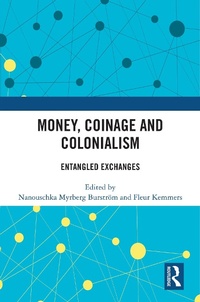
Money, Coinage and Colonialism
Entangled Exchanges
1st Edition
Published on 10. October 2024
268 pages
978-1-040-13314-9 (ISBN)
Description

This book explores coinage and related object types as an important form of material culture that is crucial to interrogating interactions between coloniser and colonised.
Money, Coinage and Colonialism is a much overdue treatment of coinage and money in debates around ancient and recent colonial practices. It argues that coinage offers unique opportunities to study interactions and effects of the meeting between colonisers and colonised, as well as the economic, political and ideological interactions between colonial communities and the state of origin. It is argued that the study of coins and other means of exchange may reveal less apparent and under-communicated processes, values and discourses in the study of colonial environments and projects, with commonalities informing a larger "global history" approach. A broad picture is built from numerous case studies, spanning from Classical Greek colonies to European colonial enterprises of the Modern period, exploring colonial histories, settings, ideology and resistance. Particular attention is paid to the role of coins in identity construction; to ambiguity, hybridity and creolisation of monetary objects in colonial contexts; and to specific uses of coins that tell of violence, oppression and resistance as well as of networks, acculturation and globalisation.
Composed of chronologically broad and diverse case studies from colonial contexts, this book is for researchers in colonial and post-colonial archaeology as well as archaeological and cultural-historical numismatics.
Money, Coinage and Colonialism is a much overdue treatment of coinage and money in debates around ancient and recent colonial practices. It argues that coinage offers unique opportunities to study interactions and effects of the meeting between colonisers and colonised, as well as the economic, political and ideological interactions between colonial communities and the state of origin. It is argued that the study of coins and other means of exchange may reveal less apparent and under-communicated processes, values and discourses in the study of colonial environments and projects, with commonalities informing a larger "global history" approach. A broad picture is built from numerous case studies, spanning from Classical Greek colonies to European colonial enterprises of the Modern period, exploring colonial histories, settings, ideology and resistance. Particular attention is paid to the role of coins in identity construction; to ambiguity, hybridity and creolisation of monetary objects in colonial contexts; and to specific uses of coins that tell of violence, oppression and resistance as well as of networks, acculturation and globalisation.
Composed of chronologically broad and diverse case studies from colonial contexts, this book is for researchers in colonial and post-colonial archaeology as well as archaeological and cultural-historical numismatics.
Reviews / Votes
"Money, Coinage and Colonialism demonstrates how the study of material forms of money can reveal often contradictory forms of adaptation, negotiation and identity construction during colonial cultural interactions. The authors explore a stimulating selection of global contexts, ranging from 600 BCE to the twentieth century."Christopher Howgego, Professor, University of Oxford and Research Keeper, Ashmolean Museum
"An invaluable collection revealing how money and coinage were powerful players in both prehistoric and historic colonial encounters. Linking material and immaterial spheres, Money, Coinage and Colonialism offers novel insights from around the world into the mechanisms, values and discourses at the heart of colonial projects. Whether enforced or developed through on-site negotiations, the authors ably demonstrate how currencies form a vital part of global history and cultural heritage. A must-read contribution for scholars working across archaeology, material culture and colonial history."
Lynn Meskell, Penn Integrates Knowledge (PIK) Professor, Department of Anthropology, School of Arts & Sciences, Penn Museum, and Weitzman School of Design, University of Pennsylvania
"This is a path-breaking book that establishes the centrality of control of money and the economy to the colonial project. Its appeal lies in the rich and diverse range of interdisciplinary case studies that cut across chronological and geographic boundaries."
Himanshu Prabha Ray, Fellow, Oxford Centre for Hindu Studies
"From the first millennium BCE to the twentieth century, the arrival of colonialism has often meant the arrival of money. However, this is seldom examined as a cultural phenomenon by archaeologists and has been virtually absent in postcolonial discussions. The present book redresses this situation by showing the relevance of currency and its materiality in understanding colonial ideologies, identities and processes of cultural hybridisation. The volume, global in scope, shows through a diversity of thought-provoking case studies that the introduction of money has never been straightforward, but always subject to negotiations, appropriations and resistance. This is a must-read for anybody interested in the history and archaeology of colonialism, as well as in theoretically informed approaches to numismatics."
Alfredo Gonzalez-Ruibal, Researcher, Institute of Heritage Sciences, Spanish National Research Council Part 1 Powerplay
1. Viking Money and Colonisation in Ninth-Century England
Rory Naismith
2. The Late Medieval Colonial Condition of the Southern Balkans and the Aegean in the Light of Coinage
Julian Baker
3. Keep Out the Coins! Colonialist Approaches to Northern Norway by the German Hansa?
Jon Anders Risvaag
4. Exchanging Coins in Colonial Bombay: Coin Collectors and Scholars at the Bombay Branch of the Royal Asiatic Society
Shreya Gupta
5. Japanese Invasion Money in the Dutch East Indies and Indonesia (1942-1965): Objects of Violence, Oppression and Resistance
Pim Moehring
Part 2 Crossovers
6. Republican Rome in Colonial Discourses: "Consuming" Provincial Coinages in the Eastern Mediterranean
Georgia Galani
7. Monetisation, Wealth and Material Histories in the Colonial Andes
Noa Corcoran-Tadd
8. First Contacts, First Exchanges, First Coins: The Surprising and Slow Monetisation of the French West Indies in the First Half of the Seventeenth Century
Jerome Jambu
9. Of Paper and Metals. East African Societies, Colonialism and the Materiality of Money
Karin Pallaver
Part 3 Entanglements
10. Carthaginians, Italiots and Greeks: Colonial Coin Iconography in Sicily and Southern Italy, 500-200 BCE
Ulrike Wolf
11. Massalia's Different Monetary Impact: North and South
John Creighton
12. Hybrid Dirhams at Rus' Markets. Coins and Colonisation along the Viking Eastern Trade Routes in the Tenth Century CE
Florent Audy
13. Crusades, Colonies and Coins: Strategies and Subversion in the Medieval Baltic Sea
Nanouschka Myrberg Burstroem
More details
Edition
1. Auflage
Language
English
Place of publication
London
United Kingdom
Publishing group
Taylor & Francis Ltd
Target group
College/higher education
Professional and scholarly
Illustrations
4 Tables, black and white; 44 Halftones, color; 14 Halftones, black and white; 44 Illustrations, color; 14 Illustrations, black and white
ISBN-13
978-1-040-13314-9 (9781040133149)
Copyright in bibliographic data and cover images is held by Nielsen Book Services Limited or by the publishers or by their respective licensors: all rights reserved.
Schweitzer Classification
Other editions
Additional editions
Book
approx. 07/2026
1st Edition
Routledge
€57.50
Not yet published
Book
10/2024
1st Edition
Routledge
€197.50
Shipment within 10-20 days
Persons
Nanouschka Myrberg Burstroem is Associate Professor and Senior Lecturer at Stockholm University, Sweden.
Fleur Kemmers is Professor of Coinage and Money in the Graeco-Roman World at Goethe University, Frankfurt am Main, Germany.
Fleur Kemmers is Professor of Coinage and Money in the Graeco-Roman World at Goethe University, Frankfurt am Main, Germany.
Content
Part 1 Powerplay 1. Viking Money and Colonisation in Ninth-Century England 2. The Late Medieval Colonial Condition of the Southern Balkans and the Aegean in the Light of Coinage 3. Keep Out the Coins! Colonialist Approaches to Northern Norway by the German Hansa? 4. Exchanging Coins in Colonial Bombay: Coin Collectors and Scholars at the Bombay Branch of the Royal Asiatic Society 5. Japanese Invasion Money in the Dutch East Indies and Indonesia (1942-1965): Objects of Violence, Oppression and Resistance Part 2 Crossovers 6. Republican Rome in Colonial Discourses: "Consuming" Provincial Coinages in the Eastern Mediterranean 7. Monetisation, Wealth and Material Histories in the Colonial Andes 8. First Contacts, First Exchanges, First Coins: The Surprising and Slow Monetisation of the French West Indies in the First Half of the Seventeenth Century 9. Of Paper and Metals. East African Societies, Colonialism and the Materiality of Money Part 3 Entanglements 10. Carthaginians, Italiots and Greeks: Colonial Coin Iconography in Sicily and Southern Italy, 500-200 BCE 11. Massalia's Different Monetary Impact: North and South 12. Hybrid Dirhams at Rus' Markets. Coins and Colonisation along the Viking Eastern Trade Routes in the Tenth Century CE 13. Crusades, Colonies and Coins: Strategies and Subversion in the Medieval Baltic Sea
