

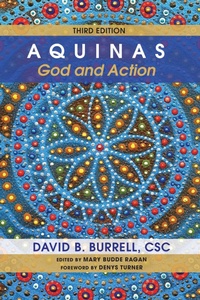
Aquinas
God and Action, Third Edition
Published on 25. October 2016
222 pages
978-1-5326-0891-9 (ISBN)
Description

This exploration of Thomas Aquinas's philosophical theology, decidedly "unorthodox" at the time of its original publication, had the good fortune to be employed extensively--notably at Yale and Cambridge--by my eminent colleagues George Lindbeck and Nicholas Lash. It essayed a "non-foundational" reading of the Summa Theologiae, unabashedly beholden to Wittgenstein, thereby preparing the way for a postmodern yet thoroughly traditional appreciation of the central role which Aquinas played in adapting Hellenic thought to form the hybrid discipline of "philosophical theology." Such a reading proved a welcome alternative to the neo-Thomist attempt to separate "philosophy" from "theology," in an effort to show the wider world that the Catholic faith was "based on reason." While this unfortunate divide has been fixed in the departmental structure of Catholic colleges and universities throughout the world, it was effectively undermined by the universally respected expositor of Aquinas, Josef Pieper, who noted that free creation is "the hidden element in Aquinas's philosophy." However propitious it may have appeared to Catholic apologists in the heyday of modernism to sever "philosophy" from "theology," it would have made no more sense to Aquinas than it could have to Anselm or Augustine before him. Ironically enough, a postmodern sensibility presaged by John Henry Newman in his Grammar of Assent finds the neo-Thomist construction of reason unadulterated by faith to be just that--an abstract construction--after Hans-Georg Gadamer succeeded in showing how any inquiry is fiduciary in its inception, and as Alasdair MacIntyre has reminded us that all inquiry is in fact "tradition-directed," whatever its ostensible attitude towards "tradition." So a "non-foundational" reading of Aquinas was to prove amenable to current philosophers, as well as more faithful to the thought-world of Aquinas himself.
More details
Other editions
Additional editions
Book
10/2016
2nd Edition
Wipf & Stock Publishers
€27.30
Shipment within 15-20 days
Book
10/2016
2nd Edition
Wipf & Stock Publishers
€45.50
Shipment within 3-4 weeks
Persons
David B. Burrell, CSC is the Theodore Hesburgh Professor Emeritus of Philosophy and Theology at the University of Notre Dame. In addition to authoring more than one hundred fifty scholarly articles, his many books include Analogy and Philosophical Language (1973), a translation of al-Ghazali's Faith in Divine Unity and Trust in Divine Providence (2000) as well as Towards a Jewish-Christian-Muslim Theology (2011). He presently serves the Congregation of Holy Cross in Bangladesh.
Content
- Intro
- Title page
- Contents
- Foreword
- Foreword to Second Edition
- Preface
- Part I Scientia Divina:The Grammar of Divinity
- 1 Background: Philosophical Grammar
- 1.1 Examples
- 1.2 Concluding observations: linguistic tools and their use
- 2 The Unknown
- 2.1 Structure of the inquiry
- 2.2 God's simpleness
- 2.3 Why simpleness is not a deficiency in God
- 3 Showing a Way
- 3.1 Grammar of esse
- 3.2 How we are (not) able to use esse
- 4 Analogical Predication
- 4.1 Naming God
- 4.2 Aquinas' treatment
- 4.3 Analogy
- 5 Truth in Matters Religious
- 5.1 Art of using analogical expressions
- 5.2 Respecting divine transcendence
- 5.3 Status of Aquinas' account
- 6 A Philosophical Objection: Process Theology
- 6.1 Alternative roles for philosophy
- 6.2 On conceiving God
- 6.3 An operative distinction
- 6.4 Relating levels of discourse
- 6.5 God and the world
- 6.6 Grammar and religious affirmation
- 7 A Psychological Objection: Jung and Privatio Boni
- 7.1 Positions outlined
- 7.2 Mediating the positions
- 7.3 Reinstating the devil
- 7.4 Concluding observations
- Part II Actus:The Operative Analogous Expression
- 8 Actus: An Inherently Analogous Expression
- 8.1 Characteristic uses of actus
- 8.2 The paradigm use
- 8.3 Order of treatment
- 9 Intentional Activity and Performance: Paradigm for Actus
- 9.1 Understanding as active receptivity
- 9.2 Performance and understanding
- 9.3 Habitus or "first act"
- 9.4 Summary
- 10 Natural Process: Actus and Causality
- 10.1 From actus to relatio
- 10.2 Role actus plays
- 10.3 Conclusion
- 11 Divine Activity: Creative and Immanent
- 11.1 Creation
- 11.2 Activity immanent to God: persons as relations
- 12 The Act of Understanding: A Thoery and an Analogy
- 12.1 Aquinas' theory of knowledge
- 12.2 Language and "Word" in God
- 12.3 Love as the tendency completing expression
- 12.4 Concluding reflections
- 13 Paradoxes of Action: Some Structural Parallels
- 13.1 Some contrasting uses of actus
- 13.2 Action and accomplishment
- 13.3 Actus as the transcendent expression
- Index
