

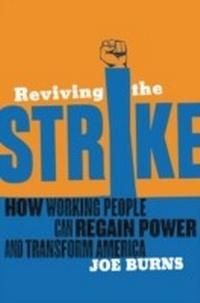
Reviving the Strike
Description

If the American labor movement is to rise again, it will not be as a result of electing Democrats, the passage of legislation, or improved methods of union organizing. Rather, workers will need to rediscover the power of the strike. Not the ineffectual strike of today, where employees meekly sit on picket lines waiting for scabs to take their jobs, but the type of strike capable of grinding industries to a halt-the kind employed up until the 1960s.
In Reviving the Strike, union negotiator Joe Burns draws on labor economics, history, and current analysis to show how only a campaign of civil disobedience can overcome an illegitimate system of labor control that has been specifically constructed over the past thirty years to reign in the power of the American worker. The book challenges prevailing views within the labor movement that say that tactics such as organizing workers or amending labor law can resolve the crisis of the American worker. Instead, Reviving the Strike offers a fundamentally different solution to the current labor crisis, showing how collective bargaining backed by a strike capable of inflicting economic harm upon an employer is the only way for workers to break free of the repressive system that has been inflicted upon them for the past three decades.
Joe Burns is a veteran union negotiator and labor lawyer, and a former local union president. For the past decade, he has negotiated labor contracts in the airline and health care industries. He has a law degree from the New York University School of Law.
All prices
More details
Other editions
Additional editions
Person
Content
For generations of trade unionists and labor economists, trade unionism meant collective bargaining backed by an effective strike. This chapter will look at the economics of collective bargaining as well as analyze the strike's role in the success of the labor movement in the post-World War II period. The weakness of the modern labor movement stems from the fact that collective bargaining is no longer backed by a strike which economically impacts the employer. The chapter will give a brief history of the rise and fall of the strike in the post-World War II era.
Chapter 2 Organizing the Unorganized Fails to Resolve Labor's Crisis
The main thrust of the labor movement since the mid 1990s, organizing the unorganized, has been unable to reverse the labor movement's decline The chapter explains, based on economic theory, why increasing union density is not the key factor in reviving the labor movement. Rather, economics and trade union history show that only a labor movement able to force concessions from employers will attract workers.
Chapter 3 The Failure of Alternatives to the Open Ended Strike
During the 1980s and 1990s, labor activists developed a variety of tactics to substitute for the traditional strike. Tactics such as the corporate campaign, the one-day strikes, and work-to-rule campaigns provide vehicles for workers to demand improvements or fight concessions in a period of union-busting and trade union decline. However, none have proven able to extract sufficient concessions from employers to replace a strike which halts production.
Chapter 4: The Economics and History of Stopping Production
Contrary to prevailing strike theory, the economics of successful striking for industrial workers are not, and have never been, based on a mere withdrawal of labor. Through an examination of conventional labor economics and labor history, the chapter will demonstrate that, to succeed, a strike must stop production. Finally, the chapter will discuss how the system of labor control forbids necessary and historically successful tactics such as mass picketing and sit-down strikes.
Chapter 5: Solidarity and the Economics of Collective Bargaining
Solidarity is the heart and soul of trade unionism. This chapter details the various methods typically employed by trade unions such as industry-wide strikes, secondary strikes and secondary boycotts. The chapter will then examine how and why labor law outlaws workplace-based solidarity.
Chapter 6: Globalization, Business Change and the Anti-union Offensive
The rules of bargaining are critical in allowing corporations to use corporate fictions to avoid collective bargaining. What appear to be unstoppable forces turn out to have very human and conscious origins. Only a labor movement that strategically challenges pro-employer bargaining rules and values will be able to combat global corporations.
Chapter 7: Breaking Free From the System of Labor Control
The system of court cases, administrative rulings and labor practices constitute a system of labor control. This system rests on deeply-held and class-based values and assumptions. The system of labor control will not change through court cases, acts of Congress, or electing Democrats. That means, like the labor movement of years gone by, trade unionists will have to develop tactics which are effective, even if they must violate existing, repressive labor laws.
Chapter 8: Alternative Visions of Trade Unionism
Any road forward for the labor movement must have at its core the revival of a strike. This chapter takes issue with proposals advocating an ill-defined social unionism as the way forward for the labor movement. This chapter analyzes, in depth, social unionism, minority unionism and workers centers. It concludes that the concepts underlying social unionism and other strategies must be wedded to a strike-based strategy for labor to succeed.
Chapter 9: The Right to Strike and the Struggle for Rank and File Control
This chapter discusses the link between the struggle for democratic rights within the trade union movement and the right to strike. The most significant labor struggles have come from trade unions closest to the grassroots. For that reason, trends within labor that say we need to centralize power in the name of bargaining efficiency must be opposed. At the same time, the idea that trade unionists can fundamentally reform the trade union movement in the absence of the strike, the vital source of rank and file power, is critiqued.
Chapter 10: Towards a New Theory of Labor Rights.
This chapter argues that labor must develop a broad-based consensus that the system of labor control violates fundamental rights of workers. By reviving some very traditional notions of the labor movement, such as "labor is not a commodity" and "labor creates all wealth," trade unions can justify confrontational tactics necessary to revive the strike.
Chapter 11: Worker Militancy and Employer Repression
The labor movement has faced government repression against the exercise of basic labor rights before and it will again. This chapter will discuss how labor can confront government repression against effective union tactics. Just as employers have used the corporate form to shield employer assets, unions will need to create lean fighting organizations which are able to shield union assets while engaging in effective strike tactics.
Chapter 12: Labor's Search For Effective Strike Tactics.
From workers at Pittston Coal to the immigrant rights strike in 2005, groups of workers in recent decades have fought against the tide and attempted to develop effective tactics. This chapter will examine these and other struggles, such as Local P9 at Hormel, the Staley workers and the Charleston V, to glean lessons for today's labor movement.
Chapter 13: Practical Steps For Labor and Conclusion
This chapter will offer concrete suggestions for labor activists attempting to implement a strike-based strategy for labor renewal.
