

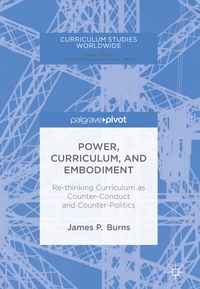
Power, Curriculum, and Embodiment
Re-thinking Curriculum as Counter-Conduct and Counter-Politics
Published on 31. October 2017
IX, 157 pages
978-3-319-68523-6 (ISBN)
Description

Winner of the 2019 AERA Division B (Curriculum Studies) Outstanding Book Award
This book explores curriculum inquiry through the theoretical lens of governmentality as a site of disciplinary biopolitics and a system of heteropatriarchal political economy. Examining the powerscape in which education is currently situated, the author offers a conceptual framework for curriculum scholarship based on Foucault's genealogy of power, and analyzes how curriculum design has historically effectuated disciplinary power on students and teachers. The book engages in a synoptic essay of the history of American violence, an important curricular issue, and finally applies Foucault's concepts of truth-telling and self-care to curriculum studies as a form of self and social reconstruction in complicated conversation with each other.
This book explores curriculum inquiry through the theoretical lens of governmentality as a site of disciplinary biopolitics and a system of heteropatriarchal political economy. Examining the powerscape in which education is currently situated, the author offers a conceptual framework for curriculum scholarship based on Foucault's genealogy of power, and analyzes how curriculum design has historically effectuated disciplinary power on students and teachers. The book engages in a synoptic essay of the history of American violence, an important curricular issue, and finally applies Foucault's concepts of truth-telling and self-care to curriculum studies as a form of self and social reconstruction in complicated conversation with each other.
More details
Series
Edition
1st ed. 2018
Language
English
Place of publication
Cham
Switzerland
Publishing group
Springer International Publishing
Target group
Professional and scholarly
Product notice
Reflowable
Illustrations
IX, 157 p.
File size
2,31 MB
ISBN-13
978-3-319-68523-6 (9783319685236)
DOI
10.1007/978-3-319-68523-6
Schweitzer Classification
Other editions
Additional editions
James P. Burns
Power, Curriculum, and Embodiment
Re-thinking Curriculum as Counter-Conduct and Counter-Politics
Book
11/2017
Palgrave Macmillan
€64.19
Shipment within 10-15 days
Person
James P. Burns is Assistant Professor of Curriculum and Instruction in the School of Education and Human Development at Florida International University, USA.
Content
1. Power, Curriculum, and Embodiment.- 2. Governmentality, Biopolitics, and Curriculum Theorizing.- 3. The Past in the Present: The Historic Reach of the Tyler Rationale.- 4. Reflections on Heteropatriarchal Violence: A Proleptic Narrative?.- 5. Re-thinking Power and Curriculum.
