

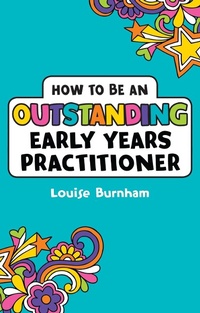
How to be an Outstanding Early Years Practitioner
A Comprehensive Guide to Improving and Developing Your Early Years Knowledge
1st Edition
Published on 22. September 2016
128 pages
978-1-4729-3441-3 (ISBN)
Description

How to be an Outstanding Early Years Practitioner is an all-encompassing, comprehensive guide to improving and developing your early years knowledge and delivering outstanding practice on a daily basis. It is the perfect companion for any new school-based early years practitioner or for experienced practitioners looking to revisit fundamental elements of the profession and be inspired.
Each easy-to-follow chapter is broken down into key areas of practice, including knowledge of the EYFS, relationships with others, planning and assessment, and safeguarding and child protection. Experienced teacher and author Louise Burnham provides ideas for incorporating these critical concepts into your lesson planning and practical advice for handling any number of scenarios that may arise in the early years classroom day-to-day.
Each easy-to-follow chapter is broken down into key areas of practice, including knowledge of the EYFS, relationships with others, planning and assessment, and safeguarding and child protection. Experienced teacher and author Louise Burnham provides ideas for incorporating these critical concepts into your lesson planning and practical advice for handling any number of scenarios that may arise in the early years classroom day-to-day.
More details
Edition
1. Auflage
Language
English
Place of publication
London
United Kingdom
Publishing group
Bloomsbury Publishing PLC (Digital)
Target group
Professional and scholarly
ISBN-13
978-1-4729-3441-3 (9781472934413)
Copyright in bibliographic data and cover images is held by Nielsen Book Services Limited or by the publishers or by their respective licensors: all rights reserved.
Schweitzer Classification
Other editions
Additional editions
Louise Burnham
How to be an Outstanding Early Years Practitioner
A comprehensive guide to improving and developing your Early Years knowledge
Book
09/2016
Bloomsbury Education
€41.03
Shipment within 10-20 days
Person
Louise Burnham has worked in primary schools and in further education as a teacher for over 20 years. In addition to this, she is also a certified assessor for teaching assistants and early years students. She has written and co-authored over 12 books on the work of teaching assistants and early years professionals and has also published a series of articles for magazines.
Content
- Cover
- Half-Title
- Series Page
- Title
- Imprint
- Contents
- Acknowledgements
- Introduction
- Chapter 1 The role of the adult in the early years
- The EYFS and what it means for the role of the adult
- Roles and responsibilities of adults working in early years settings
- Chapter 2 Working with parents
- The role of the key person when working with parents
- Making the setting welcoming to parents
- Encouraging communication between home and school/nursery
- How to encourage parents to support different areas of the EYFS
- Chapter 3 Relationships with others
- How to build positive relationships and why this is important
- Communication with others and skills needed
- Types of communication
- Developing relationships with children
- Working with colleagues
- Developing local links and community cohesion in the early years
- Chapter 4 Enabling environments
- What should the learning environment provide?
- Keep different areas of the room clearly labelled and accessible to everyone
- Other aspects to consider when looking at the learning environment
- School visits and trips
- The outdoor learning environment
- Health and safety in the learning environment
- Chapter 5 Areas of learning and development
- Characteristics of effective teaching and learning
- The areas of learning and development
- Prime areas
- Specific areas
- Children who speak English as an additional language (EAL)
- Chapter 6 Planning, evaluation, observation and assessment
- Planning
- Evaluation
- Observation
- Assessment
- Chapter 7 Safeguarding and welfare requirements
- Safeguarding children
- Staff qualifications and suitable people
- Health and safety
- Managing behaviour
- Maintaining information and records
- Chapter 8 Managing behaviour
- School policies
- The role of the adult when managing behaviour
- Factors affecting children's behaviour
- Chapter 9 Transition
- Effects of transition
- Settling in
- Moving year group
- Supporting children who have special educational needs and disabilities
- Chapter 10 Continuing professional development
- Main aims of CPD
- Induction period for NQTs
- Support for teaching and nursery assistants new to EYFS
- Qualifications for early years workers
- Chapter 11 Extra tips for a happy classroom
- Set the boundaries
- Keep to routines
- Give children ownership of the space
- Promote children's independence
- Encourage a 'have a go' attitude
- Get the children's attention before you speak to them
- Tidying up
- Sing your way through the day!
- Glossary of abbreviations and acronyms
- Further reading and resources
- Index
