

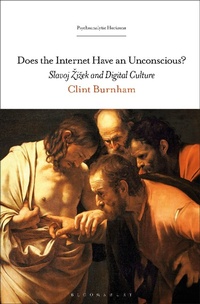
Does the Internet Have an Unconscious?
Slavoj ZizEk and Digital Culture
1st Edition
Published on 31. May 2018
240 pages
978-1-5013-4131-1 (ISBN)
Description

Does the Internet Have an Unconscious? is both an introduction to the work of Slavoj Zizek and an investigation into how his work can be used to think about the digital present.
Clint Burnham uniquely combines the German idealism, Lacanian psychoanalysis, and Marxist materialism found in Zizek's thought to understand how the Internet, social and new media, and digital cultural forms work in our lives and how their failure to work structures our pathologies and fantasies. He suggests that our failure to properly understand the digital is due to our lack of recognition of its political, aesthetic, and psycho-sexual elements.
Mixing autobiographical passages with critical analysis, Burnham situates a Zizekian theory of digital culture in the lived human body.
Clint Burnham uniquely combines the German idealism, Lacanian psychoanalysis, and Marxist materialism found in Zizek's thought to understand how the Internet, social and new media, and digital cultural forms work in our lives and how their failure to work structures our pathologies and fantasies. He suggests that our failure to properly understand the digital is due to our lack of recognition of its political, aesthetic, and psycho-sexual elements.
Mixing autobiographical passages with critical analysis, Burnham situates a Zizekian theory of digital culture in the lived human body.
Reviews / Votes
Clint Burnham does not merely apply psychoanalysis to the internet; he demonstrates how the unconscious itself is 'structured like the internet,' how our entanglement in the impenetrable digital web allows us to understand properly the way the unconscious overdetermines our thinking and activities. This is why Burnham's path-breaking book reaches much deeper than the usual analyses of the social and psychological implications of the internet: it does not just socialize and historicise the internet, it throws a new light on the unconscious itself. * Slavoj Zizek, Senior Researcher in the Department of Philosophy, University of Ljubljana, Slovenia, and author of Less Than Nothing: Hegel and the Shadow of Dialectical Materialism * Clint Burnham has produced the definitive psychoanalytic account of digital culture. This is the book that those seeking to understand how the unconscious manifests itself in the digital universe have been waiting for. For too long, psychoanalytic theorists have confined themselves to analyses of film and literature, but now Burnham provides the breakthrough. Far from being an application of psychoanalysis to a foreign realm, the digital provides the privileged ground for encountering the unconscious. As Burnham's delightful and witty prose indicates, the internet functions as an event with concrete ramifications for the psyches that emerge in its wake. * Todd McGowan, Professor of English, University of Vermont, USA, and author of Only a Joke Can Save Us: A Theory of Comedy * Were there ever two formations with less in common than 'the Internet,' a machinic transmission of discrete data, and 'psychoanalysis,' a wild science of messy social relationality? Clint Burnham's genius is to show how psychoanalysis is indispensable to any robust theory of digital culture, but as well to reveal the cybernetics already at work in psychoanalytic theory from Freud to Zizek. In readings of multiple media, he vividly demonstrates the ongoing necessity of concepts like negation, enjoyment, and disavowal for making sense of aesthetic productions like cinema, social experiences like Facebook, and the cyber mode of production that binds online pleasures to offline battery factories. This is an expansive, fascinating book, offering its readers a dazzling plenty of speculation and critique. * Anna Kornbluh, Associate Professor of English, University of Illinois at Chicago, USA, and author of Realizing Capital: Financial and Psychic Economies in Victorian Form (2013) *More details
Series
Edition
1. Auflage
Language
English
Place of publication
New York
United States
Publishing group
Bloomsbury Publishing PLC (Digital)
Target group
Professional and scholarly
Illustrations
3 b/w illustrations
ISBN-13
978-1-5013-4131-1 (9781501341311)
Copyright in bibliographic data and cover images is held by Nielsen Book Services Limited or by the publishers or by their respective licensors: all rights reserved.
Schweitzer Classification
Other editions
Additional editions
Book
11/2019
Bloomsbury Academic USA
€48.40
Shipment within 15-20 days
Book
05/2018
Bloomsbury Academic USA
€178.56
Shipment within 15-20 days
Person
Clint Burnham is Professor of English at Simon Fraser University, Canada. He is the author of Fredric Jameson and The Wolf of Wall Street (Bloomsbury, 2016).
Content
List of Figures
List of Abbreviations
Acknowledgments
Introduction
1. Does the Internet Have an Unconscious?
2. Slavoj Zizek as Internet Philosopher
3. Was Facebook an Event?
4. Is the Internet a Thing?
5. The Subject Supposed to LOL
6. Her: Or, There Is No Digital Relation (with Matthew Flisfeder)
7. The Selfie and the Cloud
Conclusion
Notes
Index
List of Abbreviations
Acknowledgments
Introduction
1. Does the Internet Have an Unconscious?
2. Slavoj Zizek as Internet Philosopher
3. Was Facebook an Event?
4. Is the Internet a Thing?
5. The Subject Supposed to LOL
6. Her: Or, There Is No Digital Relation (with Matthew Flisfeder)
7. The Selfie and the Cloud
Conclusion
Notes
Index
