

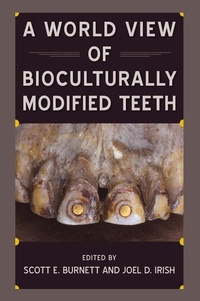
A World View of Bioculturally Modified Teeth
Description

Tooth modification is the longest-lasting type of body modification and the most widespread in the archaeological record. It has been practiced throughout many time periods and on every occupied continent and conveys information about individual people, their societies, and their relationships to others. This necessary volume presents the wide spectrum of intentional dental modification in humans across the globe over the past 16,000 years.
These essays draw on research from the Americas, Africa, Asia, Oceania, and Europe. Through archaeological studies, historical and ethnographic sources, and observations of contemporary people, contributors examine instances of tooth filing, notching, inlays, dyeing, and removal. They discuss how to distinguish between these purposeful modifications of teeth and normal wear and tear or disease while demonstrating what patterns of tooth modification can reveal about people and their cultures in the past and present.
A volume in the series Bioarchaeological Interpretations of the Human Past: Local, Regional, and Global Perspectives, edited by Clark Spencer LarsenMore details
Persons
Content
- Cover
- A WORLD VIEW OF BIOCULTURALLY MODIFIED TEETH
- Title
- Copyright
- Contents
- List of Figures
- List of Tables
- Foreword
- Acknowledgments
- 1. Introduction to a World View of Bioculturally Modified Teeth
- PART I. AFRICA: THE FIRST AND THE PRESENT
- 2. The Chronology and Significance of Ablation in the Later Stone Age Maghreb
- 3. Knocking, Filing, and Chipping: Dental Modification in Sub-Saharan Africans
- 4. Identity Marker or Medicinal Treatment? An Exploration of the Practice and Purpose of Dental Ablation in Ancient Nubia
- 5. Dental Modification in Modern-Day Cape Town, South Africa: A Link to the Past
- PART II. EUROPE AND NORTHEAST ASIA: OUT AND ABOUT
- 6. Dental Modifications of Anterior Teeth in the Danish Viking Age
- 7. The Relationship between Intentional Dental Ablation and Hereditary Agenesis in Late Neolithic to Early Bronze Age China
- 8. Tooth Ablation in Early Neolithic Skeletons from Taiwan
- 9. Biocultural Perspectives on Jomon Dental Ablation: Social Complexity, Identity, and Visage
- 10. Use of Stable Isotope Analysis to Reveal Relationships between Diet and Tooth Ablation Types in Jomon Period Japan
- PART III. SOUTHEAST ASIA, AUSTRALIA, AND OCEANIA: DIFFERENT LANDS AND POSSIBILITIES
- 11. The Biocultural Context of Dental Modification in Prehistoric Southeast Asia
- 12. Tooth Filing in Surabayan Javanese and Balinese: A Change in Tradition
- 13. Intentional Dental Modification and Oral-Dental Health in Western Micronesia
- 14. Tooth Ablation along the Murray River in Southeastern Australia
- PART IV. THE AMERICAS: A NEW WORLD OF MODIFICATION
- 15. Modified Teeth, Cultural Diversity, and Community Building at Cahokia (AD 900-1400)
- 16. Intentional or Not? Characterization and Reassessment of Proposed Intentional Dental Modification Cases in the Present-Day Southwestern United States
- 17. Permanent Dental Modifications among the Ancient Maya: Procedures, Health Risks, and Social Identities
- 18. Social Complexity and Intraregional and Interregional Variation in Dental Modification: A Test Case from the Lower Río Verde Valley, Oaxaca
- 19. Dental Modification and the Expansion and Manipulation of Mesoamerican Identity into Northwest Mexico
- PART V. CONCLUSION
- 20. Out of Regard to Custom: Tooth Modification in the Ancient and Modern Worlds
- List of Contributors
- Index
