

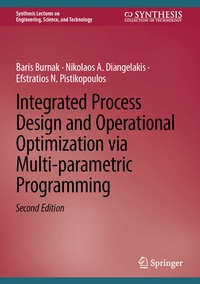
Integrated Process Design and Operational Optimization via Multi-parametric Programming
Description

This book presents a comprehensive optimization based theory and framework that exploits the synergistic interactions and tradeoffs between process design and operational decisions that span different time scales. The authors explain how conventional methods in the process industry often isolate decision making mechanisms with a hierarchical information flow to achieve tractable problems, risking suboptimal, even infeasible operations. This book details the foundations of systematic model based strategies for simultaneous process design, scheduling, and control optimization to achieve reduced cost and improved energy consumption in process systems. The authors approach the following questions: When does the need for such an integration of scales arise? Which types of industrially relevant problems and applications can be considered for such an approach? Where do we stand regarding methodological developments and solution strategies as enablers and tools for such an integration? If desired, what would be the ideal framework and potentially the target software platform for achieving such a unification? This Second Edition includes developments in methodological approaches and software platform unification, as well as discussion on the need for integration.
More details
Other editions
Additional editions
Persons
Baris Burnak, Ph.D., is a Research Scientist with the Network Team at Amazon. He works on optimizing the topology of one of the largest supply chain networks in the U.S. Dr. Burnak received his Ph.D. from the Artie McFerrin Department of Chemical Engineering at Texas A&M University. He earned his B.Sc. and M.Sc. degrees from the Department of Chemical Engineering at Bogazici University, Turkey. Before his career as an operations researcher, he practiced chemical engineering at Phillips 66, where he improved efficiency of midstream and downstream oil and gas operations with his expertise in modeling and optimization. He has co-authored 15 peer reviewed journal articles and six conference proceedings in the field of process systems engineering.
Nikolaos A. Diangelakis, Ph.D., is an Assistant Professor in the Department of Chemical and Environmental Engineering at the Technical University of Crete. He holds a Ph.D. and M.Sc. from Imperial College London. He earned his bachelor's degree from the National Technical University of Athens. His research interests are on the area of optimal receding horizon strategies, non-linear, data-based and robust optimization. More specifically, his research focuses on the development of control and scheduling policies of chemical and energy processes while simultaneously optimizing their design. He is the co-author of 21 peer reviewed articles, 16 conference papers, three book chapters, and two books.
Efstratios N. Pistikopoulos, Ph.D., is the Director of the Texas A&M Energy Institute and holds the Dow Chemical Chair Professorship in the Artie McFerrin Department of Chemical Engineering at Texas A&M University. He holds a Ph.D. degree from Carnegie Mellon University and was previously a professor of Chemical Engineering at Imperial College London. A pioneer of multi-parametric optimization and explicit model predictive control, he has authored or co-authored over 600 major research publications in the areas of modelling, control and optimization of process, energy and systems engineering applications, 17 books, and four patents. He is a Member of the Texas Academy of Medicine, Engineering, Science, and Technology and a Fellow of the Royal Academy of Engineering in the UK.
Content
An Introduction to the Grand Unification of Process Design and Operational Optimization.- Mixed-Integer Dynamic Optimization for Simultaneous Process Design and Control.- PAROC: PARametric Optimization and Control Framework.- Integrating Process Design Optimization and Advanced Model-Based Control Strategies.- Process Scheduling and Control via Multiparametric Programming.- Simultaneous Process Design, Scheduling, and Advanced Model-Based Control.
