

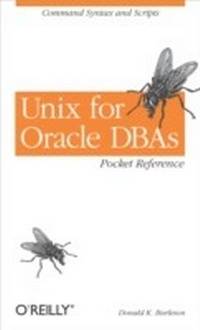
Unix for Oracle DBAs Pocket Reference
Command Syntax and Scripts
1st Edition
Published on 1. February 2001
112 pages
978-0-596-55054-7 (ISBN)
Description

The Unix for Oracle DBAs Pocket Reference puts within easy reach the commands that Oracle database administrators need most when operating in a Unix environment. If you are an Oracle DBA moving to Unix from another environment such as Windows NT or IBM Mainframe, you know that these commands are far different from those covered in most beginning Unix books. To jump start your learning process, Don Burleson has gathered together in this succinct book the Unix commands he most often uses when managing Oracle databases. You'll be able to reach into your pocket for the answer when you need to know how to:Display all Unix components related to Oracle, identify the top CPU consumers on your server, and even kill processes when necessaryStack Unix commands into powerful scripts that can perform vital DBA functionsMonitor Unix filesystems, and automatically manage your trace files, dump files, and archived redo log filesUse essential server monitoring commands such as top, sar, and vmstatAnd there's much more between these covers. If you need to get up to speed with Oracle on Unix, and quickly, this book is for you.
More details
Other editions
Additional editions
Book
03/2001
O'Reilly
€10.00
Shipment within 10-20 days
Content
- Intro
- Table of Contents
- Unix for Oracle DBAs Pocket Reference
- Introduction
- Acknowledgments
- Conventions Used in This Book
- Long Code Lines
- Understanding Unix
- History
- Case Sensitivity
- Safety
- Linkability
- Shells
- Building Unix Commands
- Decompose a Complex Unix Command
- Build a Complex Unix Command from Scratch
- A script to kill all Oracle processes
- A script to find all files containing a specific string
- Unix Server Environment
- Set a Standard Unix Prompt
- Create Useful Unix Aliases for Oracle
- Place a SQL*Plus Script in a Unix Shell Wrapper
- Submit a Task to Run in the Background
- Watch the Execution of a Background Process
- Ensure That Proper Parameters Are Passed to an Oracle Shell Script
- Ensure That Only the Oracle User Can Run a Script
- Validate an Oracle SID Passed to a Unix Script
- Loop Between Unix Servers
- Execute a SQL*Plus Script on All Databases
- Send Unix Files via Internet Mail
- Change a String in All Files in a Directory
- Process Management
- Display Unix Processes
- Display Top CPU Consumers
- Show Number of Active Oracle Dedicated Connection Users
- Kill Processes
- Pin the Oracle SGA in Memory
- Server Values
- Display Server Device Values in HP-UX
- Display Server Device Values in AIX
- Display System Kernel Parameters in HP-UX
- Display System Kernel Parameters in AIX
- Memory and CPU Management
- Display RAM Size in DEC Unix
- Display RAM Size in HP-UX
- Display RAM Size in Solaris
- Display RAM Size in AIX
- Use svmon in AIX
- Display Allocated Memory Segments
- Manually Deallocate a Memory Segment
- Display the Number of CPUs
- Display the number of CPUs in Solaris
- Semaphore Management
- Change Kernel Parameters
- Display Values for Semaphores
- Count Used Semaphores
- Determine the Semaphore Sets Held by an Instance
- Remove a Held Semaphore After a Crash
- System Log Messages
- Show Server Log in HP-UX
- Show Server Log in AIX
- Server Monitoring
- Use top
- Use sar
- sar -u (CPU report)
- sar -w (memory switching and swapping activity)
- sar -b (buffer activity report)
- Use sadc
- Use vmstat
- Automate vmstat Collection
- cr_vmstat_tab.sql
- get_vmstat.ksh
- Sample vmstat report
- Display Swap Usage in AIX
- Display Swap Usage in HP-UX
- Show Server Load Averages
- Use iostat
- Automate iostat Collection
- cr_iostat_tab.sql
- get_iostat.ksh
- File Management
- List Recently Touched Files
- List Recently Changed Files
- Delete Unchanged Files
- Display File Sizes in 512-Byte Blocks
- Locate Files That Contain Certain Strings
- Find Recently Created Files
- Find Large Files on a Server
- Delete Files in Bulk
- Delete Old Trace and Audit Files
- Allocate an Empty File
- Change Default File Permissions
- Understand Unix file permissions
- Find the systemwide default file permissions
- Set default permissions for your session
- Change File Ownership
- Change File Permissions
- Disk Management
- List Logical Volumes in HP-UX
- Display Unix Mount Points
- Display mount points in HP-UX
- Display mount points in AIX and Solaris
- Manage Dialect Differences for Filesystems
- Show Mount Points for a Physical Disk in AIX
- Miscellaneous Shell Scripts
- Create a Soft Link for a File
- Make a Tape Backup Using tar
- Copy tnsnames.ora to All Unix Servers
- Test for a Dead Net8 Listener
- Exit a Script When the Database Is Not Running
- Detect When Oracle Is Not Accepting Connections
- Mail ORA-600 Errors from the Alert Log to the DBA
- Schedule Tasks with cron
- View currently scheduled jobs
- Schedule a new job
- Index of Commands
