

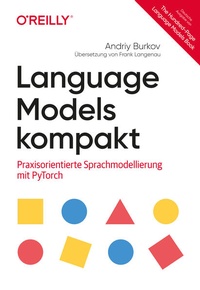
Language Models kompakt
Praxisorientierte Sprachmodellierung mit PyTorch
1st Edition
Published on 24. September 2025
197 pages
978-3-96010-940-2 (ISBN)
Available for download
Description

Der schnellste Weg, um die Mechanismen von LLMs zu verstehen
- Dieses Buch ist eine sehr komprimierte und gleichzeitig gut verständliche Einführung in die Entwicklung von Large Language Models
- Ideal für alle, die sich schnell und fundiert in die Grundlagen von LLMs einarbeiten wollen
- Vom Bestseller-Autor Andriy Burkov, der in seiner renommierten »Hundred-Page«-Reihe zu Machine-Learning-Themen Konzepte besonders klar und knapp erklärt
Sie möchten in die Welt der Large Language Models eintauchen? Dieses handliche Buch hilft Ihnen, das nötige Grundlagenwissen aufzubauen, um das Innenleben von LLMs zu verstehen und erste praktische Erfahrungen zu sammeln. Es führt Schritt für Schritt in die Sprachmodellierung ein, beginnend mit Machine Learning und neuronalen Netzen über RNNs und Transformern bis zu aktuellen LLM-Architekturen.
Bestseller-Autor Andriy Burkov - bekannt für seine »Hundred-Page«-Reihe zu Machine-Learning-Themen - macht die komplexen Ideen leicht zugänglich, indem er gut verständliche Erklärungen der Mathematik, zahlreiche Illustrationen und den Python-Code ausgewogen einsetzt. Auf der Website zum Buch finden Sie direkt ausführbare Codeschnipsel und PyTorch-Implementierungen in Jupyter Notebooks, die die Konzepte perfekt veranschaulichen.
Das Buch unterstützt Sie dabei:
- die mathematischen Grundlagen des Machine Learnings und der neuronalen Netze zu verstehen und zu beherrschen
- drei Architekturen von Language Models in Python zu erstellen und zu trainieren
- ein Transformer-Sprachmodell von Grund auf in PyTorch zu programmieren
- mit LLMs zu arbeiten und effektive Prompt-Engineering- und Feinetuning-Techniken kennenzulernen
- Halluzinationen zu vermeiden und Modelle zu bewerten
More details
Other editions
Additional editions
Book
08/2025
O'Reilly
€29.90
Available immediately
Persons
Andriy Burkov hat einen Doktortitel in Künstlicher Intelligenz und ist ein anerkannter Experte für Machine Learning und Natural Language Processing. Bei Fujitsu und Gartner hat er zahlreiche produktionsreife KI-Projekte in verschiedenen Geschäftsbereichen erfolgreich geleitet. Seine Bücher wurden in zwölf Sprachen übersetzt und werden als Lehrbücher an vielen Universitäten weltweit verwendet. Seine Arbeit hat Millionen von Praktikern und Forschern im Bereich Machine Learning weltweit beeinflusst.
Content
- Cover
- Stimmen zum Buch: Language Models kompakt
- Hinweise zur Benutzung
- Titel
- Impressum
- Widmung
- Inhalt
- Vorwort
- Einführung
- Für wen dieses Buch gedacht ist
- Was dieses Buch nicht ist
- Wie dieses Buch aufgebaut ist
- Beispiele und Wiki zum Buch
- Verwenden von Codebeispielen
- Danksagungen
- 1 Grundlagen des Machine Learning
- KI und Machine Learning
- Modelle
- Machine Learning - Prozess in vier Schritten Vektoren
- Neuronale Netze
- Matrizen
- Gradientenabstieg
- Automatisches Differenzieren
- 2 Grundlagen der Sprachmodellierung
- Bag-of-Words
- Wort-Embeddings
- Byte-Paar-Codierung
- Sprachmodelle
- Zählbasierte Sprachmodelle
- Sprachmodelle bewerten
- Perplexität
- ROUGE
- Menschliche Bewertung
- 3 Rekurrente neuronale Netze
- Elman-RNN
- Mini-Batch-Gradientenabstieg
- Ein RNN programmieren
- RNN als Sprachmodell
- Embedding-Schicht
- Ein RNN-Sprachmodell trainieren
- Die Klassen Dataset und DataLoader
- Trainingsdaten und Verlustberechnung
- 4 Transformer
- Decoder-Block
- Self-Attention
- Schritt 1 der Self-Attention
- Schritt 2 der Self-Attention
- Schritt 3 der Self-Attention
- Schritt 4 der Self-Attention
- Schritt 5 der Self-Attention
- Schritt 6 der Self-Attention
- Positionsbezogenes Multilayer Perceptron
- Rotary Position Embedding
- Multi-Head-Attention
- Residualverbindungen
- RMS-Normalisierung
- Schlüssel-Wert-Caching
- Transformer in Python
- 5 Große Sprachmodelle (LLMs)
- Warum größer besser ist
- Große Parameteranzahl
- Großer Kontextumfang
- Großer Trainingsdatensatz
- Großer Rechenaufwand
- Überwachtes Feintuning
- Ein vortrainiertes Modell feintunen
- Baseline für den Klassifizierer von Emotionen
- Emotionen erzeugen
- Feintuning zum Befolgen von Anweisungen
- Sampling von Sprachmodellen
- Einfaches Sampling mit Temperatur
- Top-k-Sampling
- Nucleus-(Top-p-)Sampling
- Strafen
- Low-rank Adaptation (LoRA)
- Die Kernidee
- Parametereffizientes Feintuning (PEFT)
- LLM als Klassifizierer
- Prompt Engineering
- Merkmale eines guten Prompts
- Folgeaktionen
- Codegenerierung
- Synchronisieren der Dokumentation
- Halluzinationen
- Gründe für Halluzinationen
- Halluzinationen verhindern
- LLMs, Urheberrecht und Ethik
- Trainingsdaten
- Generierte Inhalte
- Open-Weight-Modelle
- Allgemeine ethische Erwägungen
- 6 Fortgeschrittene Themen
- Mixture of Experts
- Model Merging
- Modellkomprimierung
- Präferenzbasierte Ausrichtung
- Advanced Reasoning
- Sicherheit von Sprachmodellen
- Vision Language Models
- Überanpassung verhindern
- Schlussbemerkungen
- Mehr vom Autor
- Fußnoten
- Index
- Über den Autor
