

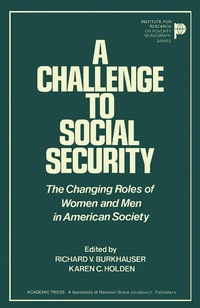
A Challenge to Social Security
The Changing Roles of Women and Men in American Society
Published on 22. October 2013
298 pages
978-1-4832-6126-3 (ISBN)
Description

A Challenge to Social Security: The Changing Roles of Women and Men in American Society is a collection of papers that deals with social security reform. The papers concern insurance and pure income transfer aspects of various proposals and the assumptions regarding the family and work behavior found in each proposal. The proposed reforms attempt to fix the shortcomings of the Old Age, Survivors Insurance (OASI) Program, sometimes at the expense of reducing the subsidy for women who remain at home, or through alterations of the subsidy's nature. Other papers discuss the current spouse benefits under the dual entitlement rule; homemaker credits; child-care drop-out years; and one going against the grain, earnings sharing. One paper sees earning sharing as the only way to provide security to the homemaker without being unfair to the working wife. Other papers tackle the issues of women and a two-tier social security system; the double-decker alternative to eliminate dependency under social security; and the social security reform from a feminist's perspective. This collection can prove useful for economists, sociologists, political scientists, and policy makers involved in welfare and social security.
More details
Other editions
Additional editions

Richard V. Burkhauser | Karen C. Holden
Challenge to Social Security
Changing Roles of Women and Men in American Society
Book
01/1982
Academic Press
€34.66
Article exhausted; check different version
Content
List of Figures and TablesContributorsAcknowledgmentsDirector's Foreword1 Introduction The Current System: How It Works Historical Conflicts in OASI The Controversy over Spouse Benefits A Look at Alternative Reforms Conclusions2 Concepts Underlying the Current Controversy about Women's Social Security Benefits Basic Concepts in Social Insurance and Related Programs Changing the Social Security System Summary3 Supplemental OASI Benefits to Homemakers Through Current Spouse Benefits, a Homemaker Credit, and Child-Care Drop-Out Years The Dual Entitlement Provision: An Implicit Means Test The Distribution of Dependent Benefits among the Aged Substituting an Explicit Credit for Spouse Benefits Evaluation of Alternative Systems AppendixDiscussion4 Earnings Sharing: Incremental and Fundamental Reform Spouse Benefit versus Earnings Sharing The Current Earnings-Sharing Proposals ConclusionDiscussion5 Women and a Two-Tier Social Security System Major Problems Surrounding the Treatment of Women under Social Security The Two-Tier System with Earnings Sharing Impact on Women Conclusion AppendixDiscussion6 The Double-Decker Alternative for Eliminating Dependency under Social Security The Double-Decker Alternative for Eliminating Dependency under Social Security The Simulation The Immediate Impact of Adopting a Double-Decker System The Overall Social Security Benefit Structure and the Objectives of Old-Age Income Maintenance PolicyDiscussion7 Disability Insurance under Proposed Reforms Introduction Definitions and Concepts The Objectives of Disability Insurance (DI) The Effects of Extending DI Coverage Administrative Feasibility of Extending Coverage ConclusionDiscussion8 Occupational Pension Plans and Spouse Benefits Historical Background Current Pension Plan Benefits for Spouses Rights of a Spouse to Employee Pension Entitlements on Dissolution of Marriage The Future of Spouse Benefits under Occupational Pension Plans SummaryDiscussion9 The Housewife and Social Security Reform: A Feminist Perspective10 Incremental Change in Social Security Needed to Result in Equal and Fair Treatment of Men and Women Nature of OASDI and Medicare History of Equal Treatment of Men and Women under Social Security Criticism of Present Treatment of Men and Women Proposed Solutions and Their Weaknesses Solutions Through Incremental Change Conclusion11 The Changing Nature of Social SecurityGlossaryReferencesIndex
