

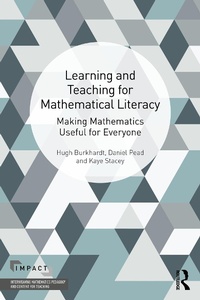
Learning and Teaching for Mathematical Literacy
Making Mathematics Useful for Everyone
1st Edition
Published on 19. February 2024
294 pages
978-1-003-84461-7 (ISBN)
Description

Typically, most people don't realize when and how they can use the mathematics they were taught in high school - yet many of the mathematical ideas and skills can be a powerful tool for understanding how the world works. Learning and Teaching for Mathematical Literacy addresses this situation, offering practical strategies for developing a broader vision of mathematical literacy in the classroom and recognising the importance of maintaining these skills into adult life. Linked to the material explored throughout this book, classroom activities and lesson materials are freely available for use via the QR codes included in each chapter.
Filled with case studies and classroom activities, chapters tackle several topics:
Describing a framework for a broader vision of mathematical literacy - what is it, and why is it important?
Teaching mathematical literacy in the classroom
Applying mathematical literacy to 'real life' scenarios: My dad is buying a new dishwasher. Should he buy the extended warranty on offer? My phone works fine but I've been offered an upgrade. How should I decide whether to take it?
The role of technology in teaching mathematical literacy
Designing mathematical measures for real-word quantities
Firmly grounded by practical applications for the classroom and beyond, this is an essential handbook for any teacher, teaching assistant, or mathematics subject lead who wishes to develop their students' mathematical literacy skills. This is also an ideal resource for those delivering or enrolled in teacher preparation courses.
Filled with case studies and classroom activities, chapters tackle several topics:
Describing a framework for a broader vision of mathematical literacy - what is it, and why is it important?
Teaching mathematical literacy in the classroom
Applying mathematical literacy to 'real life' scenarios: My dad is buying a new dishwasher. Should he buy the extended warranty on offer? My phone works fine but I've been offered an upgrade. How should I decide whether to take it?
The role of technology in teaching mathematical literacy
Designing mathematical measures for real-word quantities
Firmly grounded by practical applications for the classroom and beyond, this is an essential handbook for any teacher, teaching assistant, or mathematics subject lead who wishes to develop their students' mathematical literacy skills. This is also an ideal resource for those delivering or enrolled in teacher preparation courses.
More details
Series
Edition
1. Auflage
Language
English
Place of publication
London
United Kingdom
Publishing group
Taylor & Francis Ebooks
Target group
Professional and scholarly
Product notice
Reflowable
Illustrations
7 Tables, black and white; 110 Line drawings, black and white; 3 Halftones, black and white; 113 Illustrations, black and white
ISBN-13
978-1-003-84461-7 (9781003844617)
Copyright in bibliographic data and cover images is held by Nielsen Book Services Limited or by the publishers or by their respective licensors: all rights reserved.
Schweitzer Classification
Other editions
Additional editions
Hugh Burkhardt | Daniel Pead | Kaye Stacey
Learning and Teaching for Mathematical Literacy
Making Mathematics Useful for Everyone
Book
02/2024
1st Edition
Routledge
€51.50
Shipment within 10-20 days
Hugh Burkhardt | Daniel Pead | Kaye Stacey
Learning and Teaching for Mathematical Literacy
Making Mathematics Useful for Everyone
Book
02/2024
1st Edition
Routledge
€206.00
Shipment within 10-20 days
Persons
Hugh Burkhardt, long time Professor of Mathematical Education and Director of Nottingham University's internationally renowned Shell Centre, is an applied mathematician and strategic researcher-designer in education. Working in both the United Kingdom and the United States, he is particularly interested in the challenges of achieving change in school systems.
Daniel Pead has been an IT leader of the Shell Centre team since spending his gap year working on the Investigations on Teaching with Microcomputers as an Aid project in 1983. He has worked on the Centre's contributions to reSolve, Bowland Maths, and World Class Tests, amongst others. He is particularly interested in the design of computer-based material for teaching and assessment - preferably both together!
Kaye Stacey is an internationally renowned researcher, teacher educator, and a prolific designer of educational materials. She is Emeritus Professor Mathematics Education at the University of Melbourne and chaired the Expert Group for the 2012 PISA assessments of Mathematical Literacy.
All three authors have received awards for contributions to educational design in STEM subjects from ISDDE, the International Society for Design and Development in Education.
Daniel Pead has been an IT leader of the Shell Centre team since spending his gap year working on the Investigations on Teaching with Microcomputers as an Aid project in 1983. He has worked on the Centre's contributions to reSolve, Bowland Maths, and World Class Tests, amongst others. He is particularly interested in the design of computer-based material for teaching and assessment - preferably both together!
Kaye Stacey is an internationally renowned researcher, teacher educator, and a prolific designer of educational materials. She is Emeritus Professor Mathematics Education at the University of Melbourne and chaired the Expert Group for the 2012 PISA assessments of Mathematical Literacy.
All three authors have received awards for contributions to educational design in STEM subjects from ISDDE, the International Society for Design and Development in Education.
Content
1. What is mathematical literacy?; 2. The power of tasks; 3. Teaching for mathematical literacy; 4. How risky is life?; 5. Climate change - the science, the mathematics and the politics; 6. Planning for good things in life; 7. Looking past the 'spin'; 8. Equality and inequality; 9. Your money in your life; 10. Computers in teaching for mathematical literacy; 11. The importance of curiosity; 12. Designing measures; 13. Mathematics for information technology; 14. Reflections
