

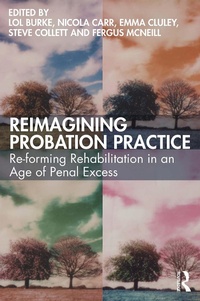
Reimagining Probation Practice
Re-forming Rehabilitation in an Age of Penal Excess
1st Edition
Published on 17. October 2022
268 pages
978-1-000-64791-4 (ISBN)
Description

This book provides a comprehensive and positive reimagining of probation practice in England and Wales across all the key settings in which work with people subject to supervision takes place. Bringing together chapters co-authored by academics and practitioners, it offers an overall conceptualisation of the rehabilitative endeavour within the realities of a probation service recently unified after the acknowledged failure of the Transforming Rehabilitation reforms.
Reimagining Probation Practice covers the main themes and job functions of probation practice, from court work to individual and group interventions, to resettlement and public protection, to partnerships, to education and training. Each chapter includes a brief critical history of the area of practice, the current policy context, the applicability of different forms of rehabilitation (personal, legal/judicial, social and moral) to this area of practice, an overview of current good practice and areas in need of development. The book argues that the principles of parsimony, proportionality and productiveness should be applied to the criminal justice system in its work to rehabilitate individuals.
This book is essential reading for practitioners and all those engaged in probation training, as well as policy makers, leaders, managers and those interested in social and criminal justice.
.
Reimagining Probation Practice covers the main themes and job functions of probation practice, from court work to individual and group interventions, to resettlement and public protection, to partnerships, to education and training. Each chapter includes a brief critical history of the area of practice, the current policy context, the applicability of different forms of rehabilitation (personal, legal/judicial, social and moral) to this area of practice, an overview of current good practice and areas in need of development. The book argues that the principles of parsimony, proportionality and productiveness should be applied to the criminal justice system in its work to rehabilitate individuals.
This book is essential reading for practitioners and all those engaged in probation training, as well as policy makers, leaders, managers and those interested in social and criminal justice.
.
Reviews / Votes
As countries world-wide focus on ways to reform various aspects their criminal justice systems, most are focusing on tweaking existing systems rather than considering what can and should occur. Reimaging Probation offers such an approach to English and Welsh Probation Services. By combining academic and practitioner perspectives, each chapter offers a critique of current approaches with recommendations for rethinking probation services that focus on the individuals rather than impersonal risk assessments.Rita Shah, Associate Professor of Criminology, Eastern Michigan University
A book constructed by such an impressive line-up of editors raises expectations of originality, critical analysis, realistic idealism and progressive thinking, and it will not disappoint. The editors, by bringing together practitioners and academics to prepare the ground for a renewal of probation as an instrument for rehabilitative endeavour in its reimagined forms, have produced what is likely to become a landmark publication in its field.
Maurice Vanstone, Emeritus Professor of Criminology and Criminal Justice, Swansea University
The changes involved in the emerging new structure for probation in Britain represent a unique watershed moment to reimagine and refocus probation practice there. The authors of this book, which could not be more timely, have seen and seized that moment and produced an optimistic vision through which to explore the emerging 'windows of opportunity,' not only to reimagine but to help reshape, renew and rebuild probation practice for the better. This exciting vision is created and developed through building on previous studies and pairing academic researchers with practitioners, in a uniquely helpful thematic approach and structure, all of which combine to realise what is a huge gift to the probation community in the widest sense.
Vivian Geiran, Adjunct Assistant Professor, School of Social Work & Social Policy, Trinity College Dublin and former Director, Irish Probation Service
As probation emerges from the ravages of Transforming Rehabilitation, this book arrives, instilling hope for its future and the possibilities for practice. But it is also heartening that it is so grounded in reality with each chapter co-produced by a creative pairing of practitioner and academic. Without question, Re-imagining Probation Practice will become essential reading for new and long-established probation officers - and for all, like me, involved in training.
Anne Robinson, Head of Community Justice Learning, Sheffield Hallam University
More details
Edition
1. Auflage
Language
English
Place of publication
London
United Kingdom
Publishing group
Taylor & Francis Ltd
Target group
College/higher education
Professional and scholarly
Product notice
Reflowable
Illustrations
5 Line drawings, black and white; 5 Illustrations, black and white
ISBN-13
978-1-000-64791-4 (9781000647914)
Copyright in bibliographic data and cover images is held by Nielsen Book Services Limited or by the publishers or by their respective licensors: all rights reserved.
Schweitzer Classification
Other editions
Additional editions
Lol Burke | Nicola Carr | Emma Cluley
Reimagining Probation Practice
Re-forming Rehabilitation in an Age of Penal Excess
Book
10/2022
1st Edition
Routledge
€60.40
Shipment within 15-20 days
Lol Burke | Nicola Carr | Emma Cluley
Reimagining Probation Practice
Re-forming Rehabilitation in an Age of Penal Excess
Book
10/2022
1st Edition
Routledge
€187.50
Shipment within 15-20 days
Persons
Lol Burke is professor in criminal justice at Liverpool John Moores University and specialises in the areas of probation research, policy and practice.
Nicola Carr is the editor of the Probation Journal and a Professor of criminology at the University of Nottingham.
Emma Cluley is a probation officer of 22 years standing with Greater Manchester and currently specialises in responding to personality difficulties. She is a clinical lead in a therapeutic community in Greater Manchester Mental Health Service (NHS).
Stephen Collett is a retired chief probation officer. He holds honorary positions at the universities of Liverpool and Manchester and is an adjunct professor at Liverpool John Moores University and an honorary fellow of the university.
Fergus McNeill is professor of criminology and social work at the University of Glasgow where he works in the Scottish Centre for Crime and Justice Research and in Sociology.
Nicola Carr is the editor of the Probation Journal and a Professor of criminology at the University of Nottingham.
Emma Cluley is a probation officer of 22 years standing with Greater Manchester and currently specialises in responding to personality difficulties. She is a clinical lead in a therapeutic community in Greater Manchester Mental Health Service (NHS).
Stephen Collett is a retired chief probation officer. He holds honorary positions at the universities of Liverpool and Manchester and is an adjunct professor at Liverpool John Moores University and an honorary fellow of the university.
Fergus McNeill is professor of criminology and social work at the University of Glasgow where he works in the Scottish Centre for Crime and Justice Research and in Sociology.
Content
1.Introduction: Reforming, reimagining and moving forward - for what purpose? Lol Burke, Nicola Carr, Emma Cluley, Steve Collett and Fergus McNeill 2.Court work and assessment: Laying the foundations for effective probation practice Gwen Robinson, Peter Halsall and Mark Nixon 3.Individual Interventions: Re-imagining the one-to-one interaction at the heart of probation practice Rachel Reed and Jane Dominey 4.Group Interventions: Reimagining groupwork by embedding personal, judicial, moral, and social rehabilitation into practice Nicole Renehan and Olivia Henry 5.Community Service and Rehabilitation: Untapped potential Nicola Carr and Linda Neimantas 6.Resettlement: A people first approach to community (re)integration Matt Cracknell and Charlotte Flinterman 7.Public Protection: Examining the impact of strengthened public protection policy on probation practice Stephanie Kewley and Sharon Brereton 8.Reimagining Partnerships: A forensic democratic therapeutic community model Emma Cluley and Shadd Maruna 9.Approved Premises: Futures of control in the community Peter Marston and Carla Reeves 10.Education and training: Delivering the four forms of rehabilitation: training and developing probation practitioners Anne Burrell and Madeline Petrillo 11.Inspection Work: Reimagining probation practice indirectly: how the work of the Inspectorate can support a reimagined rehabilitation Simi Badachha, Robin Moore and Jake Phillips 12.From electronic monitoring to artificial intelligence: Technopopulism and the future of probation services Mike Nellis 13Conclusion: Reforming and reimagining - beyond the realities of contemporary probation practice Lol Burke, Nicola Carr, Emma Cluley, Steve Collett and Fergus McNeill
