

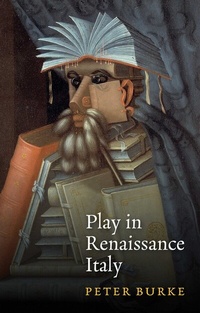
Play in Renaissance Italy
Description

This entertaining study of play reveals much about the culture of Renaissance Italy, and illuminates an essential element in human life.
More details
Other editions
Additional editions
Person
Content
1: Introduction
2: Fun and Games
3: Laughter
4: Play: For and Against
5: Who, Where and When?
6: New Trends
7: Epilogue: Beyond 1650
Dramatis Personae
Notes
Further Reading
Index
2
Fun and Games
This chapter offers descriptions of the many and various games - in a wide sense of that term - that were played in Renaissance Italy. The sources for reconstructing these games are much richer than they are for the Middle Ages, including treatises on games in general and also on specific activities such as chess, dancing, football and tennis. Some of the treatises were widely read. By the year 1609, Girolamo Bargagli's Dialogo dei Giuochi (first published in 1572) had been reprinted eight times.1
Some of the most important of these treatises were produced not in Florence, Rome or Venice but in three smaller cities: Ferrara, Siena and Bologna. In Ferrara, the rulers and the courtiers seem to have taken a particular interest in different forms of play. The Duke, Alfonso II, was particularly interested in ball games, sometimes keeping envoys waiting while he was playing.2 A treatise on palla (an ancestor of tennis), formulating rules, was written for Alfonso by a diplomat in his service, the priest Antonio Scaino.3 Scaino gave the game an underpinning in philosophy, including natural philosophy. In Siena, the initiative appears to have come from academies, a favourite form of sociability for urban elites. The Bargagli brothers, for instance, were both members of the Sienese Academy of the Intronati.
The invention of printing was doubtless an encouragement to individuals with some kind of expertise in this ample domain to set down their knowledge and ideas in writing. It is likely that the treatises not only described rules for different games but also constructed them, or at the very least helped - like grammars of vernacular languages - to standardize practices that had previously varied from one place to another.
Outdoor Games4
In a few cases, the forms of play were shaped by the humanist project of reviving classical antiquity. The practice of athletics was revived by following the Greek example. In the fifteenth century, the manysided Leonbattista Alberti recommended exercise and prided himself on his jumping, while a later humanist, Girolamo Mercuriale, published a book on The Art of Gymnastics (1569). Nevertheless, the outdoor games of the Renaissance owed much more to medieval traditions than they did to classical models.
For the nobility, the most important forms of exercise were riding, hunting and practice in the use of weapons, especially lances and swords. Young nobles went to fencing schools. They practised their horsemanship by 'riding at the ring' (piercing a ring with a lance while galloping), or by 'riding at the quintain', spearing a life-sized doll, known in Italian as a 'Saracen'. Martial games were viewed as training for war, as well as a means to show off one's courage and skill to impress the ladies and 'cut a good figure' (fare bella figura), as Italians still say.5 Hunting, a favourite pursuit of the upper classes in Italy, as elsewhere, was also justified as training for war. In the fourteenth chapter of The Prince, for instance, Machiavelli wrote that 'Hunting is excellent exercise, because it strengthens the body and makes the ruler more familiar with the surrounding terrain.' Falconry was another noble sport.
Jousts - in which an individual armed with a blunted lance tried to knock his opponent off his horse - and tournaments, a form of mock-battle with real weapons, remained common practices in the fifteenth and early sixteenth centuries. Lorenzo de' Medici, for instance, the unofficial ruler of Florence from 1469 to 1492, won first prize in a joust there in the year in which he came to power, an event celebrated by the poet Luigi Pulci in his 'Stanzas for the Joust' (Stanze per la Giostra). The prowess of Lorenzo's younger brother Giuliano in a joust on Piazza Santa Croce in 1475 was celebrated by a poem with the same title as Pulci's, written by the humanist Angelo Poliziano.6 These competitive games had - among other things - the serious purpose of showing that the mercantile family of the Medici had accepted the noble values known as chivalry and were therefore fit to govern.
Only in the later sixteenth century, when the use of guns was transforming warfare, did jousts and tournaments turn into a kind of choreography - so many displays of the elegance and grace recommended in Castiglione's Book of the Courtier.7 An even more spectacular display was the mock sea battle, or naumachia, following classical models, which was staged in the courtyard of the Pitti Palace in Florence, flooded for the purpose during the celebration of the wedding of Grand Duke Ferdinando de' Medici and Christine of Lorraine in 1589.
Tournaments and jousts were joined by football (calcio) and tennis (pallone), games that were mainly - though not exclusively - played by upper-class males. In Florence, a ball game was played on Piazza Santa Croce, following a ritual defiance that gave the game something of the atmosphere of a tournament.8 In pallone, an ancestor of tennis, the ball was struck either by the palm of the hand, by a glove, by a wooden cylinder worn over the forearm, or by a racquet.
Figure 1 Calcio Fiorentino 1688
Source: Wikimedia Commons
Mock-battles were not a preserve of the Italian nobility. At a lower social level, on foot rather than on horseback, were what is known as the 'little battles' (battagliole). The most famous or notorious of these battles were the 'fist wars' (guerre de' pugni) or 'stick wars' (guerre de' canne), regularly waged between the inhabitants of two quarters of Venice: the Castellani, who worked on ship-building at the Arsenal, and the Nicolotti, mainly fishermen. 9 Battles usually took place on the borders of their territories, especially bridges, liminal spaces appropriate for rituals of solidarity among the community of each quarter.10 Bones might be broken, but communal bonds were mended. The encounters were celebrated in a poem by the goldsmith Alessandro Caravia, 'The Old War' (La verra antiga, 1550).
In similar fashion, in Florence, there were battles on the bridge of Santa Trinità which separated the quarters of Santa Maria Novella and Santo Spirito, while, in Pisa, an annual battle known as 'the bridge game' (il gioco del ponte) took place on the Ponte Vecchio and once again pitted men from rival quarters against each other.11 Elsewhere, the two sides threw stones at each other, as was the tradition in Perugia, for instance.12 These battles may appear to be huge brawls, free-for-alls, but there were what might be called 'rules of disorder', implicit in the case of Venice but explicit in that of Pisa.13 Less formal were snowball fights, which are rarely recorded but seem to have appealed to all classes and both sexes.
Another popular exercise was the race or palio ('banner'), named after the prize awarded to the winner. The palio is still run in Siena. In the summary description of the American folklorist Alan Dundes, 'Twice a summer, for approximately 90 seconds, ten horses race clockwise three times around the Piazza del Campo, the main square of the city of Siena, which has been transformed into a race track for the occasion. The horses are ridden bareback by jockeys wearing costumes displaying the colours of ten of Siena's seventeen contrade or wards.' In the period with which this essay is concerned, the race used to take place through the city rather than in its centre, while the mounts were buffaloes and asses, replaced by horses in 1633.14
The palio of Siena was only one of many such races held in different Italian cities in the Middle Ages. In Venice, during Carnival, there were boat races along the Grand Canal and bull races across the bridge at the Rialto. In Florence, the palio of San Giovanni was a horse race that took place on 24 June, during the festival of the patron of the city. Originally intended to encourage civic patriotism by commemorating the victories of the commune, it was reduced to 'a mere competitive sport' by the fifteenth century.15 In Rome, there were races of buffaloes and asses during Carnival, while Paul II, who was Pope from 1464 to 1471, introduced foot races along the Via Lata (hence its new name, the Corso). The events included races by Jews, prostitutes and old men. Although the winner of each race was rewarded, the participants are unlikely to have enjoyed the races, which offered the bystanders opportunities to throw stones and shout insults.16
Other games offered displays of skill by professionals. Acrobatics, for example, required rigorous training. In Venice, the displays included tightrope walking and the human pyramid known as 'the forces of Hercules' (le forze d'Ercole).17 Some mock-battles were a kind of outdoor theatre, as in the case of festive sieges of castles, like the one in Florence in 1513 described in a contemporary chronicle.
Battles between animals presented a kind of 'theatre of cruelty'. Watching two cocks fighting was a common sport in Italy. 'Bear-baiting', in which the bear was...
