

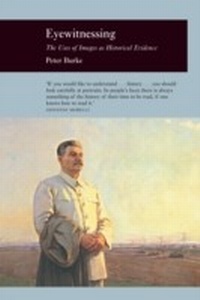
Eyewitnessing
The Uses of Images as Historical Evidence
1st Edition
Published on 16. June 2011
240 pages
978-1-86189-828-9 (ISBN)
Description

Eyewitnessing evaluates the place of images among other kinds of historical evidence. By reviewing the many varieties of images by region, period and medium, and looking at the pragmatic uses of images (e.g. the Bayeux Tapestry, an engraving of a printing press, a reconstruction of a building), Peter Burke sheds light on our assumption that these practical uses are 'reflections' of specific historical meanings and influences. He also shows how this assumption can be problematic.
Traditional art historians have depended on two types of analysis when dealing with visual imagery: iconography and iconology. Burke describes and evaluates these approaches, concluding that they are insufficient. Focusing instead on the medium as message and on the social contexts and uses of images, he discusses both religious images and political ones, also looking at images in advertising and as commodities.
Ultimately, Burke's purpose is to show how iconographic and post-iconographic methods - psychoanalysis, semiotics, viewer response, deconstruction - are both useful and problematic to contemporary historians.
Traditional art historians have depended on two types of analysis when dealing with visual imagery: iconography and iconology. Burke describes and evaluates these approaches, concluding that they are insufficient. Focusing instead on the medium as message and on the social contexts and uses of images, he discusses both religious images and political ones, also looking at images in advertising and as commodities.
Ultimately, Burke's purpose is to show how iconographic and post-iconographic methods - psychoanalysis, semiotics, viewer response, deconstruction - are both useful and problematic to contemporary historians.
Reviews / Votes
Provides us with a compendium . . . which continues the long process of restoring the balance between written documentation and optical representation as carriers of historical information . . . a thoroughly engrossing explication of how fine art, graphics, photographs, film and other media can be used to make sense of lives lived out in other times * <i>Tate Magazine</i> * Well-informed and fair-minded, and it prompts one to ponder * Michael Baxandall, <i>English Historical Review</i> * Eyewitnessing is not about the value of images at all, but rather about the primacy of words . . . The book becomes a sustained argument for the preservation of old-fashioned text-based history, through the constant citing of contexts in which images are nothing without textual support. * Nicholas Hiley, <i>Times Literary Supplement</i> * Burke . . . describes and evaluates the methods by which art historians have traditionally analyzed images, finding them insufficient to address the complexities of visual imagery. * <i>Book News</i> * Burke . . . has produced a fine book resulting from his study of images as sources of historical evidence. . . .The author . . . is known for his interest in finding links between languages, cultures, and epochs as well as methodologies and disciplines. The present volume is an example of this sweeping intelligence at work and is a must for students of history, culture, fine arts, anthropology, and film. * <i>Choice</i> * This book is especially valuable for its many examples of images that could be used in historical research, and for its coherent summary of key concepts and theories . . . Eyewitnessing is highly recommended for historians and art historians alike. * Nina K. Stephenson, University of New Mexico, <i>Art Documentation</i> * Any timid historian reading this book would run in terror from even thinking about using images as evidence. Burke details the pitfalls as he surveys types of images historians might use . . . Overall, an encouraging short introduction to a tricky subject. * <i>Virginia Quarterly Review</i> * As Peter Burke illustrates in Eyewitnessing, images have a long tradition of distorting the facts. Of what use, then, are images to scholars of history? What types of historical evidence do images provide? Burke sets out to answer these questions. His book is intended to encourage and instruct readers in the historiographic use of images, and it succeeds splendidly on both counts . . . Through an impressive array of case studies, Burke demonstrates the value of images to historians while providing instructive warnings about their use . . . For those new to the study of images, Eyewitnessing provides an accessible and practical introduction to the historiographic use of visual culture. For art historians and scholars already committed to the study of visual phenomena, Burkes book serves as a cogent reminder of the complex relations between images and history * Sharon Corwin, University of California, Berkeley, <i>Technology and Culture </i> *More details
Language
English
Place of publication
London
United Kingdom
Illustrations
82 black and white
File size
13,73 MB
ISBN-13
978-1-86189-828-9 (9781861898289)
Copyright in bibliographic data and cover images is held by Nielsen Book Services Limited or by the publishers or by their respective licensors: all rights reserved.
Schweitzer Classification
Other editions
Additional editions
Book
08/2019
Reaktion Books
€17.00
Article not available at the moment
Book
12/2005
Reaktion Books
€50.95
Shipment within 10-20 days
Person
Peter Burke is Professor Emeritus of Cultural History and Fellow of Emmanuel College, Cambridge. His many books include What is Cultural History? (2004) and A Social History of Knowledge (Volume I, 2000; Volume II, 2012).
Content
- Cover
- Title Page
- Imprint Page
- Contents
- Preface to the Second Edition
- Introduction: The Testimony of Images
- 1: Photographs and Portraits
- 2: Iconography and Iconology
- 3: The Sacred and the Supernatural
- 4: Power and Protest
- 5: Material Culture through Images
- 6: Views of Society
- 7: Stereotypes of Others
- 8: Visual Narratives
- 9: From Witness to Historian
- 10: Beyond Iconography?
- 11: The Cultural History of Images
- References
- Select Bibliography
- Acknowledgements
- Photographic Acknowledgements
- Index
