

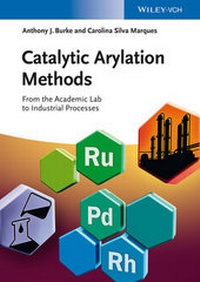
Catalytic Arylation Methods
From the Academic Lab to Industrial Processes
1st Edition
Published on 16. October 2014
528 pages
978-3-527-67285-1 (ISBN)
Description

This "hands-on" approach to the topic of arylation consolidates the body of key research over the last ten years (and up to around 2014) on various catalytic methods which involve an arylation process. Clearly structured, the chapters in this one-stop resource are arranged according to the reaction type, and focus on novel, efficient and sustainable processes, rather than the well-known and established cross-coupling methods. The entire contents are written by two authors with academic and industrial expertise to ensure consistent coverage of the latest developments in the field, as well as industrial applications, such as C-H activation, iron and gold-catalyzed coupling reactions, cycloadditions or novel methodologies using arylboron reagents. A cross-section of relevant tried-and-tested experimental protocols is included at the end of each chapter for putting into immediate practice, along with patent literature.
Due to its emphasis on efficient, "green" methods and industrial applications of the products concerned, this interdisciplinary text will be essential reading for synthetic chemists in both academia and industry, especially in medicinal and process chemistry.
Due to its emphasis on efficient, "green" methods and industrial applications of the products concerned, this interdisciplinary text will be essential reading for synthetic chemists in both academia and industry, especially in medicinal and process chemistry.
More details
Other editions
Additional editions
Anthony J. Burke | Carolina Silva Marques
Catalytic Arylation Methods From the Academic Lab to Industrial Processes
Software
01/2015
Wiley-VCH
€248.24
No shipping information available
Anthony J. Burke | Carolina Silva Marques
Catalytic Arylation Methods
From the Academic Lab to Industrial Processes
Book
12/2014
1st Edition
Wiley-VCH
€192.00
Article exhausted; check different version
Persons
Anthony J. Burke obtained a BSc (joint honours in Chemistry & Biology, 1988) from NUI-Maynooth and a PhD from University College Dublin, Ireland (1993, under the supervision of W. Ivo O'Sullivan, in the group of Prof. DMX Donnelly). After post-doctoral studies with Steve Davies (Oxford, 1993-96) and Chris Maycock (ITQB -- Portugal, 1996-1999) he obtained a position as assistant professor in organic chemistry, at the University of Evora, Portugal. His interests lie mainly in the areas of asymmetric synthesis and catalysis, reaction mechanisms and medicinal chemistry. In 2012 he obtained his aggregation in organic chemistry from the University of Évora. He is a former vice-president of the organic chemistry division of the Portuguese Chemical Society, and has journal editorial experience. Professor Burke has authored over 60 publications, including a book chapter, papers and patents. He founded Chiratecnics Lda -- a chiral technology specialist house in 2009.
Carolina S. Marques was born in Alcobaça (Portugal) in 1981. She finished her first degree in chemistry at the University of Évora, Portugal in 2005 and obtained a masters' degree in Applied Chemistry at the same institution in 2007. In 2008 she won a scholarship to work with Prof. Carlos Afonso at Instituto Superior Técnico, Portugal. In 2009 she returned to Évora, after winning a national PhD scholarship to do research in the field of asymmetric catalysis under the supervision of Prof. Burke, which she defended successfully in 2013. Dr Marques is currently developing new catalytic methods using metal based catalysts for the synthesis of small-molecules for neurodegenerative diseases. She was the recipient of the prize of best PhD in organic chemistry by the SPQ in 2013 and has authored 25 publications, including patents.
Carolina S. Marques was born in Alcobaça (Portugal) in 1981. She finished her first degree in chemistry at the University of Évora, Portugal in 2005 and obtained a masters' degree in Applied Chemistry at the same institution in 2007. In 2008 she won a scholarship to work with Prof. Carlos Afonso at Instituto Superior Técnico, Portugal. In 2009 she returned to Évora, after winning a national PhD scholarship to do research in the field of asymmetric catalysis under the supervision of Prof. Burke, which she defended successfully in 2013. Dr Marques is currently developing new catalytic methods using metal based catalysts for the synthesis of small-molecules for neurodegenerative diseases. She was the recipient of the prize of best PhD in organic chemistry by the SPQ in 2013 and has authored 25 publications, including patents.
Content
1) Cross-Coupling Arylations: Precedents and Rapid Historical Review of the Field
2) Amine, Phenol, Alcohol and Thiol Arylation
3) Decarboxylative Coupling Techniques
4) C-H Bond Activation for Arylations
5) Conjugate Additions
6) Imine Arylations - Synthesis of Arylamines
7) Carbonyl Group Arylation
8) alpha-Arylation Processes
9) Catalytic Cycloaddition Aromatization Processes
Ac acetyl ABPP activity-based protein profiling acac acetylacetonate AChE acetylcholine esterase Ad adamantyl Ar aryl BCN bicyclo[6.1.0]non-4-yne BINAP 2,2´-bis(diphenylphosphino)-1,1´-binaphthyl BINOL [1,1´-binaphthalene]-2,2´-diol BQ benzoquinone BOM benzyloxymethyl Bn benzyl bpy 2,2´-bypiridine Bu buthyl Cat catalyst CATPHOS 12,12´-bis(diphenylphosphino)-9,9´,10,10´-tetrahydro-11,11´-bi-9,10-ethenoanthracene Cbz benzyloxycarbonyl CDC cross-dehydrogenative coupling CHD 1,4-cyclohexadiene CMD concerted metallation deprotonation COD cyclooctadiene coe cyclooctene Cp cyclopentadienyl CPME cyclopentyl methyl ether CSA camphorsulfonic acid CTAB cetyltrimethylammonium CuAAC copper(I)-catalyzed azide-alkyne cycloaddition CuTC copper(I) thiophen-2-carboxylate Cy cyclohexyl DABCO 1,4-diazabicyclo[2.2.2]octane dba trans, trans-dibenzylideneacetone DCE dichloroethane dcype 1,2-bis-(dicyclohexylphosphino) ethane DFT density functional theory DIOP (2,3-o-isopropylidene-2,3-dihydroxy-1,4-bis(diphenylphosphino)butane Dipimp 2-(2,6-diisopropylphenyl)iminomethylpyridine DMA dimethylacetamide DME 1,2-dimethoxyethane DMF N,N-dimethylformamide dmphen 2,9-dimethyl-1,10-phenanthroline DMSO dimethyl sulfoxide dppb 1,4-bis(diphenylphosphino)butane dppe diphenylphosphinethane dppf 1,1´-bis(diphenylphosphino)ferrocene DPPP 1,3-bis(diphenylphosphino)propane DSC dye sensitized solar cells DTBP 2,6-di-tert-butylpyridine dtbpf di-tert-butylphosphino ferrocene EA elementar analysis ee enantiomeric excess EI electron ionization Et ethyl er enantiomeric ratio ESI electrospray ionization EWG electron withdrawing group Fc ferrocenyl GC gas chromatography GLC gas-liquid chromatography GPC gel-permeation-chromatography HCV hepatitis C virus HheC halohydrin dehalogenase HMDS hexamethyldisilazane HMPA hexamethylphosphoramide HPLC high performance liquid chromatography HQ hydroquinone HRMS high resolution mass spectrometry IL ionic liquid IMS industrial methylated spirits (approximate composition is EtOH 94%, MeOH 5%, and water 1%) IPA iso-propyl alcohol IR infra-red IPr 1,3-bis-(2,6-diisopropylphenyl)imidazol-2-ylidene KIE kinetic isotope effect LDA lithium diisopropylamide LHMDS lithium hexamethyldisilizane Me methyl Mes mesityl group MNP magnetic nanoparticles MOP (+)-2-(diphenylphosphino)-2´-methoxy-1,1´-binaphthyl MPEG monomethylated poly(ethylene glycol) MS molecular sieves Ms mesyl MTBE methyl tert-butyl ether NLO non-linear optical properties NHC N-heterocyclic carbene NMM N-methyl morpholine NMP N-methylpyrrolidinone NMR nuclear magnetic resonance Nuc nucleophile OTf triflate PDI polydispersity index PG protecting group Ph phenyl Pht phthalimidoyl Pin pinacol PMP 4-methoxyphenyl iPr iso-propyl PTFE poly(tetrafluoroethene) RAFT reversible addition-fragmentation chain transfer Rx reaction SEM scanning electron microscopy [2-(Trimethylsilyl)ethoxy]methylacetal SIPr 1,3-bis-(2,6-diisopropylphenyl)-4,5-dihydroximidazol-2-ylidene SiaNAz N-azidoacetyl sialic acid SPAAC strain-promoted azide-alkyne cycloaddition SPhos 2-dicyclohexylphosphino-2´,6´-dimethoxybiphenyl TASF tris(diethylamino)sulfonium difluoro(trimethyl)silicate TBAA tetrabutylammonium acetate TBAB tetra-n-butylammonium bromide TBAC tetrabutylammonium chloride TBAF tetrabutylammonium fluoride TBS tert-butyldimethylsilyl TBTA tris[(1-benzyl-1H-1,2,3-triazol-4-yl)methyl]amine TEMPO 2,2,6,6-tetramethyl-1-piperidinyloxy Tf trifluoromethanesulfonyl (trifyl) TFA trifluoroacetic acid TGS target guided synthesis THF tetrahydrofuran THPTA tris(3-hydroxypropyltriazolylmethyl)amine TIPS triisopropylsilyl group TLC thin-layer-chromatography TMP 2,2,6,6-tetramethylpiperidyl TMEDA N,N,N´,N´-tetramethylethane-1,2-diamine TMS tetramethylsilane TOF time-of-flight TON turn over number Tol tolyl TPPTS 3,3´,3"-phosphanetriyltris(benzenesulfonic acid) trisodium salt (sodium triphenylphosphine trisulfonate) TPP triphenylphosphane tr retention time (for HPLC or...
2) Amine, Phenol, Alcohol and Thiol Arylation
3) Decarboxylative Coupling Techniques
4) C-H Bond Activation for Arylations
5) Conjugate Additions
6) Imine Arylations - Synthesis of Arylamines
7) Carbonyl Group Arylation
8) alpha-Arylation Processes
9) Catalytic Cycloaddition Aromatization Processes
List of Abbreviations
Ac acetyl ABPP activity-based protein profiling acac acetylacetonate AChE acetylcholine esterase Ad adamantyl Ar aryl BCN bicyclo[6.1.0]non-4-yne BINAP 2,2´-bis(diphenylphosphino)-1,1´-binaphthyl BINOL [1,1´-binaphthalene]-2,2´-diol BQ benzoquinone BOM benzyloxymethyl Bn benzyl bpy 2,2´-bypiridine Bu buthyl Cat catalyst CATPHOS 12,12´-bis(diphenylphosphino)-9,9´,10,10´-tetrahydro-11,11´-bi-9,10-ethenoanthracene Cbz benzyloxycarbonyl CDC cross-dehydrogenative coupling CHD 1,4-cyclohexadiene CMD concerted metallation deprotonation COD cyclooctadiene coe cyclooctene Cp cyclopentadienyl CPME cyclopentyl methyl ether CSA camphorsulfonic acid CTAB cetyltrimethylammonium CuAAC copper(I)-catalyzed azide-alkyne cycloaddition CuTC copper(I) thiophen-2-carboxylate Cy cyclohexyl DABCO 1,4-diazabicyclo[2.2.2]octane dba trans, trans-dibenzylideneacetone DCE dichloroethane dcype 1,2-bis-(dicyclohexylphosphino) ethane DFT density functional theory DIOP (2,3-o-isopropylidene-2,3-dihydroxy-1,4-bis(diphenylphosphino)butane Dipimp 2-(2,6-diisopropylphenyl)iminomethylpyridine DMA dimethylacetamide DME 1,2-dimethoxyethane DMF N,N-dimethylformamide dmphen 2,9-dimethyl-1,10-phenanthroline DMSO dimethyl sulfoxide dppb 1,4-bis(diphenylphosphino)butane dppe diphenylphosphinethane dppf 1,1´-bis(diphenylphosphino)ferrocene DPPP 1,3-bis(diphenylphosphino)propane DSC dye sensitized solar cells DTBP 2,6-di-tert-butylpyridine dtbpf di-tert-butylphosphino ferrocene EA elementar analysis ee enantiomeric excess EI electron ionization Et ethyl er enantiomeric ratio ESI electrospray ionization EWG electron withdrawing group Fc ferrocenyl GC gas chromatography GLC gas-liquid chromatography GPC gel-permeation-chromatography HCV hepatitis C virus HheC halohydrin dehalogenase HMDS hexamethyldisilazane HMPA hexamethylphosphoramide HPLC high performance liquid chromatography HQ hydroquinone HRMS high resolution mass spectrometry IL ionic liquid IMS industrial methylated spirits (approximate composition is EtOH 94%, MeOH 5%, and water 1%) IPA iso-propyl alcohol IR infra-red IPr 1,3-bis-(2,6-diisopropylphenyl)imidazol-2-ylidene KIE kinetic isotope effect LDA lithium diisopropylamide LHMDS lithium hexamethyldisilizane Me methyl Mes mesityl group MNP magnetic nanoparticles MOP (+)-2-(diphenylphosphino)-2´-methoxy-1,1´-binaphthyl MPEG monomethylated poly(ethylene glycol) MS molecular sieves Ms mesyl MTBE methyl tert-butyl ether NLO non-linear optical properties NHC N-heterocyclic carbene NMM N-methyl morpholine NMP N-methylpyrrolidinone NMR nuclear magnetic resonance Nuc nucleophile OTf triflate PDI polydispersity index PG protecting group Ph phenyl Pht phthalimidoyl Pin pinacol PMP 4-methoxyphenyl iPr iso-propyl PTFE poly(tetrafluoroethene) RAFT reversible addition-fragmentation chain transfer Rx reaction SEM scanning electron microscopy [2-(Trimethylsilyl)ethoxy]methylacetal SIPr 1,3-bis-(2,6-diisopropylphenyl)-4,5-dihydroximidazol-2-ylidene SiaNAz N-azidoacetyl sialic acid SPAAC strain-promoted azide-alkyne cycloaddition SPhos 2-dicyclohexylphosphino-2´,6´-dimethoxybiphenyl TASF tris(diethylamino)sulfonium difluoro(trimethyl)silicate TBAA tetrabutylammonium acetate TBAB tetra-n-butylammonium bromide TBAC tetrabutylammonium chloride TBAF tetrabutylammonium fluoride TBS tert-butyldimethylsilyl TBTA tris[(1-benzyl-1H-1,2,3-triazol-4-yl)methyl]amine TEMPO 2,2,6,6-tetramethyl-1-piperidinyloxy Tf trifluoromethanesulfonyl (trifyl) TFA trifluoroacetic acid TGS target guided synthesis THF tetrahydrofuran THPTA tris(3-hydroxypropyltriazolylmethyl)amine TIPS triisopropylsilyl group TLC thin-layer-chromatography TMP 2,2,6,6-tetramethylpiperidyl TMEDA N,N,N´,N´-tetramethylethane-1,2-diamine TMS tetramethylsilane TOF time-of-flight TON turn over number Tol tolyl TPPTS 3,3´,3"-phosphanetriyltris(benzenesulfonic acid) trisodium salt (sodium triphenylphosphine trisulfonate) TPP triphenylphosphane tr retention time (for HPLC or...
