

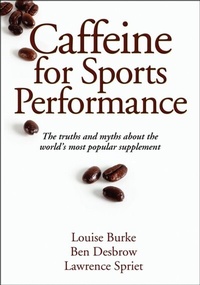
Caffeine for Sports Performance
1st Edition
Published on 23. August 2013
216 pages
978-1-4925-8221-2 (ISBN)
Description

Caffeine for Sports Performance is the definitive resource for all your questions regarding caffeine and its impact on sports performance. Based on the most recent research, studies, and guidelines, this guide is ideal for athletes and fitness enthusiasts looking to improve training and competition. Inside you will find these features:
* The history of how caffeine has become the most widely used drug in the world
* The pros and cons of using caffeine, including habitual daily caffeine intake, to boost sports performance
* Personal usage guides that can be applied to various sports or scenarios of caffeine use in training and competition
* Health advice regarding caffeine use
* Performance effects of caffeine use
* Safety considerations and potential risks
* Best and worst sources for caffeine
Caffeine for Sports Performance provides plenty of practical tips for using caffeine. In particular you will find sidebars that feature interviews with top athletes and coaches who have interesting stories to tell regarding their experiences using caffeine. You will also gain new insight into current attitudes towards caffeine and how those attitudes have changed over the years.
Caffeine for Sports Performance gives you all you need to understand and use caffeine to get the most out of your sport.
* The history of how caffeine has become the most widely used drug in the world
* The pros and cons of using caffeine, including habitual daily caffeine intake, to boost sports performance
* Personal usage guides that can be applied to various sports or scenarios of caffeine use in training and competition
* Health advice regarding caffeine use
* Performance effects of caffeine use
* Safety considerations and potential risks
* Best and worst sources for caffeine
Caffeine for Sports Performance provides plenty of practical tips for using caffeine. In particular you will find sidebars that feature interviews with top athletes and coaches who have interesting stories to tell regarding their experiences using caffeine. You will also gain new insight into current attitudes towards caffeine and how those attitudes have changed over the years.
Caffeine for Sports Performance gives you all you need to understand and use caffeine to get the most out of your sport.
More details
Language
English
Place of publication
Champaign, IL
United States
Publishing group
Human Kinetics Publishers
ISBN-13
978-1-4925-8221-2 (9781492582212)
Copyright in bibliographic data and cover images is held by Nielsen Book Services Limited or by the publishers or by their respective licensors: all rights reserved.
Schweitzer Classification
Other editions
Additional editions
Louise Burke | Ben Desbrow | Lawrence Spriet
Caffeine for Sports Performance
Book
08/2013
Human Kinetics
€38.59
Article exhausted; check different version
Persons
Professor Louise Burke is a sports dietician with nearly 30 years of experience in the counselling and education of elite athletes. Since 1990 she has served as the head of sports nutrition at the Australian Institute of Sport and served as the team dietician for the Australian Olympic team for five Summer Olympics from 1996-2012. Burke is also director of the International Olympic Committee diploma in sports nutrition and is part of the Nutrition Working Group of the IOC. Her research and education interests in sports supplements have included work on caffeine and sports performance. Louise has a very modest caffeine habit. She hates coffee and has never tried an energy drink, and her daily caffeine intake consists (to her husband's annoyance) of half-cups of weak black tea. She is committed to practicing her (also very modest) sporting ability. Towards the end of her annual marathon she consumes caffeinated cola drinks or sports confectionary, which gets her to the finish line with a smile on her face.
Dr. Ben Desbrow is a sports dietician and senior lecturer at Griffith University in Queensland, Australia. He completed his PhD in 2008 investigating the effects of cola beverages on endurance exercise performance. In 1999, Desbrow was awarded the first Nestle Fellowship in Sports Nutrition at the Australian Institute of Sport. Since that time he has worked with many sporting groups, including the 2000 British Olympic team and the Australian Institute of Sport Cricket Centre of Excellence. Desbrow has co-authored numerous articles on caffeine use by both athletes and the general population for scientific nutrition journals. Desbrow is currently conducting new studies investigating caffeine's ability to influence exercise performance. Ben has an addiction to iced coffee, which usually manifests as confusion around lunch time on most workdays. The solution can only be found by consuming 1 of 3 particular brands (he has a refined palate) or by his own homemade (secret) version. He completed his PhD investigating the effects of cola beverages on endurance performance--an achievement fuelled entirely by caffeine.
Dr. Lawrence L. Spriet is a professor in the department of human health and nutritional sciences at the University of Guelph in Guelph, Ontario, Canada. Dr Spriet received his bachelor's degree in kinesiology at the University of Waterloo, his master's degree in exercise physiology from York University in Toronto, and his doctoral degree in medical sciences from McMaster University. He was a post-doctoral fellow at Huddinge Hospital, Karolinska Institute in Stockholm, Sweden, and a visiting scientist in the School of Health Sciences, Deakin University, Melbourne, Australia. He has studied the regulation of fat and carbohydrate metabolism in skeletal muscle metabolism during exercise and has also worked on the effect of various nutritional and pharmacological interventions on athletic performance. His research output appears in numerous scientific journals, including Journal of Physiology, American Journal of Physiology, and Journal of Applied Physiology. Dr. Spriet is a member of the editorial board for the International Journal of Sports Medicine and the U.S.-based Sports Medicine Review Board of the Gatorade Sports Science Institute. He is also the chair of the Canadian Gatorade Sports Science Institute. Lawrence is a committed caffeine user. He first sampled the benefits of coffee use while completing his MSc degree many years ago. Coffee now starts his every day, except when he's volunteering for a caffeine withdrawal study! Two to three additional cups of coffee punctuate the day, and just having the cup on the desk is a positive influence on the many tasks that need to be done.
Dr. Ben Desbrow is a sports dietician and senior lecturer at Griffith University in Queensland, Australia. He completed his PhD in 2008 investigating the effects of cola beverages on endurance exercise performance. In 1999, Desbrow was awarded the first Nestle Fellowship in Sports Nutrition at the Australian Institute of Sport. Since that time he has worked with many sporting groups, including the 2000 British Olympic team and the Australian Institute of Sport Cricket Centre of Excellence. Desbrow has co-authored numerous articles on caffeine use by both athletes and the general population for scientific nutrition journals. Desbrow is currently conducting new studies investigating caffeine's ability to influence exercise performance. Ben has an addiction to iced coffee, which usually manifests as confusion around lunch time on most workdays. The solution can only be found by consuming 1 of 3 particular brands (he has a refined palate) or by his own homemade (secret) version. He completed his PhD investigating the effects of cola beverages on endurance performance--an achievement fuelled entirely by caffeine.
Dr. Lawrence L. Spriet is a professor in the department of human health and nutritional sciences at the University of Guelph in Guelph, Ontario, Canada. Dr Spriet received his bachelor's degree in kinesiology at the University of Waterloo, his master's degree in exercise physiology from York University in Toronto, and his doctoral degree in medical sciences from McMaster University. He was a post-doctoral fellow at Huddinge Hospital, Karolinska Institute in Stockholm, Sweden, and a visiting scientist in the School of Health Sciences, Deakin University, Melbourne, Australia. He has studied the regulation of fat and carbohydrate metabolism in skeletal muscle metabolism during exercise and has also worked on the effect of various nutritional and pharmacological interventions on athletic performance. His research output appears in numerous scientific journals, including Journal of Physiology, American Journal of Physiology, and Journal of Applied Physiology. Dr. Spriet is a member of the editorial board for the International Journal of Sports Medicine and the U.S.-based Sports Medicine Review Board of the Gatorade Sports Science Institute. He is also the chair of the Canadian Gatorade Sports Science Institute. Lawrence is a committed caffeine user. He first sampled the benefits of coffee use while completing his MSc degree many years ago. Coffee now starts his every day, except when he's volunteering for a caffeine withdrawal study! Two to three additional cups of coffee punctuate the day, and just having the cup on the desk is a positive influence on the many tasks that need to be done.
Content
Chapter 1 A Brief History
Chapter 2 What Is Caffeine and What Does It Do?
Chapter 3 Where Is It Found?
Chapter 4 How Is It Used?
Chapter 5 Does It Work?
Chapter 6 Is It Safe?
Chapter 7 Should It Be Legal?
Chapter 8 Recovery and Other Considerations
Chapter 9 Will It Work for You?
Chapter 10 Putting It All Together
Chapter 2 What Is Caffeine and What Does It Do?
Chapter 3 Where Is It Found?
Chapter 4 How Is It Used?
Chapter 5 Does It Work?
Chapter 6 Is It Safe?
Chapter 7 Should It Be Legal?
Chapter 8 Recovery and Other Considerations
Chapter 9 Will It Work for You?
Chapter 10 Putting It All Together
