

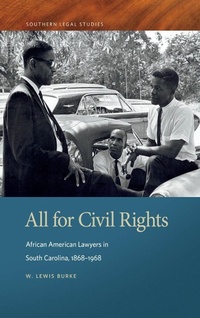
All for Civil Rights
Description

"The history of the black lawyer in South Carolina," writes W. Lewis Burke, "is one of the most significant untold stories of the long and troubled struggle for equal rights in the state." Beginning in Reconstruction and continuing to the modern civil rights era, 168 black lawyers were admitted to the South Carolina bar. All for Civil Rights is the first book-length study devoted to those lawyers' struggles and achievements in the state that had the largest black population in the country, by percentage, until 1930-and that was a majority black state through 1920.
Examining court processes, trials, and life stories of the lawyers, Burke offers a comprehensive analysis of black lawyers' engagement with the legal system. Some of that study is set in the courts and legislative halls, for the South Carolina bar once had the highest percentage of black lawyers of any southern state, and South Carolina was one of only two states to ever have a black majority legislature. However, Burke also tells who these lawyers were (some were former slaves, while others had backgrounds in the church, the military, or journalism); where they came from (nonnatives came from as close as Georgia and as far away as Barbados); and how they were educated, largely through apprenticeship.
Burke argues forcefully that from the earliest days after the Civil War to the heyday of the modern civil rights movement, the story of the black lawyer in South Carolina is the story of the civil rights lawyer in the Deep South. Although All for Civil Rights focuses specifically on South Carolinians, its argument about the legal shift in black personhood from the slave era to the 1960s resonates throughout the South.
More details
Other editions
Additional editions
Person
Content
- Cover
- Half Title
- Title
- Copyright
- Contents
- Acknowledgments
- List of Abbreviations
- INTRODUCTION
- CHAPTER 1 The Coming of Freedom
- CHAPTER 2 Reconstruction and the Birth of a New Kind of Lawyer
- CHAPTER 3 The Education of the New Lawyers
- CHAPTER 4 Law Practice in Reconstruction
- CHAPTER 5 The End of Reconstruction: Purge, Exodus, and Demise
- CHAPTER 6 New Lawyers
- CHAPTER 7 Law Practice and Politics in the Gilded Age
- CHAPTER 8 A Last Stand
- CHAPTER 9 From the Great Migration to the Great Depression
- CHAPTER 10 All-White Juries and the Continuing Struggle for Voting Rights
- CHAPTER 11 The 1940s and the Civil Rights Era
- CHAPTER 12 The Modern Civil Rights Era
- CHAPTER 13 A New Generation
- CONCLUSION
- APPENDIX A: African American Lawyers in South Carolina, 1868-1968
- APPENDIX B: Alphabetical List
- APPENDIX C: Read Law
- APPENDIX D: Law School Attended
- APPENDIX E: White Lawyers and Black Lawyers in Southern States
- Notes
- Index
- A
- B
- C
- D
- E
- F
- G
- H
- J
- K
- L
- M
- N
- O
- P
- Q
- R
- S
- T
- U
- V
- W
- Y
