

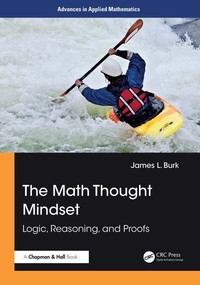
The Math Thought Mindset
Logic, Reasoning, and Proofs
Will be published approx. on 9. June 2026
341 pages
978-1-040-67086-6 (ISBN)
Description

The Math Thought Mindset: Logic, Reasoning, and Proofs prioritizes the understanding of how things work, which is crucial for mastering mathematics. This mindset is central in computer science, economics, artificial intelligence, data science, machine learning, and engineering, where analytical reasoning determines success. Mathematics is a language of reasoning that reveals deeper truths about our world.
This book embraces the Math Thought Mindset as a bridge between computational problem-solving and abstract mathematical reasoning. This text aims to develop mathematical intuition by guiding students to construct logical arguments, recognize patterns, and confidently write proofs.
This subtle shift in thinking distinguishes students who excel in mathematics from those who merely pass by memorizing steps. Many students struggle with mathematics because of how they were trained to rely on rote memorization. Students struggle because they have learned to focus on getting the right answer rather than understanding why an answer is correct, believing that mastering procedures is the same as mastering mathematical concepts.
This book challenges that notion. Readers will learn to construct arguments, recognize patterns, and think critically. Whether the reader is encountering formal proofs for the first time or needs to refine a skill set, this text is designed to guide the student of mathematics forward. By the end of this text, readers will improve problem-solving and foster a deeper mathematical understanding.
Step-by-step explanations and examples are presented through each section, aiming to bridge the gap between computational mathematics and abstract reasoning. Exercise sets contain a mix of problems requiring little background in proof-based mathematics and challenging problems for those seeking deeper engagement with the material.
This book embraces the Math Thought Mindset as a bridge between computational problem-solving and abstract mathematical reasoning. This text aims to develop mathematical intuition by guiding students to construct logical arguments, recognize patterns, and confidently write proofs.
This subtle shift in thinking distinguishes students who excel in mathematics from those who merely pass by memorizing steps. Many students struggle with mathematics because of how they were trained to rely on rote memorization. Students struggle because they have learned to focus on getting the right answer rather than understanding why an answer is correct, believing that mastering procedures is the same as mastering mathematical concepts.
This book challenges that notion. Readers will learn to construct arguments, recognize patterns, and think critically. Whether the reader is encountering formal proofs for the first time or needs to refine a skill set, this text is designed to guide the student of mathematics forward. By the end of this text, readers will improve problem-solving and foster a deeper mathematical understanding.
Step-by-step explanations and examples are presented through each section, aiming to bridge the gap between computational mathematics and abstract reasoning. Exercise sets contain a mix of problems requiring little background in proof-based mathematics and challenging problems for those seeking deeper engagement with the material.
More details
Series
Language
English
Place of publication
London
United Kingdom
Publishing group
Taylor & Francis Ltd
Target group
College/higher education
Product notice
Reflowable
Illustrations
98 Tables, color; 9 Tables, black and white; 62 Line drawings, color; 5 Line drawings, black and white; 8 Halftones, color; 2 Halftones, black and white; 70 Illustrations, color; 7 Illustrations, black and white
File size
20,10 MB
ISBN-13
978-1-040-67086-6 (9781040670866)
Copyright in bibliographic data and cover images is held by Nielsen Book Services Limited or by the publishers or by their respective licensors: all rights reserved.
Schweitzer Classification
Other editions
Additional editions
Book
approx. 06/2026
1st Edition
Chapman & Hall/CRC
€85.50
Not yet published
Book
approx. 06/2026
1st Edition
Chapman & Hall/CRC
€234.50
Not yet published
Person
James L. Burk is Professor of Mathematics at Harding University, where he teaches linear algebra, discrete mathematics, proof writing, and graph theory. He is the department's Putnam Exam Supervisor and an AP Calculus Reader for the College Board. Beyond the classroom, Dr. Burk engages students worldwide through online platforms at MathThought.com. He also serves as a lead mathematician and expert reviewer on artificial intelligence research projects. His mathematical interests include topics found in discrete mathematics and linear algebra.
Content
1. Logic Basics 2. Deductive Reasoning 3. Elementary Set Theory 4. Proof Methods 5. Boolean Algebra
