

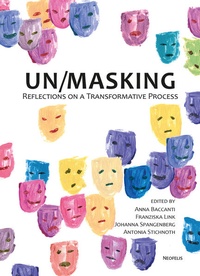
Un/Masking
Description

This volume looks at masking and unmasking as indivisible aspects of the same process. It gathers articles from a wide range of disciplines and addresses un/masking both as a historical and a contemporary phenomenon. By highlighting the performative dimensions of un/masking, it challenges dichotomies like depth and surface, authenticity and deception, that play a central role in masks being commonly associated with illusion and dissimulation.
The contributions explore topics such as the relationship between face, mask, and identity in artistic contexts ranging from Surrealist photography to video installations and from Modernist poetry to fin-de-siècle cabaret theater. They investigate un/masking as a process of transition and transformation - be it in the case of the wooden masks of the First Nations of the American Northwest Coast or of the elaborate costumes and vocal masking of pop icon Lady Gaga.
In all of these instances, the act of un/masking has the power to simultaneously hide and reveal. It destabilizes supposedly fixed identities and blurs the lines between the self and the other, the visible and the invisible. The volume offers new perspectives on current debates surrounding issues such as protective masks in public spaces, facial recognition technologies, and colonial legacies in monuments and museums, offering insight into what the act of un/masking can mean today.
With contributions by Laurette Burgholzer, Joyce Cheng, Sarah Hegenbart, Bethan Hughes, Judith Kemp, Christiane Lewe, W. Anthony Sheppard, Bernhard Siegert, Anja Wächter, and Eleonore Zapf.
More details
Other editions
Additional editions
Persons
Anna Baccanti studied comparative literature and philosophy at Freie Universität Berlin and Scuola Normale Superiore in Pisa and was a visiting scholar at Columbia University in New York. Currently, she is a doctoral candidate at Ludwig-Maximilians-Universität München and is affiliated with the International Doctoral Program MIMESIS and the Junior Research Group Creativity and Genius. Her PhD thesis focuses on representations of the creative process in biographical films.
Franziska Link studied comparative literature, philosophy, Finnish language and culture, and Slavic studies at Ludwig-Maximilians-Universität München, University of Helsinki (2015), and State University in Saint Petersburg (2019). In 2019, she was a visiting scholar at the Pushkin House in Saint Petersburg. She is currently working on her PhD thesis on 'drastic voices' in the works of Fyodor Dostoevsky and Louis-Ferdinand Céline (in affiliation with the International Doctoral Program MIMESIS).
Johanna Spangenberg studied comparative literature and musicology at Ludwig-Maximilians-Universität München and King's College London and has been a visiting scholar at Harvard University. She was a doctoral candidate at the International Doctoral Program MIMESIS from 2017 to 2020 and currently holds a scholarship from the Stiftung Bildung und Wissenschaft to complete her PhD thesis on the relationship between poetry and music in the works of Stéphane Mallarmé, Pierre Boulez, and Gilles Deleuze.
Antonia Stichnoth studied comparative literature and film studies at Freie Universität Berlin and École Normale Supérieure in Paris. Since 2017, she has been a PhD candidate at Ludwig-Maximilians-Universität München, where she also works as a research assistant. Her dissertation deals with the genre of the newspaper inquiry (Rundfrage) in the Weimar Republic. She was a visiting scholar at Columbia University in New York and is an associated member of the International Doctoral Program MIMESIS.
Content
- Cover
- Half Title
- Title Page
- Table of Contents
- Anna Baccanti / Franziska Link / Johanna Spangenberg / Antonia Stichnoth: Paradigms of Transformation and Contemporary Perspectives. Introduction
- 1. Inside Out. The Liminal Space of Un/Masking
- Laurette Burgholzer: Facing Trouble. On Conjunctures of Theatrical Masking and Unmasking
- Bernhard Siegert: Switching Perspectives. The Operative Ontology of the Transformation Masks of the American Northwest Coast
- Bethan Hughes: Corpsing. CGI as Grotesque Realism in the Work of Ed Atkins
- 2. Expressive Sur/Face. Looking Beyond the Mask
- Anja Wächter: Creative Incognito. Stefan Moses' Künstler hinter Masken
- Joyce Suechun Cheng: Style as Mask. Toward a Surrealist Theory of Expression
- Christiane Lewe: Surface and Depth. The Revival of Physiognomy in Deep Learning
- 3. A Multitude of Selves. Artistic Personae, Identity, and Representation
- Eleonore Zapf: Thoughts Becoming Persons. Fernando Pessoa's Existential Carnival
- Judith Kemp: "Wüstes Farbengetändel". Peter Altenberg's Masken in Cabaret Fledermaus
- W. Anthony Sheppard: Morality and Meaning in Lady Gaga's Vocal Masking
- Sarah Hegenbart: Redressing History in South Africa. Sethembile Msezane and Mary Sibande and Their Masking of the Black Body
- Table of Figures
- Contributors
- Colophon
