

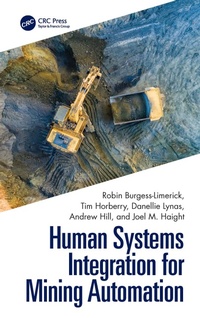
Human Systems Integration for Mining Automation
1st Edition
Published on 12. February 2025
164 pages
978-1-040-27703-4 (ISBN)
Description

Human Systems Integration for Mining Automation is the professional's guide to understanding the issues, approaches, and pitfalls associated with mining automation from a human perspective. This book delves into a timely and fast-developing issue in mining and the wider minerals industry - the design and deployment of automation.
The book approaches this from a "Human Systems Integration" standpoint in which the technical and human-related aspects are jointly considered as part of an integrated, automated mining system. This accessible and readable title offers a wider Human Systems Integration framework that can be applied to mining projects. It is based on an established framework that has been developed and used successfully in other work. The framework is backed up with information obtained from mines in Australia, the USA, Canada, Sweden, and Chile and original equipment manufacturers such as Caterpillar, Komatsu, Sandvik and Epiroc. Every reader of this book will recognise the essential benefits of human systems integration for mining automation.
This book will be an ideal read for industry professionals including systems engineers, safety engineers, mining engineers, human factors engineers, and engineers working on developing and deploying automation in mining and related industries including rail, road transport, and process control. It will also be of interest to students, researchers, and academics in related fields.
The book approaches this from a "Human Systems Integration" standpoint in which the technical and human-related aspects are jointly considered as part of an integrated, automated mining system. This accessible and readable title offers a wider Human Systems Integration framework that can be applied to mining projects. It is based on an established framework that has been developed and used successfully in other work. The framework is backed up with information obtained from mines in Australia, the USA, Canada, Sweden, and Chile and original equipment manufacturers such as Caterpillar, Komatsu, Sandvik and Epiroc. Every reader of this book will recognise the essential benefits of human systems integration for mining automation.
This book will be an ideal read for industry professionals including systems engineers, safety engineers, mining engineers, human factors engineers, and engineers working on developing and deploying automation in mining and related industries including rail, road transport, and process control. It will also be of interest to students, researchers, and academics in related fields.
More details
Edition
1. Auflage
Language
English
Place of publication
London
United Kingdom
Publishing group
Taylor & Francis Ltd
Target group
College/higher education
Professional and scholarly
Illustrations
11 Tables, black and white; 11 Line drawings, black and white; 15 Halftones, black and white; 26 Illustrations, black and white
File size
3,88 MB
ISBN-13
978-1-040-27703-4 (9781040277034)
Copyright in bibliographic data and cover images is held by Nielsen Book Services Limited or by the publishers or by their respective licensors: all rights reserved.
Schweitzer Classification
Other editions
Additional editions
Robin Burgess-Limerick | Tim Horberry | Danellie Lynas
Human Systems Integration for Mining Automation
Book
approx. 06/2026
1st Edition
CRC Press
€69.00
Not yet published
Robin Burgess-Limerick | Tim Horberry | Danellie Lynas
Human Systems Integration for Mining Automation
Book
02/2025
1st Edition
CRC Press
€120.80
Shipment within 10-20 days
Persons
Professor Robin Burgess-Limerick is a Professorial Research Fellow in the Minerals Industry Safety and Health Centre at the University of Queensland in Australia. Robin is a past-President and Fellow of the Human Factors and Ergonomics Society of Australia. He is the second author of "Human-Centered Design for Mining Equipment and New Technology" (2018) and "Human Factors for the Design, Operation, and Maintenance of Mining Equipment" (2011).
Professor Tim Horberry is Professor of Human Centred Safe Design at the University of Queensland in Australia. He is the first author of "Human-Centered Design for Mining Equipment and New Technology" (2018) and "Human Factors for the Design, Operation, and Maintenance of Mining Equipment" (2011).
Dr Danellie Lynas is a Senior Research Fellow within the Minerals Industry Safety and Health Centre, Sustainable Minerals Institute at the University of Queensland, Australia. She is a Certified Professional Ergonomist and has previously conducted research in the area of mining automation.
Associate Professor Andrew Hill is Principal Research Fellow within the Minerals Industry Safety and Health Centre, Sustainable Minerals Institute, The University of Queensland. He has a PhD in Cognitive Psychology, and has conducted research in applied cognitive psychology across diverse industries.
Professor Joel Haight is Professor of Industrial Engineering, Swanson School of Engineering at University of Pittsburgh, USA. He has a PhD in Industrial and Systems Engineering from Auburn University and has spent 21 years as researcher and professor, 4 years as research manager in U.S. Federal government, and 18 years as an engineer and manager in the oil industry.
Professor Tim Horberry is Professor of Human Centred Safe Design at the University of Queensland in Australia. He is the first author of "Human-Centered Design for Mining Equipment and New Technology" (2018) and "Human Factors for the Design, Operation, and Maintenance of Mining Equipment" (2011).
Dr Danellie Lynas is a Senior Research Fellow within the Minerals Industry Safety and Health Centre, Sustainable Minerals Institute at the University of Queensland, Australia. She is a Certified Professional Ergonomist and has previously conducted research in the area of mining automation.
Associate Professor Andrew Hill is Principal Research Fellow within the Minerals Industry Safety and Health Centre, Sustainable Minerals Institute, The University of Queensland. He has a PhD in Cognitive Psychology, and has conducted research in applied cognitive psychology across diverse industries.
Professor Joel Haight is Professor of Industrial Engineering, Swanson School of Engineering at University of Pittsburgh, USA. He has a PhD in Industrial and Systems Engineering from Auburn University and has spent 21 years as researcher and professor, 4 years as research manager in U.S. Federal government, and 18 years as an engineer and manager in the oil industry.
Content
Acknowledgements
About the authors
List of Contributors
Chapter 1: Human Systems Integration and Automated Mining
Chapter 2: Automation benefits and failure modes
Chapter 3: Best practice in other industries
Chapter 4: Existing guidance for the mining industry
Chapter 5: Case Studies of Human Systems Integration in Automated Mining
Chapter 6: Risk assessments for mining automation
By guest author Professor Maureen Hassall
Chapter 7: Human systems integration for mining automation
References
About the authors
List of Contributors
Chapter 1: Human Systems Integration and Automated Mining
Chapter 2: Automation benefits and failure modes
Chapter 3: Best practice in other industries
Chapter 4: Existing guidance for the mining industry
Chapter 5: Case Studies of Human Systems Integration in Automated Mining
Chapter 6: Risk assessments for mining automation
By guest author Professor Maureen Hassall
Chapter 7: Human systems integration for mining automation
References
