

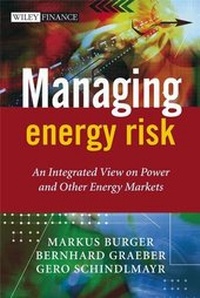
Managing Energy Risk
Description

More details
Other editions
New editions

Additional editions

Persons
Content
Preface.
1 Energy Markets.
1.1 The oil market.
1.1.1 Consumption, production and reserves.
1.1.2 Crude oil trading.
1.1.3 Refined oil products.
1.2 The natural gas market.
1.2.1 Consumption, production and reserves.
1.2.2 Natural gas trading.
1.2.3 Price formulas with oil indexation.
1.2.4 Liquefied natural gas.
1.3 The coal market.
1.3.1 Consumption, production and reserves.
1.3.2 Coal trading.
1.3.3 Freight.
1.3.4 Coal subsidies in Germany: BAFA-indexed prices.
1.4 The electricity market.
1.4.1 Consumption and production.
1.4.2 Electricity trading.
1.4.3 Products in the electricity markets.
1.4.4 Energy exchanges.
1.5 The emissions market.
1.5.1 Kyoto Protocol.
1.5.2 EU emissions trading scheme.
1.5.3 Flexible mechanisms.
1.5.4 Products and market places.
1.5.5 Emissions trading in North America.
2 Energy Derivatives.
2.1 Forwards, futures and swaps.
2.1.1 Forward contracts.
2.1.2 Futures contracts.
2.1.3 Swaps.
2.2 "Plain vanilla" options.
2.2.1 The put-call parity and option strategies.
2.2.2 Black's futures price model.
2.2.3 Option pricing formulas.
2.2.4 Hedging options: the "Greeks".
2.2.5 Implied volatilities and the "volatility smile".
2.2.6 Swaptions.
2.3 American and Asian options.
2.3.1 American options.
2.3.2 Asian options.
2.4 Commodity bonds and loans.
2.5 Multi-underlying options.
2.5.1 Basket options.
2.5.2 Spread options.
2.5.3 Quanto and composite options.
2.6 Spot price options.
2.6.1 Pricing spot price options.
2.6.2 Caps and floors.
2.6.3 Swing options.
2.6.4 Virtual storage.
3 Commodity Price Models.
3.1 Forward curves and the market price of risk.
3.1.1 Investment assets.
3.1.2 Consumption assets and convenience yield.
3.1.3 Contango, backwardation and seasonality.
3.1.4 The market price of risk.
3.1.5 Derivatives pricing and the risk-neutral measure.
3.2 Commodity spot price models.
3.2.1 Geometric Brownian motion.
3.2.2 The one-factor Schwartz model.
3.2.3 The Schwartz-Smith model.
3.3 Stochastic forward curve models.
3.3.1 One-factor forward curve models.
3.3.2 A two-factor forward curve model.
3.3.3 A multi-factor exponential model.
3.4 Electricity price models.
3.4.1 The hourly forward curve.
3.4.2 The SMaPS model.
3.4.3 Regime-switching model.
3.5 Multi-commodity models.
3.5.1 Regression analysis.
3.5.2 Correlation analysis.
3.5.3 Cointegration.
3.5.4 Model building.
4 Fundamental Market Models.
4.1 Fundamental price drivers in electricity markets.
4.1.1 Demand side.
4.1.2 Supply side.
4.1.3 Interconnections.
4.2 Economic power plant dispatch.
4.2.1 Thermal power plants.
4.2.2 Hydro power plants.
4.2.3 Optimisation methods.
4.3 Methodological approaches.
4.3.1 Merit order curve.
4.3.2 Optimisation models.
4.3.3 System dynamics.
4.3.4 Game theory.
4.4 Relevant system information for electricity market modelling.
4.4.1 Demand side.
4.4.2 Supply side.
4.4.3 Transmission system.
4.4.4 Historical data for backtesting.
4.4.5 Information sources.
4.5 Application of electricity market models.
4.6 Gas market models.
4.6.1 Demand side.
4.6.2 Supply side.
4.6.3 Transport.
4.6.4 Storage.
4.6.5 Portfolio optimisation.
4.6.6 Formulation of the market model.
4.6.7 Application of gas market models.
4.7 Market models for oil, coal, and CO2 markets.
5 Electricity Retail Products.
5.1 Interaction of wholesale and retail markets.
5.2 Retail products.
5.2.1 Common full service contracts.
5.2.2 Indexed contracts.
5.2.3 Partial delivery contracts.
5.2.4 Portfolio management.
5.2.5 Supplementary products.
5.3 Sourcing.
5.3.1 Business-to-business (B2B).
5.3.2 Business-to-consumer (B2C).
5.3.3 Small accounts.
5.3.4 Municipalities and reseller.
5.4 Load forecasting.
5.5 Risk premium.
5.5.1 Price validity period.
5.5.2 Balancing power.
5.5.3 Credit risk.
5.5.4 Price-volume correlation.
5.5.5 Strict risk premiums.
5.5.6 Hourly price profile risk.
5.5.7 Volume risk.
5.5.8 Operational risk.
5.5.9 Risk premium summary.
6 Risk Management.
6.1 Market price exposure.
6.1.1 Delta position.
6.1.2 Variance minimising hedging.
6.2 Value-at-Risk and further risk measures.
6.2.1 Definition of Value-at-Risk.
6.2.2 Parameters of the Value-at-Risk measure.
6.2.3 Computation methods.
6.2.4 Liquidity-adjusted Value-at-Risk.
6.2.5 Estimating volatilities and correlations.
6.2.6 Backtesting.
6.2.7 Further risk measures.
6.3 Credit risk.
6.3.1 Legal risk.
6.3.2 Quantifying credit risk.
6.3.3 Credit rating.
Appendices.
A Mathematical background.
A.1 Econometric methods.
A.1.1 Linear regression.
A.1.2 Stationary time series and unit root tests.
A.1.3 Principal component analysis.
A.1.4 Kalman filtering method.
A.1.5 Regime-switching models.
A.2 Stochastic processes.
A.2.1 Conditional expectation and martingales.
A.2.2 Brownian motion.
A.2.3 Stochastic integration and Itô's lemma.
A.2.4 The Feynman-Kac theorem.
A.2.5 Monte Carlo simulation.
Bibliography.
Index.
