

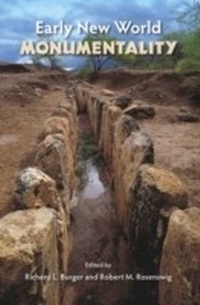
Early New World Monumentality
Description

In studies of ancient civilizations, the focus is often on the temples, palaces, and buildings created and then left behind, both because they survive and because of the awe they still inspire today. From the Mississippian mounds in the United States to the early pyramids of Peru, these monuments have been well-documented, but less attention has been paid to analyzing the logistical complexity involved in their creation.
In this collection, prominent archaeologists explore the sophisticated political and logistical organizations that were required to plan and complete these architectural marvels. They discuss the long-term political, social, and military impacts these projects had on their respective civilizations, and illuminate the significance of monumentality among early complex societies in the Americas.
Early New World Monumentality is ultimately a study of labor and its mobilization, as well as the long-term spiritual awe and political organization that motivated and were enhanced by such undertakings. Mounds and other impressive monuments left behind by earlier civilizations continue to reveal their secrets, offering profound insights into the development of complex societies throughout the New World.
All prices
More details
Other editions
Additional editions
Content
- Cover
- Title Page
- Copyright Page
- Table of Contents
- List of Figures
- List of Tables
- Part I. Introduction
- 1. Considering Early New World Monumentality
- Part II. North America
- 2. Early Mounds in the Lower Mississippi Valley
- 3. Shell Mounds of the Middle St. Johns Basin, Northeast Florida
- 4. Monumentality in Eastern North America during the Mississippian Period
- Part III. Mesoamerica
- 5. Agriculture and Monumentality in the Soconusco Region of Chiapas, Mexico
- 6. Early Olmec Wetland Mounds: Investing Energy to Produce Energy
- 7. The Origins of Monumentality in Ancient Guerrero, Mexico
- 8. Early Civilization in the Maya Lowlands, Monumentality, and Place Making: A View from the Holmul Region
- Part IV. Intermediate Area
- 9. Monumental Architecture and Social Complexity in the Intermediate Area
- Part V. South America
- 10. Early Mounds and Monumental Art in Ancient Amazonia: History, Scale, Function, and Social Ecology
- 11. Why Do People Build Monuments? Late Archaic Platform Mounds in the Norte Chico
- 12. Monumental Architecture Arising from an Early Astronomical-Religious Complex in Perú, 2200-1750 bc
- 13. Preceramic and Initial Period Monumentality within the Casma Valley of Peru
- 14. Monumental Public Complexes and Agricultural Expansion on Peru's Central Coast during the Second Millennium bc
- 15. Agricultural Terraces as Monumental Architecture in the Titicaca Basin: Their Origins in the Yaya-Mama Religious Tradition
- Part VI. Conclusion
- 16. A West Asian Perspective on Early Monuments
- List of Contributors
- Index
