

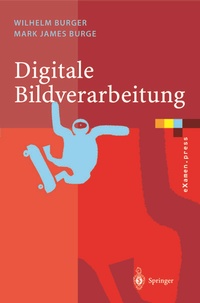
Digitale Bildverarbeitung
Description

Die Autoren geben eine fundierte Einführung in die wichtigsten Methoden der digitalen Bildverarbeitung. Dabei steht die praktische Anwendbarkeit im Vordergrund, formale und mathematische Aspekte sind auf das Wesentliche reduziert, ohne dabei auf eine präzise und konsistente Vorgehensweise zu verzichten.
Der Text eignet sich für technisch orientierte Studiengänge ab dem 3.Semester und basiert auf der mehrjährigen Lehrerfahrung der Autoren zu diesem Thema. Der Einsatz in der Lehre wird durch zahlreiche praktische Übungsaufgaben unterstützt. Das Buch eignet sich auch als detaillierte Referenz für Praktiker und Anwender gängiger Verfahren der digitalen Bildverarbeitung, z.B. in der Medizin, der Materialprüfung, der Robotik oder der Medientechnik.
Softwareseitig basiert das Buch auf der in Java implementierten und frei verfügbaren Bildverarbeitungsumgebung ImageJ.
More details
Other editions
Additional editions
Persons
Zur Vita von Herrn Dr. Burger:
Ausbildung: Master of Science (University of Utah, Computer Science), Promotion an der Johannes Kepler Universität Linz. Post-Doctoral Researcher, University of California.
Berufliche Tätigkeit: Entwicklungstechniker (Bildgebende Systeme in der Ultraschallmedizin); Research Associate (Honeywell Systems and Research Center, Minneapolis); Universitäts-Assistent an der Johannes Kepler Universität Linz (FWF-Forschungsschwerpunkt "Digitale Bildverarbeitung"); derzeit Leiter des FH-Studiengangs "Medientechnik und -Design" an der FH-Hagenberg.
Zur Vita von Herrn Dr. Burge:
He earned his doctorate degree in Computer Science at the Johannes Kepler University in Austria while a research scientist in the Austrian Science Foundation's Robust and Adaptive Methods for Image Understanding research program. He also earned a Bachelor of Arts in Computer Science from Ohio Wesleyan University, completed the fifth year's honors courses in Computer Science at the University of Aberdeen in Scotland and earned a Masters of Science in Computer Science from the Ohio State University.
He spent a number of years as a researcher at the Department of Computer Science at the Swiss Federal Institute of Technology (ETH) in Zurich, Switzerland as part of the Swiss Federal Commission for the Advancement of Scientific Research's Automatic Interpretation of Cadastral Maps project and at the Ohio State University as a postdoc in their NASA Commercial Space Center's Image Understanding and Interpretation project.
Associate Professor in Computer Science (a CSAB accredited department within the School of Computing with a total of 24 faculty members, 21 with earned Doctorate degrees and around 300 majors) at Armstrong Atlantic State University (a comprehensive Carnegie Master's University I of 6500 undergraduate and master's students that is part ofthe University System of Georgia).
