

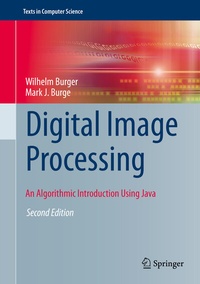
Digital Image Processing
Description

The text is supported by practical examples and carefully constructed chapter-ending exercises drawn from the authors' years of teaching experience, including easily adaptable Java code and completely worked out examples. Source code, test images and additional instructor materials are also provided at an associated website. Digital Image Processing is the definitive textbook for students, researchers, and professionals in search of critical analysis and modern implementations of the most important algorithms in the field, andis also eminently suitable for self-study.
Reviews / Votes
"This textbook is an excellent introduction to the fundamentals of digital image processing. It thoroughly blends basic theory and practical algorithms expressed in Java and Image. It also provides a set of accessible exercises at the end of each chapter. It is suitable as a two-semester textbook for third-year undergraduates." (B. Belkhouche, Computing Reviews, November, 2016)More details
Other editions
Additional editions
Previous edition
Persons
Dr. Wilhelm Burger is a faculty member of the University of Applied Sciences Upper Austria, Hagenberg, where he serves as Director of the Digital Media degree programs at the School of Informatics, Communications and Media.
Dr. Mark J. Burge
is a scientist at the non-profit organization Noblis in Falls Church, VA, USA. His other publications include the
Handbook of Iris Recognition
.
Content
Digital Images.- ImageJ.- Histograms and Image Statistics.- Point Operations.- Filters.- Edges and Contours.- Corner Detection.- Finding Simple Curves: The Hough Transform.- Morphological Filters.- Regions in Binary Images.- Automatic Thresholding.- Color Images.- Color Quantization.- Colorimetric Color Spaces.- Filters for Color Images.- Edge Detection in Color Images.- Edge-Preserving Smoothing Filters.- Introduction to Spectral Techniques.- The Discrete Fourier Transform in 2D.- The Discrete Cosine Transform (DCT).- Geometric Operations.- Pixel Interpolation.- Image Matching and Registration.- Non-Rigid Image Matching.- Scale-Invariant Feature Transform (SIFT).- Fourier Shape Descriptors.- Appendix A: Mathematical Symbols and Notation.- Appendix B: Linear Algebra.- Appendix C: Calculus.- Appendix D: Statistical Prerequisites.- Appendix E: Gaussian Filters.- Appendix F: JavaNotes.
