

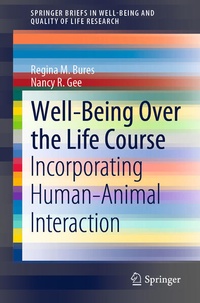
Well-Being Over the Life Course
Description

More details
Other editions
Additional editions
Persons
Regina M. Bures, Ph.D., is Senior Program Director at the Eunice Kennedy Shriver National Institute of Child Health and Human Development (NICHD) of the National Institutes of Health. At NICHD, Dr. Bures manages a diverse scientific portfolio in demography and population health. She has been an active contributor to the NICHD-Waltham partnership.
Dr. Bures received her Ph.D. in Sociology, with a specialization in Demography, from Brown University, and completed a postdoctoral fellowship at the University of Chicago. Dr. Bures has received numerous grants and awards, including research funding from the National Science Foundation and the National Institute of Aging. Her research interests include human-animal interaction, child and family health across the life course, and research methods. She currently lives on a small farm with her husband, dogs, cats, and sheep.
Nancy R. Gee, Ph.D., is Professor of Psychiatry, Bill Balaban Chair of Human-Animal Interaction, and Director of the Center for Human-Animal Interaction in the School of Medicine at Virginia Commonwealth University. Previously, Dr. Gee served as the Human-Animal Interaction Research Manager, for the Waltham Petcare Science Institute in Leicestershire England. She has published extensively on HAI, including her most recent book, How Animals Help Students Learn: Research and Practice for Educators and Mental-Health Professionals.
Dr. Gee continues to pursue research in HAI across the lifespan, seeking to identify the ways in which interactions with companion animals affect human cognition, mental, and physical health. Concern for the animal's welfare and quality of life is a primary consideration for Dr. Gee, both in the Dogs on Call hospital visitation program she administers and in her various research and writing projects. Dr. Gee is a recipient of multiple grants and awards, a member of several organizational boards and journal editorial advisory boards, a reviewer of HAI research grant proposals, and a frequent presenter at national and international HAI conferences.
Content
1. Introduction.- 2. Family Life Cycle and the Role of Pets.- 3. Aging Pets and Well-Being.-4. Health over the Life Course and HAI.- 5. Child Health and Development.- 6. Successful Aging and HAI.- 7. Animal-Assisted Interventions and Well-Being over the Life Course.- 8. Conclusion.
