

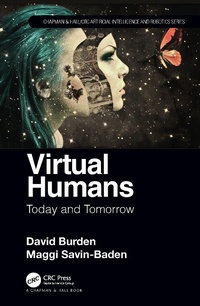
Virtual Humans
Today and Tomorrow
1st Edition
Published on 24. January 2019
318 pages
978-1-351-36526-0 (ISBN)
Description

Virtual Humans provides a much-needed definition of what constitutes a 'virtual human' and places virtual humans within the wider context of Artificial Intelligence development. It explores the technical approaches to creating a virtual human, as well as emergent issues such as embodiment, identity, agency and digital immortality, and the resulting ethical challenges. The book presents an overview of current research and practice in this area, and outlines the major challenges faced by today's developers and researchers. The book examines the possibility for using virtual humans in a variety of roles, from personal assistants to teaching, coaching and knowledge management, and the book situates these discussions around familiar applications (e.g. Siri, Cortana, Alexa) and the portrayal of virtual humans within Science Fiction.
Features
Presents a comprehensive overview of this rapidly developing field
Provides an array of relevant, real-life examples from expert practitioners and researchers from around the globe in how to create the avatar body, mind, senses and ability to communicate
Intends to be broad in scope yet practical in approach, so that it can serve the needs of several different audiences, including researchers, teachers, developers and anyone with an interest in where these technologies might take us
Covers a wide variety of issues which have been neglected in other research texts; for example, definitions and taxonomies, the ethical challenges of virtual humans and issues around digital immortality
Includes numerous examples and extensive references
Features
Presents a comprehensive overview of this rapidly developing field
Provides an array of relevant, real-life examples from expert practitioners and researchers from around the globe in how to create the avatar body, mind, senses and ability to communicate
Intends to be broad in scope yet practical in approach, so that it can serve the needs of several different audiences, including researchers, teachers, developers and anyone with an interest in where these technologies might take us
Covers a wide variety of issues which have been neglected in other research texts; for example, definitions and taxonomies, the ethical challenges of virtual humans and issues around digital immortality
Includes numerous examples and extensive references
Reviews / Votes
"This book presents an overview of the present state of play with virtual humans. Appearance, attributes, communication and intelligence are all investigated, and the architectures involved are covered in detail. If you have little knowledge of what a virtual human is, but want to find out, then this is the book for you. For researchers in the virtual human field this is a definite must."-Professor Kevin Warwick, Coventry University
"David Burden and Maggi Savin-Baden's Virtual Humans offers a thorough, research-based treatment of how digital entities with human-like features and capabilities have left the domain of science fiction and are rapidly becoming a major aspect of human culture. In their clearly-written and well-organized work, they describe the current forms and abilities of virtual humans (including smart speakers and virtual assistant systems like Siri, Alexa, and Cortana and various types of Internet-based chatbots); examine how the creation of virtual bodies, senses, and minds can be combined to create virtual humans; and consider potential developments in the nature and functionality of virtual agents across a range of timeframes from the end of the next decade to the end of the century. Significantly, the authors recognize and discuss the great ethical, moral and social implications of these technological developments which makes their work relevant and important for the social sciences and humanities as well as the domains of computing and information sciences. I certainly intend to use Virtual Humans as an assigned reading in the interdisciplinary courses I teach on the personal and social impact of leading-edge digital technologies."
-Richard Gilbert, Professor of Psychology and Director of the Psychology and New Technology Research Lab, Loyola Marymount University, Los Angeles, California
"Intelligent, pragmatic and insightful,
More details
Series
Edition
1. Auflage
Language
English
Place of publication
London
United Kingdom
Publishing group
Taylor & Francis Ltd
Target group
Professional and scholarly
Product notice
Reflowable
Illustrations
9 Tables, black and white; 41 Illustrations, black and white
File size
4,63 MB
ISBN-13
978-1-351-36526-0 (9781351365260)
Copyright in bibliographic data and cover images is held by Nielsen Book Services Limited or by the publishers or by their respective licensors: all rights reserved.
Schweitzer Classification
Other editions
Additional editions
Book
09/2020
1st Edition
Chapman & Hall/CRC
€52.50
Shipment within 15-20 days
Book
02/2019
1st Edition
CRC Press
€84.30
Shipment within 10-20 days
Persons
David Burden is a Chartered European Engineer and the Founder and CEO of Daden Limited
Maggi Savin-Baden is a Professor of Education at the University of Worcester
Maggi Savin-Baden is a Professor of Education at the University of Worcester
Content
Introduction
Part I The Landscape
Chapter 1 What are Virtual Humans?
Chapter 2 Virtual Humans and Artificial Intelligence
Part II Technology
Chapter 3 Body and Senses
Chapter 4 Mind
Chapter 5 Communication
Chapter 6 Architecture
Chapter 7 Embodiment
Chapter 8 Assembling and Assemblages
Part III Identity
Chapter 9 Digital Ethics
Chapter 10 Identity and Agency
Chapter 11 Virtual Humans for Education
Chapter 12 Digital Immortality
Chapter 13 Futures and Possibilities
Glossary
Part I The Landscape
Chapter 1 What are Virtual Humans?
Chapter 2 Virtual Humans and Artificial Intelligence
Part II Technology
Chapter 3 Body and Senses
Chapter 4 Mind
Chapter 5 Communication
Chapter 6 Architecture
Chapter 7 Embodiment
Chapter 8 Assembling and Assemblages
Part III Identity
Chapter 9 Digital Ethics
Chapter 10 Identity and Agency
Chapter 11 Virtual Humans for Education
Chapter 12 Digital Immortality
Chapter 13 Futures and Possibilities
Glossary
