

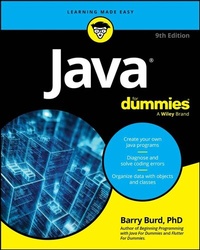
Java For Dummies
Description

Learn to code with Java and open the gate to a rewarding career
Now in its 9th edition, Java For Dummies gives you the essential tools you need to understand the programming language that 17 million software developers rely on. This beginner-friendly guide simplifies every step of the learning process. You'll learn the basics of Java and jump into writing your own programs. Along the way, you'll gain the skills you need to reuse existing code, create new objects, troubleshoot when things go wrong, and build working programs from the ground up. Java For Dummies will help you become a Java developer, even if you're brand new to the world of coding.
- Learn the basic syntax and building blocks of Java
- Begin to write your own programs in the latest Java version
- Test out your code and problem-solve any errors you find
- Discover techniques for writing code faster
This is the must-have Dummies resource for beginning programmers and students who need a step-by-step guide to getting started with Java. You'll also love this book if you're a seasoned programmer adding another language to your repertoire.
More details
Other editions
Additional editions
Person
Dr. Barry Burd is a professor of Mathematics and Computer Science at Drew University in Madison, NJ. He's a co-leader of the Garden State Java User Group and New York JavaSIG. In 2020, he was honored to be named a Java Champion. He's the author of Beginning Programming with Java For Dummies and Flutter For Dummies.
Content
Introduction 1
Part 1: Getting Started with Java 5
Chapter 1: All about Java 7
Chapter 2: All about Software. 21
Chapter 3: Using the Basic Building Blocks 35
Part 2: Writing Your Own Java Programs 57
Chapter 4: Making the Most of Variables and Their Values 59
Chapter 5: Controlling the Flow by Making Decisions 97
Chapter 6: Controlling Program Flow with Loops 135
Part 3: Working with the Big Picture: Object-Oriented Programming 155
Chapter 7: The Inside scOOP 157
Chapter 8: Constructing New Objects 205
Chapter 9: Piles of Files: Dealing with Information Overload 229
Chapter 10: Saving Time and Money: Reusing Existing Code 249
Part 4: Smart Java Techniques 279
Chapter 11: Putting Variables and Methods Where They Belong 281
Chapter 12: Using Collections and Streams 313
Chapter 13: Using Arrays to Juggle Values 349
Chapter 14: Looking Good When Things Take Unexpected Turns 377
Chapter 15: Fancy Reference Types. 407
Chapter 16: Oooey GUI Was a Worm 427
Part 5: The Part of Tens 443
Chapter 17: Ten Packs of Java Websites 445
Chapter 18: Ten Bits of Advice for New Software Developers 449
Index 455
