

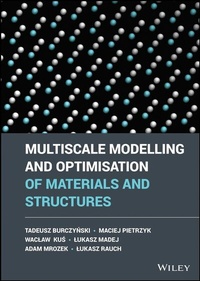
Multiscale Modelling and Optimisation of Materials and Structures
Description

Multiscale Modelling and Optimization of Materials and Structures presents an important and challenging area of research that enables the design of new materials and structures with better quality, strength and performance parameters as well as the creation of reliable models that take into account structural, material and topological properties at different scales. The authors' approach is four-fold; 1) the basic principles of micro and nano scale modeling techniques; 2) the connection of micro and/or nano scale models with macro simulation software; 3) optimization development in the framework of multiscale engineering and the solution of identification problems; 4) the computer science techniques used in this model and advice for scientists interested in developing their own models and software for multiscale analysis and optimization.
The authors present several approaches such as the bridging and homogenization methods, as well as the general formulation of complex optimization and identification problems in multiscale modelling. They apply global optimization algorithms based on robust bioinspired algorithms, proposing parallel and multi-subpopulation approaches in order to speed-up computations, and discuss several numerical examples of multiscale modeling, optimization and identification of composite and functionally graded engineering materials and bone tissues. Multiscale Modelling and Optimization of Materials and Structures is thereby a valuable source of information for young scientists and students looking to develop their own models, write their own computer programs and implement them into simulation systems.
* Describes micro and nano scale models developed by the authors along with case studies of analysis and optimization
* Discusses the problems of computing costs, efficiency of information transfer, effective use of the computer memory and several other aspects of development of multiscale models
* Includes real physical, chemical and experimental studies with modern experimental techniques
* Provides a valuable source of information for young scientists and students looking to develop their own models, write their own computer programs, and implement them into simulation systems.
More details
Other editions
Additional editions
Content
Preface ix
Biography xi
1 Introduction to Multiscale Modelling and Optimization 1
1.1 Multiscale Modelling 2
1.2 Optimization 6
1.3 Contents of the Book 7
2 Modelling of Phenomena 9
2.1 Physical Phenomena in Nanoscale 9
2.2 Physical Phenomena in Microscale 22
3 Computational Methods 81
3.1 Computational Methods for Continuum 81
3.2 Computational Methods for Nano and Micro 101
3.3 Methods of Optimization 127
4 Preparation of Material Representation 143
4.1 Generation of Nanostructures 143
4.2 Microstructure 160
5 Examples of Multiscale Simulations 189
5.1 Classification of Multiscale Modelling Methods 189
5.2 Case Studies 196
6 Optimization and Identification in Multiscale Modelling 219
6.1 Multiscale Optimization 220
6.2 Identification in Multiscale Modelling 242
7 Computer Implementation Issues 261
7.1 Interactions Between the Analysis and Optimization Solutions 261
7.2 Visualization of Large Data Sets 265
8 Concluding Remarks 293
Index
